
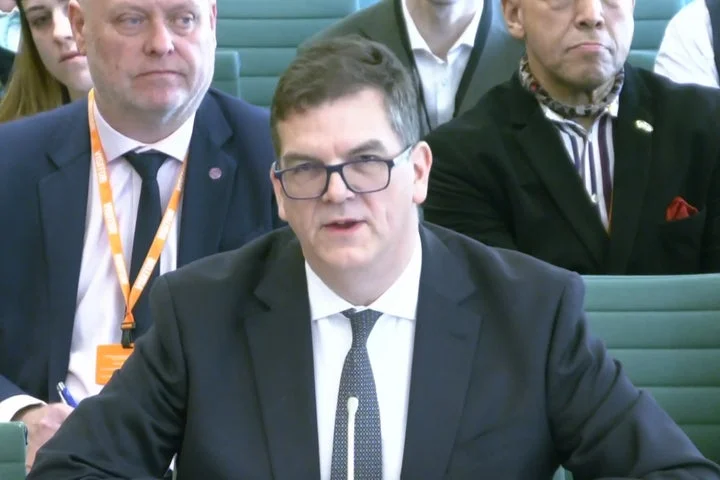
The former top official at the Foreign Office was sacked last week over failings around Peter Mandelson’s vetting
The former top official at the Foreign Office (FCDO) has hit back at Keir Starmer over the fallout from Peter Mandelson’s security vetting process.
Sir Olly Robbins gave evidence to MPs on the Commons Foreign Affairs Select Committee on Tuesday after being sacked by Downing Street last week over the decision to grant Lord Mandelson security clearance as US ambassador despite red flags in his vetting.
The saga has become the latest chapter in a scandal which has overshadowed Sir Keir Starmer’s premiership and prompted concerns about his leadership and judgement.
Sir Olly answered questions about the vetting process – including why ministers were not informed about concerns raised by UK Security Vetting (UKSV) – during a bombshell two-and-a-half-hour session.
Here are the key points from his evidence:
Robbins did not tell Starmer about Mandelson’s failed vetting
Sir Keir Starmer has always maintained that he was not told that Lord Mandelson failed his vetting, a claim which has been met with incredulity.
Sir Olly Robbins appeared to back the prime minister’s version of events.
But Sir Olly also insisted he had not withheld information because he himself was never told explicitly that Mandelson had failed his security vetting and he had never seen the forms.
Asked whether Sir Keir is right to have expected to be provided with more information on the vetting process, Sir Olly said that is a “dangerous misunderstanding” of confidentiality around the process.
“I’ve been interested, of course, over the last couple of days to read Lord Hague on this today and David Lammy even on Saturday, the former foreign secretary, deputy prime minister, where both have said in different language that they have never had vetting issues discussed with them in all their time as a minister and nor would they expect to,” he said.
Cabinet Office did not want to vet Mandelson at all
The former top mandarin at the Foreign Office said it was not a “given” that Mandelson would be vetted for his appointment, and that there was a “position taken from the Cabinet Office that there was no need” to do so at all.
He said there was a “debate” between the Cabinet Office and the FCDO about how to make sure Mandelson was sent to Washington with appropriate clearance.
“A position taken from the Cabinet Office was that there was no need to vet Mandelson,” he said.
“He was a member of the House of Lords, he was a privy counsellor, the risks attending his appointment were well-known and had been made clear to the prime minister before appointment.”
But the Foreign Office “put its foot down” and followed the process, Sir Olly said.
Foreign Office ‘pressured’ to get Mandelson in post quickly
Sir Olly said that, when he took up his post as the top official in the Foreign Office, he was told that No 10 wanted Mandelson to be in post as “quickly as humanly possible”.
He said this created an “atmosphere of pressure” within the department and claimed there had been “constant chasing” from the private office at No 10 while vetting took place.
Sir Olly alleged a “dismissive approach” from Downing Street over the process.
“The very first formal communication of this to my predecessor from No 10 private office, being that they wanted all this done at pace and Mandelson in post before inauguration,” he said.
“So that’s the situation I faced.
So I’m afraid what that translated into for my team in the Foreign Office – and certainly the handover briefing I was getting as I arrived at post – was what I felt was a generally dismissive attitude to his vetting clearance.”
He said there was “never any interest, as far as I can recall, in whether, but only an interest in when” the appointment had been cleared.
Denying Mandelson the role would have ‘damaged’ relations with US
Sir Olly Robbins told MPs it would have “damaged” relations with the US and “caused quite an issue in the relationship” if the UK had been forced to change its proposed ambassador to Washington after the Mandelson appointment had been announced.
He added that the incoming Trump administration “may well have commented on it publicly”.
He told MPs it would have been better for security clearance to be decided before the peer was public announced as Sir Keir’s pick for the Washington job.
“That’s a very, very sensible position to be in and it’s what I would have advised in this case too,” he told MPs.
Mandelson was a ‘borderline’ case
Sir Olly said he was briefed that UKSV considered Mandelson a “borderline case” and that risks identified did not relate to his relationship with paedophile financier Jeffrey Epstein.
The former senior civil servant said: “I was briefed that UKSV considered Mandelson a borderline case and that they were leaning towards recommending that clearance be denied, but that the Foreign Office’s security department assessed that the risks identified as of highest concern by UKSV could be managed and/or mitigated.
“I was also told that the risks did not relate to Mandelson’s relationship with Jeffrey Epstein.
“And I was told that UKSV acknowledged, I don’t know in what way, but acknowledged that the Foreign Office might wish to grant clearance with appropriate risk management.”
No 10 pushed for Doyle ambassadorship – and asked Robbins not to tell Lammy
Sir Olly told MPs that No 10 initiated a number of conversations with him “about potentially finding a head of mission opportunity for Matthew Doyle”, an influential figure on the right of the Labour Party, who was then working as Starmer’s director of communications.
He added that he was under “strict instruction” not to discuss the request with David Lammy, who was foreign secretary at the time.
The situation made him feel “uncomfortable”, he said.
Mandelson was also asked about the prospect of a diplomatic role in Washington for Lord Doyle, Sir Olly suggested.
Lord Doyle did not get an ambassadorial role but was elevated to the House of Lords in December.
In February, Labour suspended him over his links to a convicted paedophile, former councillor Sean Morton .
Due diligence checks ‘should have coloured PM's judgment’
In his evidence to MPs, Sir Olly suggested the PM had enough information from Cabinet Office to block the appointment.
He highlighted the due diligence process, carried out before the vetting check, which he said “threw up serious reputational risks”.
The report, produced by a propriety and ethics team (PET), summarised Mandelson’s reputational risks, including his relationship with Jeffrey Epstein.
Sir Olly told MPs: “I regret that the due diligence process, which threw up serious reputational risks, didn’t colour the PM’s judgement in making the appointment.”
Robbins ‘never saw paperwork’ on Mandelson’s failed vetting
MPs said UKSV had ticked two red boxes on Mandelson’s form, meaning they had “high concern” and recommended “clearance denied or withdrawn”.
But Sir Olly said he had never seen the document.
He had, however, been briefed by Foreign Office security staff that the agency was leaning towards recommending clearance be rejected.
“It was briefed to me that they were ‘leaning against’, I think is the phrase I remember,” he said.
He stressed that UKSV’s findings were “recommendations and not decisions” to the Foreign Office.
“What my team will have done, I’m sure, is break that down, go through the specific issues that have led UKSV to their concern and then make an assessment as to whether they can be managed.
And that’s what came to me.”
Leak was ‘breach of national security – prosecutions should follow’
Sir Olly said it was deeply worrying that the story of Mandelson’s failing vetting was given to The Guardian within days of the Cabinet Office briefing No 10 on the issues.
“I’m not making accusations at anybody, it’s not my business to do so,” he told the committee, adding: “I hope they’re being very rigorously investigated, and that prosecutions will result, because this is a grievous breach of national security.”
Join thought-provoking conversations, follow other Independent readers and see their replies
Related Stories


Source: This article was originally published by The Independent
Read Full Original Article →
Comments (0)
No comments yet. Be the first to comment!
Leave a Comment