
A day after the arrest of the former prime minister, Nepalese police also arrested the country's former energy minister.
Investigators said he was detained as part of an ongoing probe into money laundering.
Police in Kathmandu arrested Nepal 's former energy minister and Nepali Congress leader, Deepak Khadka, on Sunday morning.
Local news portal Ratopati reported the arrest warrant stated that Khadka was taken into custody for an investigation related to "money laundering offenses."
A team from the Central Investigation Bureau (CIB) of the Nepal Police made the arrest, and the former minister is currently in CIB custody, according to local media reports.
Nepal's ex-PM Oli arrested over crackdown on Gen Z protests
To view this video please enable JavaScript, and consider upgrading to a web browser that supports HTML5 video
What do we know abut the money laundering probe?
CIB spokesman Shiva Kumar Shrestha told the AFP news agency that Nepal's Department of Money Laundering Investigation will oversee the probe.
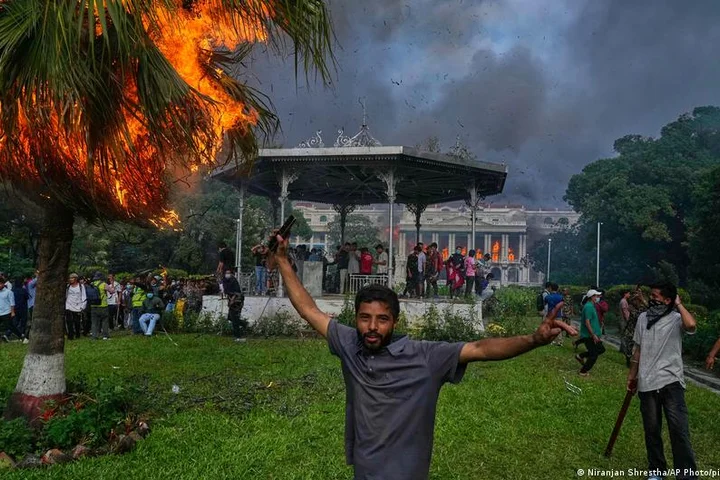
The youth-led uprising that began in September 2025 started as a response to a brief social media ban, but it grew to encompass longstanding frustrations regarding corruption and economic hardship.
More than 70 people died and some 2,300 were injured in the unrest.
Demonstrators set fire to the parliament building and government offices, eventually toppling Oli's administration.
The Khadka's residence was also set ablaze, and videos went viral showing protesters throwing cash found inside up into the air.
Nepal's Gen Z look to reshape their nation's future
An election held in Nepal earlier this month was the country's first poll since last September's protests.
The Rastriya Swatantra Party won by a landslide.
On Friday, its leader, rapper-turned-politician Balendra Shah, formally took office as prime minister .
On Saturday, the new government unveiled an ambitious 100-point agenda for governance reform.
This agenda includes a plan to establish an investigative committee that will examine the assets of politicians and high-ranking state employees.
Related Stories



Source: This article was originally published by Deutsche Welle (DW)
Read Full Original Article →
Comments (0)
No comments yet. Be the first to comment!
Leave a Comment