
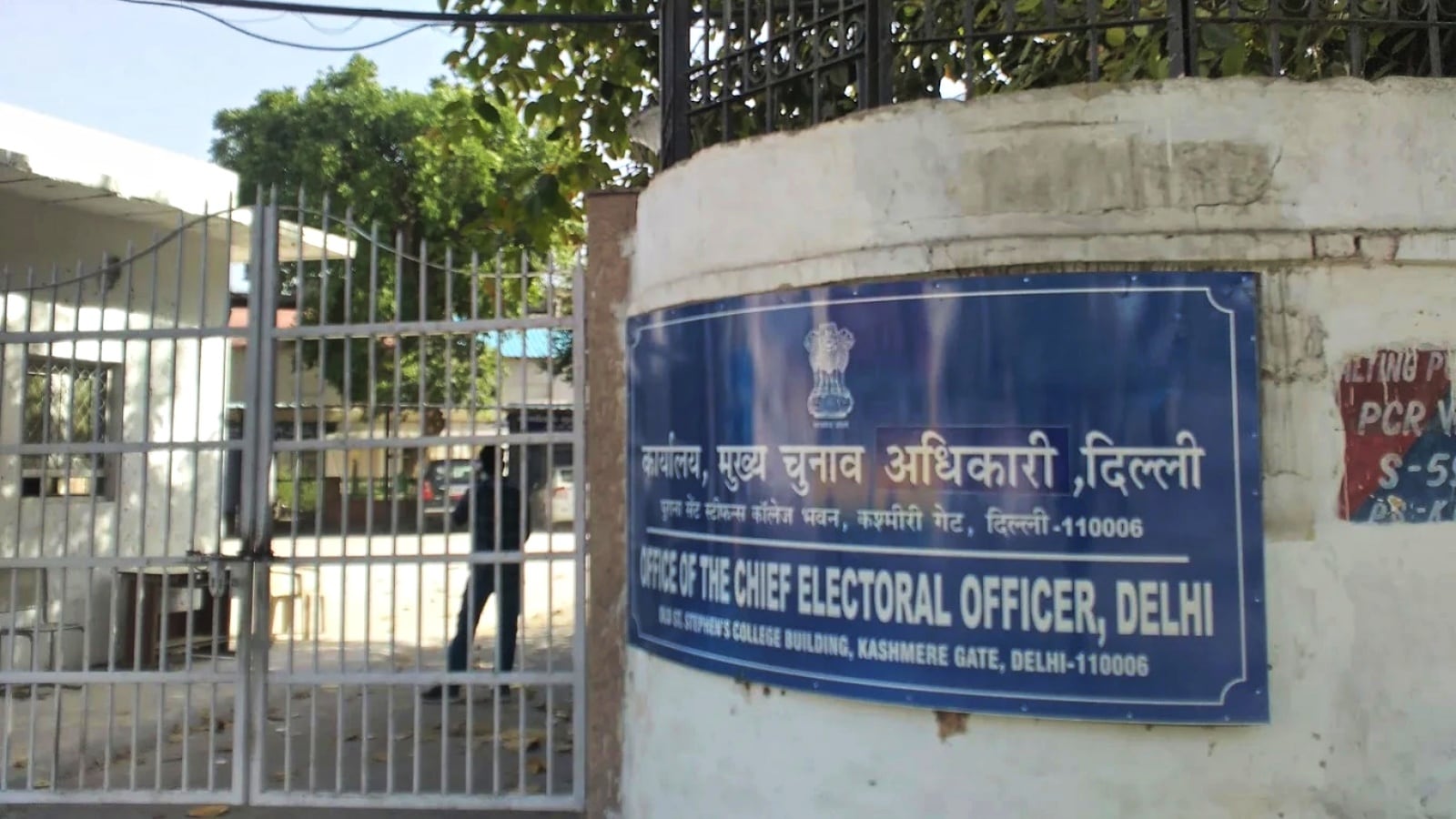
Flagging the slow progress of preparatory work for the revision of electoral rolls in Delhi, the Office of the Chief Electoral Officer (CEO), Delhi, has asked government departments to ensure that teachers and other officials deployed as Booth Level Officers (BLOs) are not assigned additional duties after office hours, so they can carry out the necessary fieldwork relating to the revision.
The letter has noted that the special intensive revision (SIR) of electoral rolls in the capital is expected to begin next month, that the preparatory exercise has progressed slowly – with only about 30 per cent of the required “mapping” exercise having been completed so far.
The Election Commission of India (ECI) carried out the SIR in Bihar between June and September last year, and notified the second phase of the exercise, covering nine states and three Union Territories, in October.
The final rolls for Uttar Pradesh and West Bengal are yet to be published.
On February 19 this year, the ECI wrote to CEOs of another 17 states and five UTs, including the NCT ofDelhi, where the next (third) phase of SIR is expected to commence in April, directing them to complete preparatory work relating to the exercise at the earliest.
On March 10, the CEO’s office wrote to the Delhi Directorate of Education, Municipal Corporation of Delhi (MCD), New Delhi Municipal Council (NDMC), and Department of Social Welfare: “Presently, mapping of electors of electoral roll-2025 is being done vis-a-vis electors of year 2002, which is a crucial exercise before start of actual SIR and has to be completed in a time bound manner.”
BLOs are required to conduct house-to-house visits in their assigned polling booth areas to collect details from voters and verify them against earlier records.
Migrants from states all over the country come to live and work in Delhi, and this exercise is expected to present challenges.
The ECI has directed that BLOs should carry out this work after their regular hours at government schools or offices, and on Sundays and other holidays.
However, the CEO’s office said, many BLOs in Delhi were not conducting these house-to-house visits after their regular work hours.
“On enquiry, it has been found that BLOs are assigned additional work by their parent department to be performed after office hours,” the letter stated.
“In view of the above”, the letter said, “you are requested to kindly direct all the officials under your jurisdiction who have been deployed as BLOs to perform their BLO duties after office/ school hours on a daily basis.”
Additional work should not be assigned to these officials after office hours during the preparatory phase of the revision, the CEO’s office said.
The ECI had ordered the SIR on June 24 last year, breaking from the past two decades during which no intensive revisions had taken place.
Instead, electoral rolls have been revised annually and before each election by adding to and deleting names from the existing rolls.
As part of the SIR, the ECI is preparing the rolls afresh, with the last intensive revision in each state as the base year.
The process has been controversial, with opposition parties accusing the ECI of playing a partisan political role by trying to eliminate certain groups of voters, and have challenged the SIR in the Supreme Court.
The ECI has denied allegations of bias and partisanship.
Devansh Mittal is a Correspondent at The Indian Express, based in the New Delhi City bureau.
He reports on urban policy, civic governance, and infrastructure in the National Capital Region, with a growing focus on housing, land policy, transport, and the disruption economy and its social implications.
Professional Background
Education: He studied Political Science at Ashoka University.
Core Beats: His reporting focuses on policy and governance in the National Capital Region, one of the largest urban agglomerations in the world.
He covers housing and land policy, municipal governance, urban transport, and the interface between infrastructure, regulation, and everyday life in the city.
Recent Notable Work
His recent reporting includes in-depth examinations of urban policy and its on-ground consequences:
An investigation into subvention-linked home loans that documented how homebuyers were drawn into under-construction projects through a “builder–bank” nexus, often leaving them financially exposed when delivery stalled.
A detailed report on why Delhi’s land-pooling policy has remained stalled since 2007, tracing how fragmented land ownership, policy design flaws, and mistrust among stakeholders have kept one of the capital’s flagship urban reforms in limbo.
A reported piece examining the collapse of an electric mobility startup and what it meant for women drivers dependent on the platform for livelihoods.
Reporting Approach
Devansh’s work combines on-ground reporting with analysis of government data, court records, and academic research.
He regularly reports from neighbourhoods, government offices, and courtrooms to explain how decisions on housing, transport, and the disruption economy shape everyday life in the city.
X (Twitter): @devanshmittal_
Email: devansh.mittal@expressindia.com...
Read More
Stay updated with the latest -Click here to follow us on Instagram
Related Stories



Source: This article was originally published by The Indian Express
Read Full Original Article →
Comments (0)
No comments yet. Be the first to comment!
Leave a Comment