
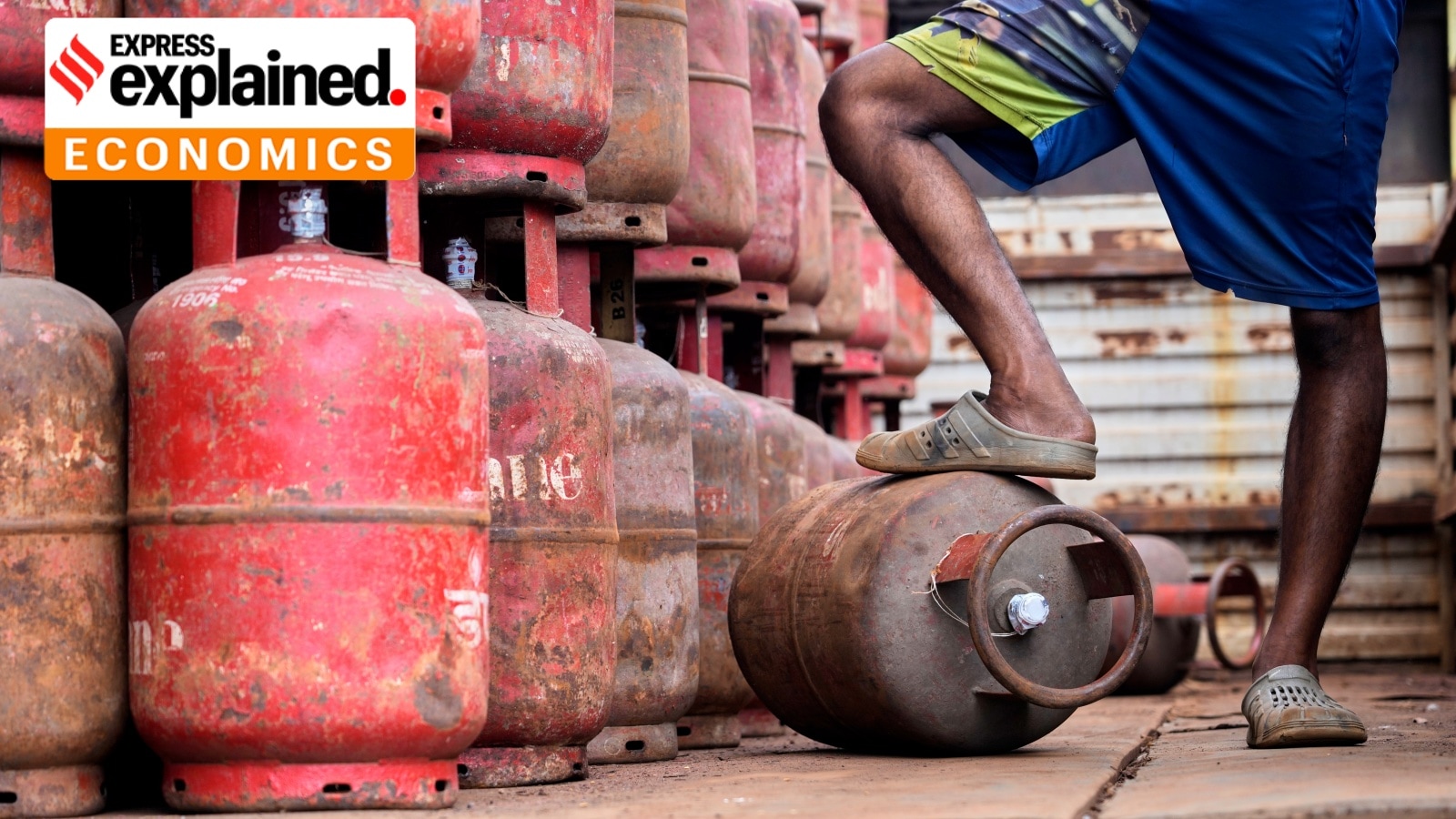
As the war in West Asia chokes global energy flows through theStrait of Hormuz, India has found itself tackling itsworst cooking gas supply crisis in recent history.
Data shows India’s reliance on imports of liquefied petroleum gas (LPG), used in crores of domestic and commercial kitchens, has grown consistently in recent decades.
Now, as much as 60% of India’s LPG supply comes from outside the country.
Toensure a steady supply of LPG, particularly to households, the government has ordered a 25% increase in domestic production and widened the gap between cylinder bookings from 21 days to 25 days for urban households and to 45 days for rural households.
It has even made fuels such askerosene, biomass and coalavailable for commercial users.
According to data published by the Petroleum Planning and Analysis Cell (PPAC), which falls under the Union Ministry of Petroleum and Natural Gas, India has been a net importer of crude oil and LPG since 1999, the earliest year for which data is available.
While the country has gradually been able to produce and export its own petroleum products, LPG in particular has remained a laggard and is now the country’s most imported petroleum product.
LPG is produced as a byproduct of refining crude oil or processing liquified natural gas (LNG).
Between 2011-12 and 2024-25, crude oil imports have grown by 40% in volume and LNG imports have doubled.
Direct imports of LPG itself have grown from 1,722 TMT (or thousand metric tonnes) in 1998-99 to 20,667 TMT in 2024-25 — a 12-fold increase over 27 years.
Given the significant domestic demand for LPG, Indian exports of cooking gas have been minimal, peaking at 551 TMT in 2024-25.
Though India has managed to reduce its import dependence for other fuel products, the growing demand for cooking gas has largely been met with increasing LPG imports.
Imports of diesel, kerosene and petrol, for instance, have now shrunk to their lowest levels since 1999, and India has in fact been a net exporter of these products since the early 2000s amid consistent expansions to its crude oil refining capacity.
In 1998-99, LPG accounted for just 7.2% of all imported petroleum products by volume, while diesel and kerosene accounted for more than 70%.
But in 2024-25, LPG accounted for 40% of all imports, making it the single largest imported petroleum product in quantity terms.
In terms of expenditure, the government went from importing Rs 1,274 crore worth of LPG in 1998-99 to Rs 1.06 lakh crore in 2024-25 — an 83-fold growth.
In 1999, LPG accounted for 10% of all petroleum product imports in monetary terms.
Now, nearly 53% of import expenditure on petroleum products is on LPG alone.
Behind the growing imports is the rising demand for LPG — on the back of accelerated urbanisation, growth of middle-class households, and Central and state governments’ schemes for free or subsidised LPG cylinders, especially for rural households.
In 1998-99, India produced 3,599 TMT of LPG and consumed 5,352 TMT.
The supply deficit (or the gap between production and consumption), therefore, was 1,753 MT.
But in 2023-24, the latest year for which this comparable data is available, India produced 12,779 TMT of LPG and consumed more than twice that quantity or 29,664 TMT.
This amounts to a deficit of 16,885 TMT.
This means that India has been reliant on imports to meet as much as 60% of its demand — almost 90% of which is sourced through the Strait of Hormuz, a crucial chokepoint for global energy flows.
While LPG consumption between 1998-99 and 2023-24 has grown more than five-fold, production grew by just over three-fold in the same period.
While India sees seasonal spikes in LPG consumption every year, particularly during festive periods and in the winter, consumption has seen a consistent year-on-year growth over the past two-and-a-half decades as more and more households turned to LPG as a clean fuel source for cooking.
LPG consumption saw the highest growth rates in the 2000s and 2010s, between 8% and 11% each year.
In 2016-17, after the launch of the Pradhan Mantri Ujjwala Yojana (PMUY), which provides free LPG connections and heavily subsidised cylinders to poor and rural households, LPG consumption recorded a growth spike of 10.1% over the previous year.
That year also saw a sharp rise in LPG imports, to 11,097 TMT from the 8,959 in the previous year.
Earlier, rural households traditionally relied on fuel sources like firewood and animal dung for cooking.
But the introduction of the PMUY resulted in an increasing acceptance of LPG as a cooking fuel.
According to a Lok Sabha answer, 80% of PMUY beneficiaries were rural households as of end-2024.
Since 2020, growth in consumption has slowed as LPG connections reached a saturation level.
In 2021-22, LPG consumption grew by 2.5% over the previous year, by just 0.9% in 2022-23 and by 4.1% in 2023-24.
As of today, there are 33.37 LPG customers across India, and 10.56 crore PMUY connections.
LPG production has hit a ceiling
But even though LPG consumption growth has slowed, India has struggled to expand its production capacity to meet the demand.
After seeing fairly rapid production growth through the 2000s and parts of the 2010s, domestic LPG production has largely flatlined since 2017-18, hovering at just under 13,000 TMT per year.
Despite expanding the capacity of its crude oil refining, a process of which LPG is a byproduct, India appears to have hit a ceiling as far as domestic LPG production goes, resulting in a growing and persistent reliance on imports.
This is exemplified by the share of LPG in the total production of petroleum products from domestic refineries — in 1998-99, LPG accounted for 5.2% of total refinery output by quantity, but by 2024-25, despite growing production capacity, LPG accounted for just 4.2% of refinery output.
In contrast, the share of petrol production in domestic refineries’ output grew from 8% to 17% in the same period.
Related Stories



Source: This article was originally published by The Indian Express
Read Full Original Article →
Comments (0)
No comments yet. Be the first to comment!
Leave a Comment