
Heidi Ledford reports for Nature from Seattle, Washington.
Search author on: PubMed Google Scholar
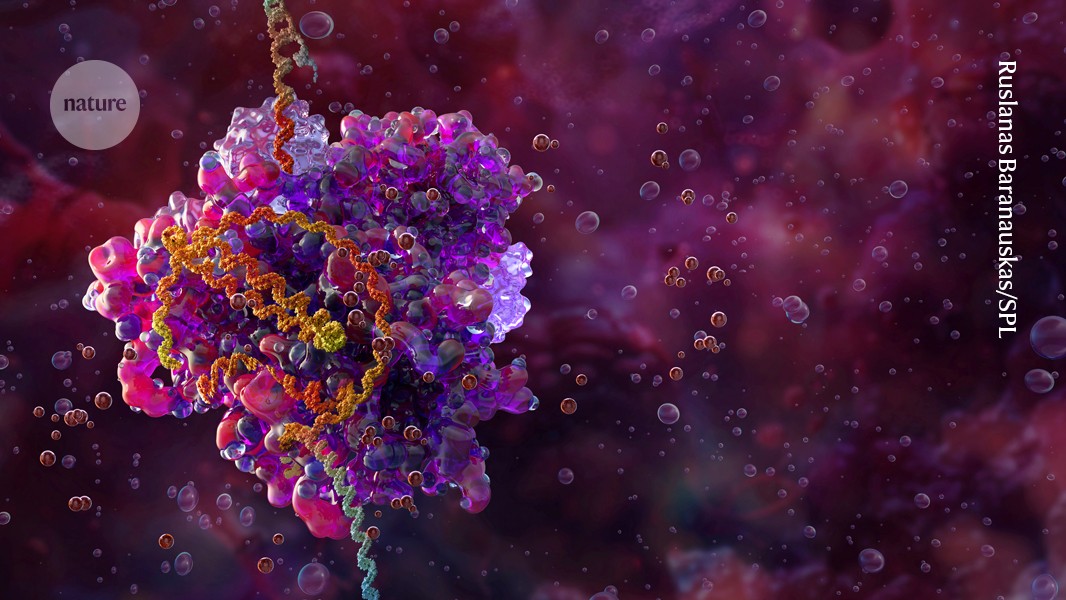
Once delivered to cells, the CRISPR-Cas9 gene-editing system (purple and pink) cuts DNA in specific places.
Credit: Ruslanas Baranauskas/SPL
The powerful gene-editing technique CRISPR–Cas9 might offer a way to make safer, more effective cancer-fighting immune cells engineered inside the human body , a mouse study has found.
Cancer-fighting immune cells could soon be engineered inside our bodies
The research, reported on 18 March in Nature 1 , adds new safety features to an emerging class of cancer treatments known as chimeric antigen receptor (CAR)-T-cell therapies, which are produced in the body.
The development could lead to treatments that are cheaper to make and easier to administer than are those currently used against some blood cancers.
At present, CAR-T therapies are made from a person’s own T cells — a type of immune cell — which are isolated, engineered to express a synthetic protein known as a CAR and then reinjected into the body.
Reprogramming T cells directly in the body would take less time, but it adds safety concerns, says Justin Eyquem, an immunologist at the University of California, San Francisco, and lead author of the study.
For one thing, “you don’t want to edit other cells”, he says.
“So we added multiple layers of safety.”
CARs are designed to target cancer cells, allowing the engineered T cells to find and destroy tumours — an approach that has produced impressive remissions in some people with cancers of the blood, such as leukaemia or lymphoma.
Not only are current CAR-T-cell therapies costly and time-consuming, but recipients must also endure toxic pretreatments, often with chemotherapy drugs.
These obliterate the recipients’ unaltered immune cells so that the CAR T cells have room to flourish.
But they leave people temporarily vulnerable to infection.
As a result, researchers have been trying to instead engineer T cells in vivo , or in the body.
With that approach, companies could produce a single therapy that would work for many people, and recipients would not need chemotherapy pretreatment.
It seemed like a wild idea at first, Eyquem says.
In 2017, he and his colleagues reported 2 that they could boost the effectiveness of CAR T cells by using CRISPR–Cas9 to insert the synthetic gene that encodes CAR protein into a specific region of the genome in isolated T cells.
“We were already wondering then whether one day we could do that in vivo ,” Eyquem says.
“It sounded like science fiction.”
Since then, researchers have taken steps towards making in vivo CAR-T-cell treatments a reality.
The first of these are in early clinical trials now 3 .
But questions about safety still loom.
For instance, if the synthetic gene that codes for CAR protein is inserted at random into the T-cell genome, it could generate a cancer-causing mutation.
And, of course, it’s also important to engineer only T cells and not other cell types, which might cause harm.
Enjoying our latest content?
Log in or create an account to continue
doi: https://doi.org/10.1038/d41586-026-00857-6
Read the related News & Views: ‘A gene-editing method generates immunotherapeutic CAR T cells in the body’
Nyberg, W.
A.
et al.
Nature https://doi.org/10.1038/s41586-026-10235-x (2026).
Eyquem, J.
et al.
Nature 543 , 113–117 (2017).
Harrison, S.
et al.
Blood 146 , LBA-1 (2025).
Innovative CAR-T therapy destroys cancer cells without dangerous side effects
‘It’s all gone’: CAR-T therapy forces autoimmune diseases into remission
Turbocharged ‘killer’ cells show promise for autoimmune disease
World first: ultra-powerful CRISPR treatment trialled in a person
Lab-grown oesophagus restores pigs’ ability to swallow
Thymic health consequences in adults
Thymic health and immunotherapy outcomes in patients with cancer
In vivo site-specific engineering to reprogram T cells
Immune evasive DNA donors and recombinases license kilobase-scale writing
Identical twins on trial: can DNA testing tell them apart?
Stress can cause eczema to flare up – now we know why
Thymus health is a predictor of lifelong well-being and immunotherapy effectiveness
Join HZAU's global faculty team to advance research with competitive benefits.
Huazhong Agricultural University (HZAU)
The Stomatology Hospital, School of Stomatology, Zhejiang University School of Medicine(ZJUSS)
IRB Barcelona invites applications for Group Leader positions in Chemical Biology (one) and Structural Biology (one).
Barcelona (Provincia), Cataluña (ES)
Fundació Institut de Recerca Biomèdica (IRB Barcelona)
The Paris Brain Institute invites expressions of interest from internationally recognized senior and mid-career researchers.
Full Professorship (W3) for ‚Clinical Epidemiology of Early Cancer Detection’ (f/m/d) We are looking for a highly distinguished physician scientist...
Heidelberg, Baden-Württemberg (DE)
Medizinische Fakultät Mannheim der Universität Heidelberg
Related Stories



Source: This article was originally published by Nature News
Read Full Original Article →
Comments (0)
No comments yet. Be the first to comment!
Leave a Comment