
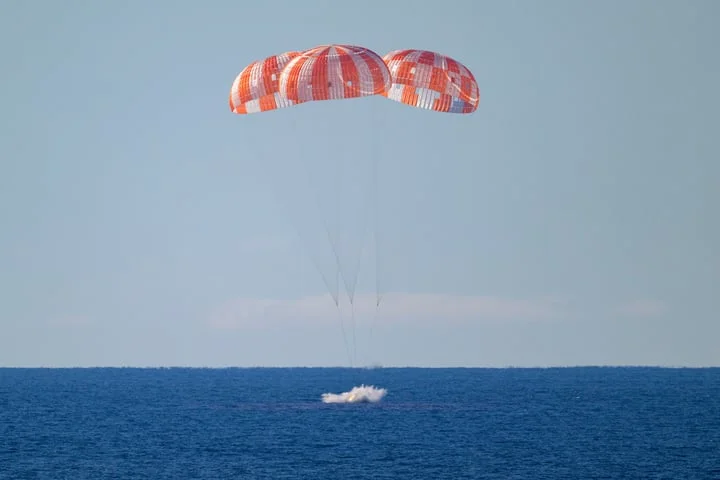
Nasa astronauts have landed safely back on Earth following their record-breaking lunar flyby which marks a stepping stone towards a future Moon landing and eventual Mars mission.
The Artemis II crew splashed down off the coast of San Diego in California at 1.07am UK time and Nasa said the four crew members – Commander Reid Wiseman, pilot Victor Glover, Christina Koch and Canadian Jeremy Hansen – were healthy.
Mission Control’s Rob Navias described their return as “a perfect bullseye splashdown”.
During re-entry, their Orion capsule was expected to hit the atmosphere at around 24,000mph (38,625kph), or about 32 times the speed of sound.
In a critical test for the spacecraft’s heat shield, temperatures outside were set to soar to as high as 2,760C (5,000F).
Following a previous test flight, engineers had altered the descent trajectory in order to reduce the risk of the module burning up.
The intensity of the return meant contact with the crew was cut off for several minutes, prior to the deployment of parachutes eventually slowing the capsule’s fall to just 17mph (27kph) before hitting the water.
Cheers erupted from the crew’s families watching in Mission Control in Houston when the capsule emerged from the communication blackout and at splashdown.
More than an hour after landing in the Pacific Ocean, the four crew members emerged from the capsule ahead of being taken to the nearby naval ship USS John P Murtha by helicopter.
Refusing the wheelchairs offered to them, the astronauts walked across the deck and after undergoing initial medical checks on board, they were expected to return to Johnson Space Centre in Houston on Saturday.
Speaking from the ship, Nasa administrator Jared Isaacman said: “This is just the beginning.
“We are back in the business of sending astronauts to the moon, bringing them back safely and to set up for a series.”
US President Donald Trump said on Truth Social the “entire trip was spectacular”, while Canadian Prime Minister Mark Carney congratulated the crew on “an historic feat”.
Nasa associate administrator Amit Kshatriya said the craft’s systems had “performed as designed”.
He said: “This moment belongs to the thousands of people across 14 countries who built, tested, and trusted this vehicle.
In Pictures: The best shots from Artemis mission to the dark side of the Moon
When is the Artemis II splashdown UK time?
Nasa team focused on getting Moon mission astronauts back to Earth safely
Choose the right education path for your child
“Artemis II proved the vehicle, the teams, the architecture, and the international partnership that will return humanity to the lunar surface.
“Reid, Victor, Christina, and Jeremy carried the hopes of this world farther than humans have travelled in more than half a century.
“Fifty‑three years ago, humanity left the Moon.
This time, we returned to stay.
The future is ours to win.”
Nasa said the mission flew a total of 694,481 miles (1,117,658 kilometres).
The first manned Moon mission in more than 50 years, which blasted off from Cape Canaveral on April 1, took the three Americans and a Canadian deeper into space than anyone has gone before.
The crew travelled 252,756 miles (406,771 kilometres) from Earth, smashing the distance milestone of 248,655 miles (400,171 kilometres) previously held by the Apollo 13 crew for 56 years.
Alongside their other duties, it provided the opportunity for the team to take some spectacular pictures of the Moon and Earth, including a total solar eclipse.
The Goonhilly Earth Station, near Helston, in Cornwall, helped track the flight.
The last time Nasa sent astronauts to the Moon was as part of the Apollo 17 mission in 1972.
The agency is seeking to return a crew to the lunar surface by 2028, before China does in about 2030.
Related Stories



Source: This article was originally published by Evening Standard
Read Full Original Article →
Comments (0)
No comments yet. Be the first to comment!
Leave a Comment