
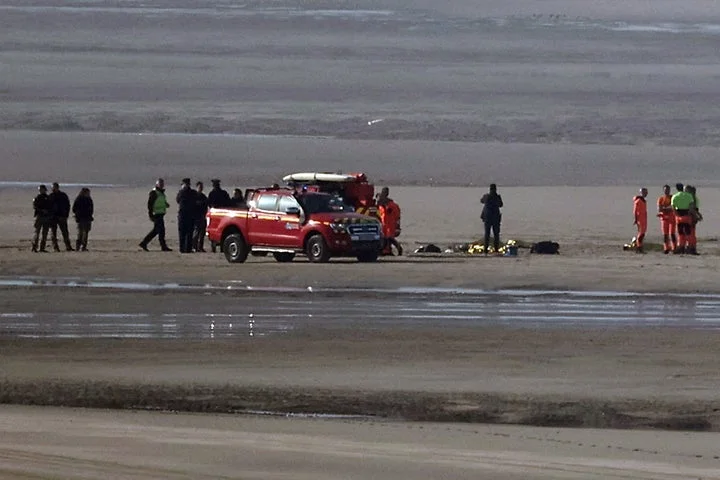
Two men and two women have died after attempting to cross the Channel
Four people have died off the coast of France after attempting to cross the Channel on a small boat, French local authorities have said.
At least 42 others were rescued in the incident off the coast of Boulogne, between Equihen-Plage and Hardelot-Plage.
Two men and two women, who were swept away by strong currents as they tried to board a dinghy, died, a French government official said.
Officials in Calais said the dinghy was a “taxi-boat”, a type of small boat used along the northern French and Belgian coastlines to pick up migrants from just offshore.
It comes amid a row between the UK and France over who should intercept small boats as talks on a new deal to tackle the illegal crossings drag on.
Francois-Xavier Lauch, the prefect of Pas-de-Calais, told reporters on Thursday: “We sadly have to report four deaths this morning.
The people who died were attempting to board a taxi-boat.
“I have to commend the actions of our officers and firefighters who, as you know, are deployed every day to stop these crossings.”
Mr Lauch said emergency services rescued at least 42 people during the course of the incident.
Speaking of the four people who died, he said: “They were already quite far into the sea.
The currents, which can be dangerous here, swept them away.
“This provisional toll – and I insist that it is provisional – states four deceased: two men, two women.”
One person also suffered hypothermia, and another 37 other people are currently being treated by emergency services.
A number of other small boats are currently at sea and being monitored by French authorities, including a military helicopter, Mr Lauch added.
About 2,200 migrants crossed the Channel, one of the world's busiest shipping lanes, to Britain in the first two months of 2026.
Around 41,500 people made the crossing in 2025, according to the University of Oxford’s Migration Observatory.
The deaths come as the UK and France continue negotiations over a renewed multimillion-pound deal to fund French police action against small boat migrants.
French negotiators have rebuffed the plan because it would mean British government vessels entering French waters.
The Independent revealed last month that the number of migrants who died while attempting to cross the Channel spiked after the last major UK-France deal was signed.
Seventeen people died or went missing in six fatal incidents in the final four months of 2023 – shortly after then-prime minister Rishi Sunak agreed a £460m pact with French president Emmanuel Macron to stop small boat migration.
The following year, 83 people were recorded dead or missing in 22 incidents – the deadliest year on record, figures compiled by Centre for Sociodigital Futures at the University of Bristol and Swiss research agency Border Forensics show.
Another 29 died or went missing in 20 fatal incidents in 2025, researchers say.
The figures, from 2019 to 2025, suggest that more people making journeys on small boats across the Channel does not lead to more deaths.
The deaths that have occurred since 2023 have happened close to French shores and often just off the beaches.
Responding to the news of four deaths in the Channel on Thursday, Imran Hussain, director of external affairs at charity Refugee Council, said: “A lack of safe routes to the UK has left people feeling they have no other choice to rebuild their lives: the government has even shut down family reunion for refugees, which overwhelmingly supported women and children.
A UK government spokesperson said: “We are deeply saddened to hear about the deaths in French waters today.
“Every death in the Channel is a tragedy and a stark reminder of the dangers posed by criminal gangs exploiting vulnerable people for profit.
We will continue working relentlessly with the French and our partners overseas to prevent these perilous journeys.
“The French authorities are leading the response to this incident and we are supporting their investigation."
Join thought-provoking conversations, follow other Independent readers and see their replies
Related Stories



Source: This article was originally published by The Independent
Read Full Original Article →
Comments (0)
No comments yet. Be the first to comment!
Leave a Comment