
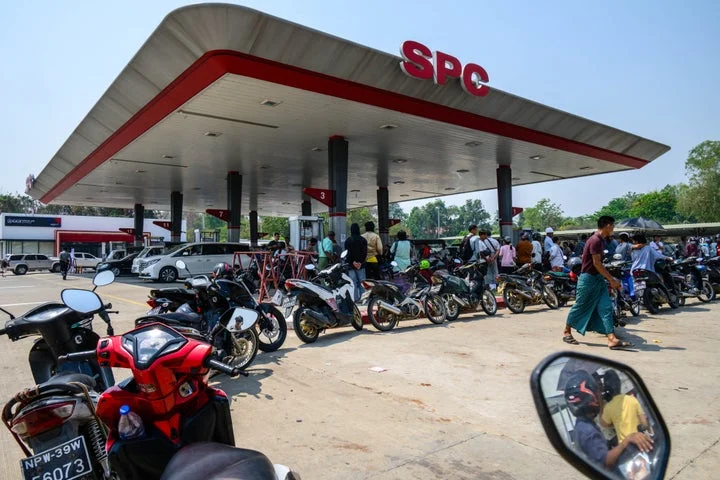
As the price of oil continues to soar, countries reliant on importing the substances are having to take emergency measures
When Iran’s Supreme Leader, Ayatollah Ali Khamenei, was killed in a joint American and Israeli strike four weeks ago, there were immediate hopes for peace and security in the war-torn region, as Donald Trump urged the Iranian people “to take back their country”.
But as Iran’s new leaders went underground , and missiles started firing at neighbouring Middle East countries, it soon became clear here was to be no quick resolution.
Despite the US president continuing to push a narrative around peace talks and fresh threats, markets appear to remain more skeptical than ever, with oil prices hitting $117 a barrel on Monday, triggering further fears of shortages worldwide.
The issue is that Iran has effectively blocked the Strait of Hormuz, a critical route through which roughly a fifth of the world’s oil supply is transported.
This is forcing governments around the world to take action to safeguard their national interests.
Here we take a look at what countries are doing:
Diesel prices reached their most expensive level on Monday (30 March) since December 2022, with the average price of a litre of the fuel at UK forecourts hitting 181.2p according to RAC analysis.
In response, chancellor Rachel Reeves has been urged to reconsider plans to raise fuel duty by 5p per litre at the end of August,
In response, chancellor Rachel Reeves has been called on to back down on plans to increase fuel duty by 5p per litre at the end of August - but no announcement has been made so far, and Sir Keir Starmer gave no indication to reporters on Monday.
Last week, Ms Reeves said contingency planning was underway for "every eventuality" after acknowledging that the full impact of the war on the UK economy was uncertain.
A second Cobra meeting, where senior ministers will discuss the ongoing economic hit caused by the war, takes place on Monday.
Under previously-announced plans, energy bills will fall from April under Ofgem’s price gap - but that could rise again before the summer.
The governments of Tasmania and Victoria have made public transport free from this week in a bid to ease the cost of living as the price of petrol and energy soars.
The military government has brought in fuel rationing which allows customers to buy it once or twice a week depending on the size of their vehicle engines.
This follows an announcement to impose driving restrictions for private vehicles to preserve petrol.
Government employees have also been ordered to work remotely every Wednesday.
The country has brought in sweeping emergency austerity and fuel conservation measures, including moving to a four-day working week for government employees.
School spring holidays were also moved back.
Ministers, parliamentarians and officials are now only allowed to make a foreign trip only for essential purposes and in economy class.
People have also been asked to restrict social gatherings, with weddings and parties capped at 200 guests and limited to one main dish.
Similar to Pakistan, the country has shifted to a four-day week in all government offices.
President Ferdinand Marcos has also ordered government agencies to cut their fuel and power consumption by up to 20 per cent.
He has also banned government study tours and team-building activities.
Although the country made a deal with Iran to allow the country’s oil vessels to safely pass through the Strait of Hormuz, the country still faces restrictions due to the crisis.
On 10 March, a government spokesperson urged civil servants to conserve energy, with measures including suspending overseas trips, wearing short-sleeve shirts to work and using stairs instead of lifts.
Officials have also been ordered to reduce electricity use in office buildings by switching off lights and electrical equipment when not needed.
A four-day week has been introduced at state institutions with Wednesday declared “a holiday”.
The measure also applies to schools and universities.
The country has also introduced fuel rationing, with drivers limited to 15 litres a week.
Join thought-provoking conversations, follow other Independent readers and see their replies
Related Stories


Source: This article was originally published by The Independent
Read Full Original Article →
Comments (0)
No comments yet. Be the first to comment!
Leave a Comment