
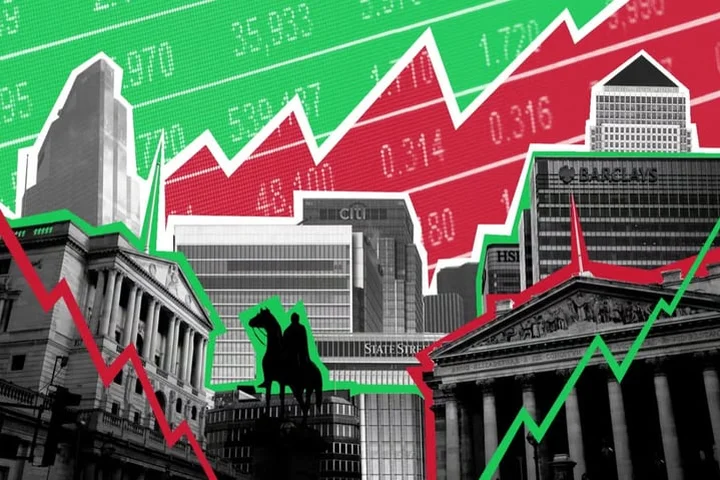
Stock markets have bounced after the oil price dipped below $100 a barrel, driven by hopes of a de-escalation of the Iran conflict .
The FTSE 100 index opened more than 1.5% higher, while Japan’s Nikkei 225 surged by about 5%.
Stronger stocks in London included BA owner IAG and Rolls-Royce, but Berkeley fell sharply after announcing it will stop buying new land .
Banks rally amid Middle East peace hopes, oil still near $100
The FTSE 100 index has settled 1.4% or 142.69 points higher at 10,319.14, while benchmarks in Paris and Frankfurt have risen by 2%.
London’s best performing stocks included Rolls-Royce, which advanced 7% or 75.5p to 1207.5p, and British Airways owner IAG following a gain of 6% or 19.9p to 369.7p.
Renewed economic optimism meant Barclays improved 18.25p to 407.7p and Lloyds Banking Group added 4% or 3.8p to 96.2p.
Richard Hunter, head of markets at Interactive Investor, said: “With a mountain of cash reportedly on the sidelines, investors had been waiting for a trigger to put the money to work
“This was provided by the US President confirming a timeline of two to three weeks before the US retreats, leaving others to restore trading through the Strait of Hormuz.
“At the same time, the Iranian President was said to be open to ending the war, subject to certain guarantees.”
Brent crude oil dropped below the $100 a barrel but is still around 50% higher than in mid-February before tensions with Iran seriously ratcheted up.
Susannah Streeter, chief investment strategist at Wealth Club, said: “This signals that scepticism still remains about Trump’s claims of progress, and worries persist about how extraction from the conflict is still set to be complex.
“Even if the war ends in weeks, the damage wreaked to energy facilities in the region will take years to repair.
Iran is also now flexing more control over the Strait of Hormuz, planning tolls on ships, so freight costs will rise even as it reopens.”
Topps Tiles announces store closures
The Leicestershire-based tile chain said the closures - 7% of its 319-strong estate - will help slash costs as part of “significant self-help measures”, which also include savings being made at its head office.
Topps said the stores are under-performing, with eight already closed since last September and the remainder being shut over the next six months.
It did not disclose what impact the moves would have on its workforce.
Berkeley had said earlier in March that the Iran war was “weighing heavily on risk sentiment” and that it was mindful of the potential for higher inflation this year, and for interest rates to stay elevated for longer.
The risk of this slowing the market recovery “has now become a reality”, while it also flagged an “unprecedented” increase in costs and regulation over recent years.
In this context, Berkeley said it “does not believe it can make its required rate of return on investment in new land acquisitions”.
The FTSE 100 index today jumped by 1.8% or 182.64 points to 10,359.09.
Their gains came as hopes for a de-escalation of the Middle East conflict helped to lower the Brent Crude oil price by 4% to just below $100 a barrel.
London–focused housebuilder Berkeley fell 7% or 246p to 3190p after it said that it would stop buying new land in response to the challenging industry conditions.
Wall Street set for fresh gains, Vix index falls back
Hopes for a de-escalation of the Middle East conflict today sparked a rebound for Asia markets, with the Nikkei 225 up by more than 5%.
The gains follow Wall Street’s strongest session since last May as the S&P 500 index jumped 2.9%, led by an advance for tech stocks including Nvidia.
IG said the improvement was accompanied by a shift in US interest rate expectations, with futures now pricing a 32% chance of July cut.
Meanwhile, the VIX index of volatility last night registered its biggest daily decline since last April.
IG futures point to another strong Wall Street session later today, while the FTSE 100 index is seen about 150 points higher.
Household energy bills drop ahead of July spike
Household energy prices today fell by 7% in a “short-lived respite” before a predicted 18% hike from July.
Ofgem’s price cap today dropped from £1,758 to £1,641 – a reduction of £117 or around £10 a month for the average household using both electricity and gas.
This is an 11% fall year on year, but still £600 more than bills were in the winter of 2020 to 2021.
The latest predictions from Cornwall Insight suggest that the Middle East conflict could cause a rise of 18% or £288 a year in July’s price cap.
FTSE 100 seen 1% higher, Brent Crude at $104
The FTSE 100 index is set for a strong start to the new quarter, with IG future pointing to a rise of 1% at today’s opening bell.
The advance follows a 2.9% surge for the S&P 500 index, while the Nasdaq Composite jumped 3.8% and the Dow Jones Industrial Average advanced 2.5%.
Hopes for an imminent end to the Middle East war also boosted Asia markets as the Nikkei 225 jumped by more than 4.5% and the Hang Seng index up 2.1%.
The FTSE 100 index last night closed 0.5% or 48.49 points higher at 10,176.45 , while the FTSE 250 improved 1.2%.
London’s top flight fell by more than 6% in March after the price of Brent Crude registered its biggest monthly rise on record.
The oil benchmark this morning traded slightly higher at $104.33 a barrel.
Related Stories



Source: This article was originally published by Evening Standard
Read Full Original Article →
Comments (0)
No comments yet. Be the first to comment!
Leave a Comment