
The CEO says artistic control remains with developers.
Get Tom's Hardware's best news and in-depth reviews, straight to your inbox.
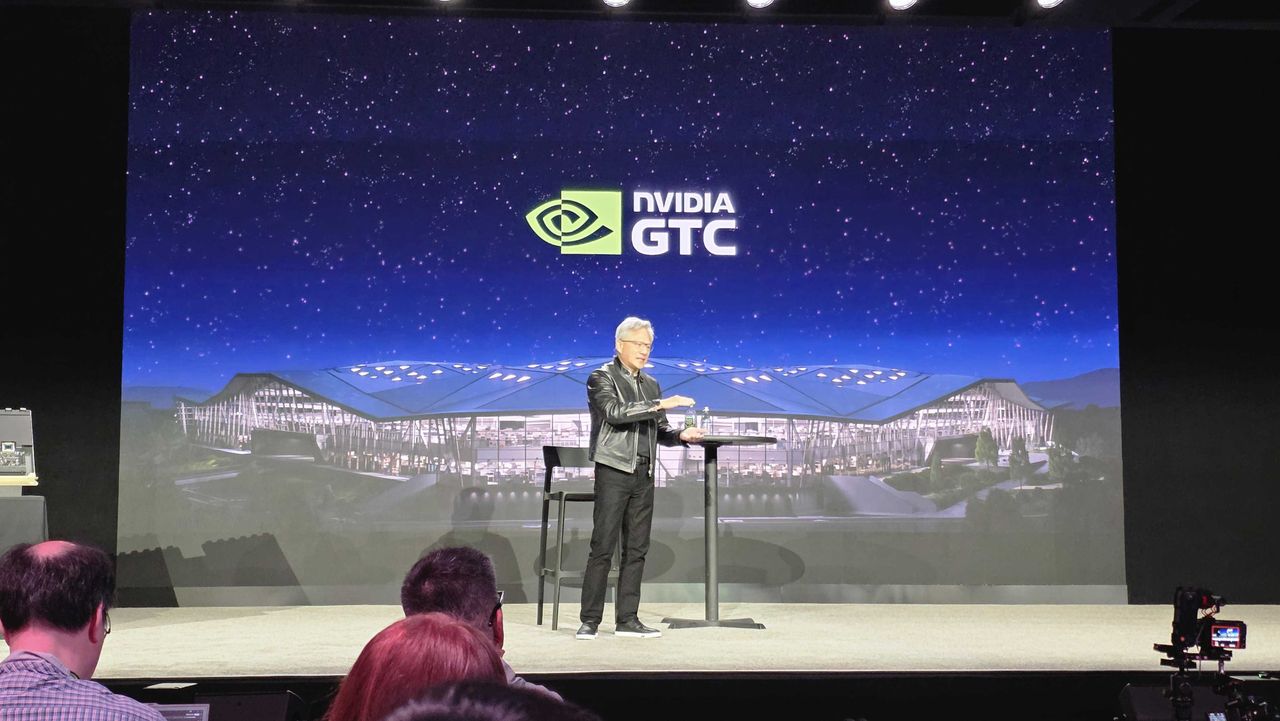
At a press Q&A with Tom's Hardware at GTC 2026 , Nvidia CEO Jensen Huang downplayed criticism of DLSS 5 , the company's new use of AI and neural rendering to infer how certain features of games would look if they were more photorealistic.
Since the debut of the feature, some critics have vocally complained on social media that the technology is making games look worse, homogenous, or only show Nvidia's view of the world.
Much of the criticism has focused on the updated appearances of Resident Evil Requiem 's Grace Ashcroft and Leon Kennedy.
"Well, first of all, they're completely wrong," Huang said in response to a question from Tom's Hardware editor-in-chief Paul Alcorn about the criticism.
"The reason for that is because, as I have explained very carefully, DLSS 5 fuses controllability of the of geometry and textures and everything about the game with generative AI," Huang continued.
He added that developers can still "fine-tune the generative AI" to make it match their style, adding that DLSS 5 adds generative capability to the existing geometry of the game, but that it "doesn't change the artistic control." "It’s not post-processing, it’s not post-processing at the frame level, it’s generative control at the geometry level," he said.
Huang also said that developers can try the tool and see how they want to use it, suggesting that it's up to a developer to try to make a "toon shader" or see if the game should be "made of glass." "All of that is in the control — direct control — of the game developer," he said.
This is very different than generative AI; it’s content-control generative AI.
That’s why we call it neural rendering." We'll see if the vocal gamers who say they dislike what they see change their mind as we see more.
DLSS 5 is set to launch in the fall, and there will likely be far more demos of this technology that are more fully baked before then.
Follow Tom's Hardware on Google News , or add us as a preferred source , to get our latest news, analysis, & reviews in your feeds.
Andrew E.
Freedman is a senior editor at Tom's Hardware focusing on laptops, desktops and gaming.
He also keeps up with the latest news.
A lover of all things gaming and tech, his previous work has shown up in Tom's Guide, Laptop Mag, Kotaku, PCMag and Complex, among others.
Follow him on Threads @FreedmanAE and BlueSky @andrewfreedman.net .
You can send him tips on Signal: andrewfreedman.01
SkyBill40 said: "Well, first of all, they're completely wrong," Huang said in a Q&A session in response to a question from Tom's Hardware editor-in-chief Paul Alcorn about the criticism.
Why are we wrong?
Because you say so?
AI might be the answer to lining your pockets with cash, but it's not the end all/be all you think it to be, Jensen.
On the contrary, it would seem as the push to AI of any sort has made things worse.
Related Stories



Source: This article was originally published by Toms Hardware
Read Full Original Article →
Comments (0)
No comments yet. Be the first to comment!
Leave a Comment