
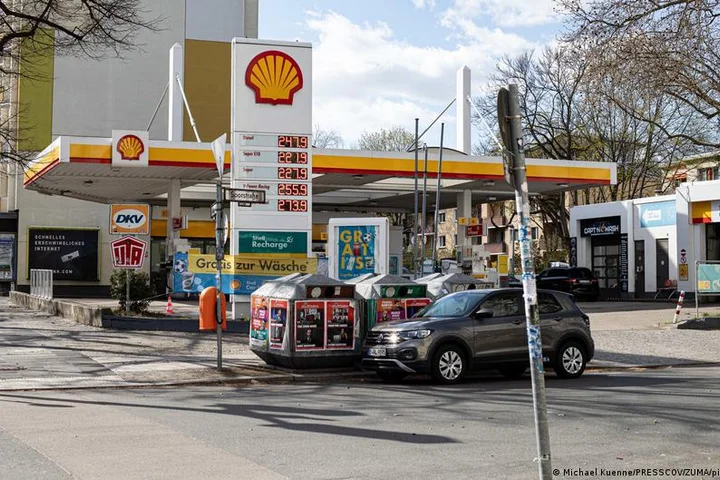
Fueled by the Middle East war, German petrol prices have risen more sharply than in neighboring EU countries.
Follow DW.
Here is a roundup of the main news from and about Germany on Thursday, April 9, 2026:
Merz: Germany to reengage with Iran after 'excessive' Trump threat averted
German Chancellor Friedrich Merz delivered a surprise on Thursday afternoon with the announcement that Berlin would be reengaging with Iran in an effort to end the war in the Middle East for good.
"After a long period of silence, for which there were serious reasons on our side, we as the Federal Government are now resuming talks with Tehran," he told reporters.
According to Germany 's Federal Press Office, Merz had been in contact "with all relevant parties" over the Easter weekend, including US President Donald Trump .
Until now, however, the Chancellor had not spoken publicly about the situation – not a single word, for instance, on President Trump's threat to wipe out a "whole civilization" before announcing a ceasefire.
Merz's silence had puzzled many observers in Berlin but, after welcoming the ceasefire, he said: "The threat of an excessive escalation, which had been looming in recent days, has thus been averted, at least for the time being."
A German Chancellor calling the behavior of a US president "excessive" – yet another step in the increasing estrangement between Berlin and Washington.
Where does Germany stand on the Iran war?
To view this video please enable JavaScript, and consider upgrading to a web browser that supports HTML5 video
Baby born on the side of a autobahn near Hamburg
A woman gave birth to a baby on the edge of a highway near Hamburg on Thursday, according to local authorities.
Emergency services responded to a call on the A23 Autobahn in Halstenbek, just outside Hamburg in the neighboring state of Schleswig-Holstein .
"We arrived one or two minutes after the birth and cordoned off the edge of the motorway with the fire engines," said a fire brigade spokesman.
After being treated by the motorway for almost an hour, the mother and baby were then taken to a hospital.
"It was an extraordinary but also lovely deployment which those involved will remember for a long time," said the spokesman.
While everything went well in this case, medical experts in northern Germany have nevertheless warned that roadside and ambulance births are on the increase due to a reduction in the number of hospitals and increased distances.
"The number of incidents is increasing due to the centralization of clinics, but there are no publicly available statistics," said Anke Bertram of the Schleswig-Holstein midwives association.
"Individual cases are not statistically recorded and evaluated, there's no responsible agency for it.
It makes me so angry."
Police in the state capital of Kiel confirmed that births in cars or ambulances aren't recorded separately.
Mannheim man steals 300 shopping carts and sells them
A man has been arrested in the southwestern German city of Mannheim on suspicion of stealing over 300 shopping carts and selling them to a scrap metal dealer.
A witness saw the 58-year-old loading the carts into a truck in a shopping mall parking lot and alerted the police.
Officers subsequently found out that the suspect had stolen hundreds of carts and sold them as scrap metal.
The losses to the shopping mall have been estimated at around €70,000 ($81,800).
Teen arrested in Hamburg after school knife threat
A teenager has been arrested after allegedly threatening pupils with a knife at a school in Hamburg , local media reported on Thursday.
According to the local Hamburger Abendblatt newspaper and the tabloid BILD , a 13-year-old pupil is suspected of drawing a knife in the yard of the school in the suburb of Lurup, to the northwest of Hamburg city center.
He reportedly fled to a nearby shopping mall where he discovered and arrested by police – but no knife has yet been found.
The teenager was reportedly injured slightly during the arrest, but no other people were harmed.
One in five young Germans plan to leave the country
A recent study shows that as many as one in five Germans between the ages of 14 and 29 are actively thinking about moving to another country — and 40% plan to do so in the long term.
Read more about why young Germans are increasingly planning for a future abroad.
German snowboarder dies in avalanche in Austria
A snowboarder from Germany has died after being struck by an avalanche in Austria's Tyrol region, local police said Thursday.
The 49-year-old man was with two other men at the Kühtai skiing area in western Austria on Wednesday when the avalanche hit.
Two of the three snowboarders were caught under the snow, police said.
One of them was rescued after being found with his head sticking out from the snow, but the avalanche buried the 49-year-old from Berlin.
More than two hours passed before rescuers were able to locate the snowboarders, who were not carrying avalanche rescue equipment, police said.
Finding someone who has been trapped by an avalanche hinges on locating them within 15 minutes.
Chances of survival after that are slim.
Unfortunately for the victim, the rescuers didn't make it in time.
This winter has been one of the deadliest in years , the European Avalanche Warnings Service (EAWS) said.
At least 135 people have been killed in the Alps and European mountain ranges since October 2025.
1st quarter insolvencies at highest in 20 years
Insolvencies in Germany during the first quarter were at their highest in more than 20 years, figures released Thursday show.
According to the Halle Institute for Economic Research (IWH), 4,573 businesses declared bankruptcy between January and March this year.
IWH said the number of insolvencies in the first quarter of 2026 was higher than during the 2009 financial crisis.
During March, insolvencies leapt by 71% compared to the average for that month during 2016 to 2019, the IWH said.
Bankruptcies in construction and retail reached their highest ever levels last month, the economic institute said.
But despite the rise in insolvencies, fewer employees were affected last month compared to the previous month and March last year.
The IWH explained that smaller businesses with smaller workforces were driving the spike in closures at the start of the year.
Insolvencies are expected to remain high during the second quarter of 2026, the IWH predicted.
"It is possible that the very high figures seen in March could be repeated," said Steffen Müller, head of IWH Bankruptcy Research.
Last year, insolvencies reached the highest level since 2005 , according to the IWH.
Why insolvencies are surging in Germany
Baby on board: Mother gives birth on German motorway
Firefighters near Hamburg received a highly unusual call on Wednesday evening, after a woman gave birth in a car parked on the side of the A23 Autobahn .
A spokesperson for the fire brigade told German news agency DPA on Thursday that rescue workers had been called for "an extraordinary yet very rewarding operation."
When the firefighters reached the scene, the baby had been delivered just minutes earlier in the car, which had pulled over on the motorway's hard shoulder just north of Hamburg.
Police and paramedics attended to the mother, with fire trucks parking around the car to shield it from traffic.
They were on the scene for about an hour before the mother and child were taken to a nearby hospital.
It was "an extraordinary and at the same time very beautiful call for the fire department, one that will surely remain in the memories of those involved for a long time," the spokesperson said.
Does our economy need a baby boom?
Federal Cartel Office chief urges rapid fuel price cuts
The president of the German government's Cartel Office has called for swift price reductions at petrol stations across the country in light of the ceasefire reached between the US and Iran.
The fragile truce agreed on Wednesday has seen the price of crude oil drop.
"Falling crude oil prices are a clear signal—and they should also be reflected at the pump in a timely manner," Andreas Mundt said told the Handelsblatt newspaper.
Since the outbreak of the war, petrol prices have surged, particularly in Germany.
To offset the rise, Germany introduced a new law that allows gas stations to raise prices only once a day.
But rather than leading to an immediate reduction, prices have continued to increase.
The price hike was implemented "very quickly," Mundt pointed out.
"It would only be logical if the same applied in the other direction."
While Mundt said assessments on whether the rule change has had the desired effect would have to wait, he said the new law should restore some stability.
"Consumers will benefit in the long run from being able to compare prices more effectively and make more informed decisions about where to fill up," he said.
Veteran German actor Mario Adorf dies aged 95
Legendary German actor Mario Adorf has died at the age of 95.
Adorf passed away on Wednesday, "after a short illness in his apartment in Paris," his longtime manager Michael Stark said.
Stark added that during a recent visit, the actor had thanked his audience for their decades of loyalty.
The president of the German Bundestag (parliament), Julia Klöckner of the ruling CDU, praised Adorf as one of Germany's "most important actors," whose artistic work had shaped generations.
"With his unmistakable presence and versatility, he enriched German and European cinema in a lasting way; his voice was powerful and authentic—yet imbued with a subtle thoughtfulness," Klöckner said Thursday in Berlin.
Learn more about Adorf and his decades-long career in this obituary by DW's Sven Töniges .
WATCH: How Germany's Left Party is split over anti-Zionism
Israel's military offensives in Gaza, Lebanon and against Iran have reopened deep divisions inside Germany's Left Party, reigniting a long‑running debate over where anti‑Zionist criticism ends and antisemitism begins.
Germany's industrial output falls after weak 1st quarter
Germany's industrial production declined unexpectedly in February.
The fall came even before the war in the Middle East broke out and severely disrupted global markets and supply chains.
Data from the German Federal Statistics Office (Destatis) published on Thursday said German industrial output declined by 0.3% in February compared to the previous month, when it remained flat.
Production had been expected to grow by 0.6% to 0.7%.
"Data released today underline that Germany's manufacturing sector was subdued even before the Iran conflict," Andrew Kennigham, chief Europe economist at Capital Economics, said, according to Reuters news agency.
Economists say the weak industrial output points to an underwhelming first quarter for the largest economy in Europe, and the fact that Germany's economy was set to contract irrespective of the crisis in the Middle East.
"As much as we were hoping to finally comment on some good economic news from Germany, it is a bit like waiting for a German train these days: definitely delayed and uncertain whether it will ever arrive," said Carsten Brzeski, global head of macro at ING.
German exports, however, rose more than expected, driven by stronger demand in Europe, Destatis said.
Exports rose by 3.6% compared to January, the biggest rise since May 2022.
Forecasts had predicted a 1% increase.
The rise was largely due to a monthly increase of 5.8% in exports to EU countries, while exports to nations outside the EU rose by 0.8%.
Exports to the US, Germany's main export destination, fell by 7.5%, largely due to the tariffs imposed by the Trump administration .
Germany's fuel prices rise much sharper than EU neighbors
Petrol prices in Germany have risen by far more than in other EU countries, the latest data from the European Commission showed.
Prices increased by around 11 euro cents ($0.12) per liter between March 30 and April 6.
The cost of gas only rose by a few cents in most countries neighboring Germany.
In Poland and Austria, prices even declined after government intervention.
The period in question overlaps with a new law that was introduced in Germany, known as the "12 p.m.
rule", which stipulates that gas stations can only raise their prices once per day, at midday.
The policy was modeled on one introduced by neighboring Austria.
Critics had highlighted the risk that it could increase prices rather than lower them, arguing that petrol stations might raise prices sharply at 12 p.m.
to offset their inability to raise them later.
ADAC, Germany's motorists' association, said the first days after the new rule was introduced saw average price jumps of more than 10 cents nationwide.
An Economy Ministry spokesperson said Wednesday that it was too early to draw firm conclusions on whether the new law is having the desired effect.
Petrol prices have surged since the outbreak of the war in the Middle East.
How Germans feel about daily fuel price freeze
Guten Morgen from Bonn, where the sun is shining, spring is nearing full swing and the city's cherry blossoms are close to peak bloom.
But the pleasant weather can't distract from the issue on many German motorists' minds: rising petrol prices, driven by the disruption to oil supplies due to the war in the Middle East.
Prices have surged in Germany in recent days, significantly more than in many of its EU neighbors.
Something that has not surged, however, are German exports, which unexpectedly fell in February, the latest figures show.
Stay tuned as we bring you the latest on those stories and more from Germany.
Related Stories



Source: This article was originally published by Deutsche Welle (DW)
Read Full Original Article →
Comments (0)
No comments yet. Be the first to comment!
Leave a Comment