
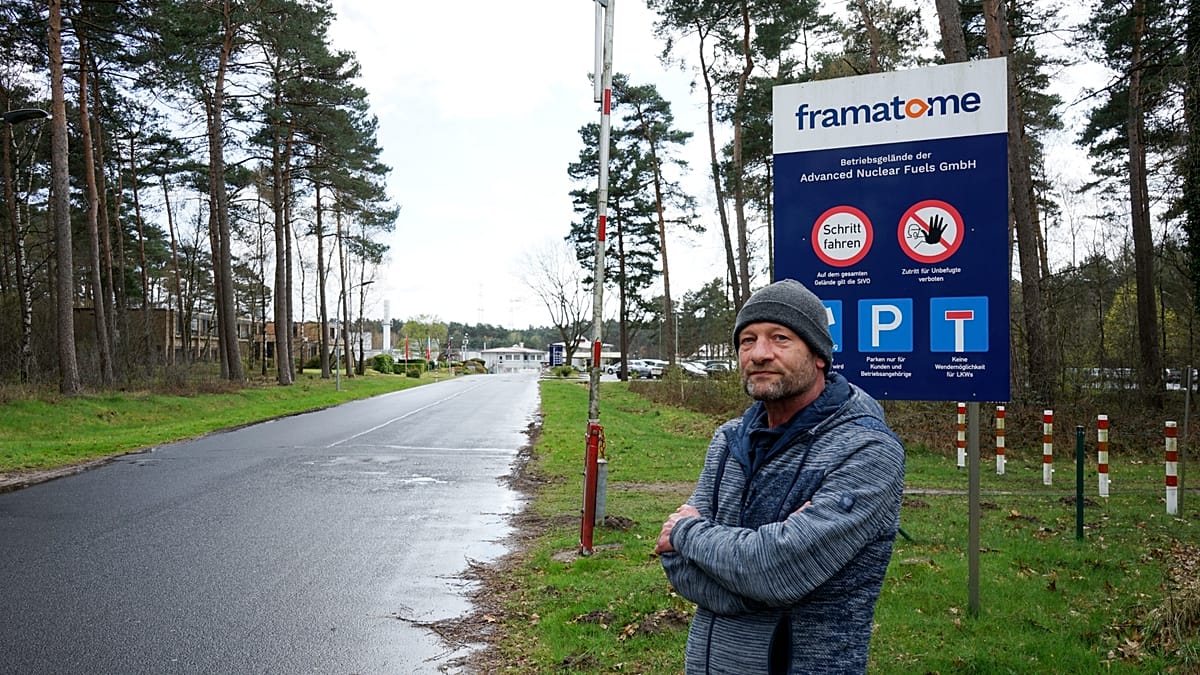
The Ministry of the Environment in Lower Saxony is to examine whether a subsidiary of Framatome in Lingen is authorised to produce fuel rods for Russian reactor types.
-
Copyright
(c) Copyright 2022, dpa (www.dpa.de)
Copyright (c) Copyright 2022, dpa (www.dpa.de)
Published on
26/03/2026 - 7:05 GMT+1
A factory in Lingen, Lower Saxony, is to produce fuel elements for Russian reactor types in future - in cooperation with Rosatom, the Russian state nuclear corporation
The project is politically and legally controversial.
In the town of Lingen in Lower Saxony, Advanced Nuclear Fuels GmbH (ANF), a subsidiary of the French nuclear group Framatome, has been producing fuel assemblies for nuclear power plants in Europe since 1979
With Germany’s nuclear phase-out on 15 April 2023 – when the last three German nuclear power plants, including the Emsland plant directly next to the ANF site, were taken off the grid – the company has largely lost its domestic market.
Even before that, however, ANF had begun to tap into a new line of business: the production of hexagonal fuel assemblies for Soviet-design pressurised water reactors (VVERs), which are still in operation in the Czech Republic, Slovakia, Bulgaria, Hungary and Finland
For a long time, these 19 reactors sourced their fuel exclusively or predominantly from Russia
According to the European Commission, all operators have now signed contracts with alternative suppliers – but they still rely to a considerable extent on Russian technology.
The path out of dependence leads through Russia
At first glance, the project appears reasonable in terms of energy policy: if Western manufacturers were to supply these fuel assemblies, Eastern European states could reduce their dependence on Moscow
Yet this is precisely where the contradiction lies – because the route out of Russian dependence is supposed to run via Russian technology and Russian participation.
The basis for the project is a licence agreement concluded in 2021 between ANF and the Russian state nuclear energy corporation Rosatom and its subsidiary TVEL Fuel Company
ANF submitted its application for nuclear regulatory approval to the Lower Saxony Ministry of the Environment in March 2022 – a few weeks after Russia’s invasion of Ukraine
Since then, an approval procedure has been under way that is legally complex and politically contentious.
Rosatom chief Alexei Likhachev at a meeting with Russian President Vladimir Putin in the Kremlin in Moscow on 15 October 2024.
Sputnik
'No routine procedure'
Formally, Lower Saxony is responsible, but in practice the state’s room for manoeuvre is limited: the final say rests with the federal government
In February 2026, Politico, citing people familiar with the matter, reported that the federal government had issued Lower Saxony with a recommendation to grant approval subject to conditions.
In response to a query from Euronews, the Federal Environment Ministry (BMUKN) said it would not comment on details while the procedure is ongoing.
Lower Saxony’s Environment Minister Christian Meyer (Greens) makes no secret of his scepticism: 'The application to switch production at the Lingen plant to hexagonal fuel assemblies with Russian involvement is not an everyday matter and is causing me, and many citizens, serious concern for internal and external security.'
The project is highly controversial
More than 11,000 people and organisations lodged written objections to it – an unusually high number for a nuclear licensing procedure.
According to an analysis (source in German) by the Federal Agency for Civic Education, Rosatom is responsible for both the civilian and military use of nuclear energy in Russia
Since 4 March 2022, the corporation has also controlled the occupied Ukrainian nuclear power plant Zaporizhzhia
Meyer likewise stresses that many experts from Ukraine and Eastern Europe warn against the state-owned nuclear group, which is directly involved in the war of aggression.
The plan: Russian technology as a stopgap
ANF and Framatome take a different view of the project
Mario Leberig, Vice President Engineering at Framatome and responsible for engineering in Germany, described the project to the FAZ as an opportunity to boost energy security in Eastern Europe
An in-house development of the fuel assemblies will not be ready for series production before 2030 at the earliest – until then, ANF is relying on the Rosatom licence
The necessary machines are already in Lingen; according to the FAZ, around 20 Russian specialists handed over the equipment to ANF employees in April 2024.
The Lower Saxony Environment Ministry disagrees: 'How closely licensed manufacturing and production with Russia – using Russian machines, know-how and finished fuel assemblies from Russia – is supposed to reduce dependence on Russian fuel assemblies is beyond us.' As an alternative model, it points to Westinghouse, which is already producing hexagonal fuel assemblies for Eastern European reactors in Sweden.
Vladimir Slivyak is also doubtful
The co-chair of the Russian environmental organisation Ecodefense and recipient of the Right Livelihood Award lives in exile in Germany
He tells Euronews: 'Framatome cannot produce this fuel without Rosatom – so the dependence remains
What is being presented as diversification is in reality a continuation of dependence, with European companies skimming off part of the profits.'
A political detour via France?
Slivyak also sees the project’s set-up as an attempt to circumvent political resistance
According to his account, the federal government in office in 2022 rejected direct cooperation on German soil
The joint venture in Lyon was then newly established – structurally identical, but as a French legal entity
Slivyak says: 'This is clearly a political detour
Germany hesitated to let Rosatom into its nuclear sector – so Framatome simply moved the joint venture to France and brought it back in via another route
Russia’s role has never disappeared; it has merely been repackaged.'
Europe’s uranium imports: ties with Russia endure
According to research by public broadcaster NDR, Russia supplied around 68.6 tonnes of uranium to the Lingen plant in 2024 – an increase of roughly 66 percent on the previous year
Across the EU, member states imported Russian uranium products worth more than 700 million euros in 2024, according to a joint study by the Kyiv think-tank DiXi Group and the Brussels-based economic institute Bruegel, based on Eurostat data.
Russian supplies remain of major importance for the French nuclear sector.
Copyright 2022 The Associated Press
Only the 20th sanctions package targets Rosatom directly
Through numerous sanctions packages, Rosatom remained untouched because states such as Hungary and Slovakia blocked corresponding measures
It was only with the 20th EU sanctions package, presented by European Commission President Ursula von der Leyen on 6 February 2026, that Rosatom and its subsidiaries – including TVEL – were explicitly included: new contracts are banned, and Russian uranium may no longer be imported
Transitional periods for existing contracts run until mid-2026.
Whether the existing ANF–TVEL joint venture falls under this remains legally unclear
Framatome invokes the 1957 Euratom Treaty, which as EU primary law is said to protect existing nuclear cooperation.
The Federal Environment Ministry indicates, in response to a request from Euronews, that it is keeping a close eye on developments at European level
'The European Commission has announced that, as part of the RePowerEU strategy, it will present a specific draft regulation under which imports of nuclear material and technology from Russia are to be gradually reduced,' the ministry’s statement reads
However, the draft has not yet been submitted to the ministry.
Environmental activist and Kremlin critic Slivyak is calling for more resolute action: 'The EU still has a window of opportunity – but it has to act now: nuclear cooperation with Rosatom and its subsidiaries must end, combined with clear, time-limited transition plans for countries that are still dependent.'
Lingen as an example of a bigger problem
Formally, the decision on the controversial project is made in Lower Saxony – but the state is acting on behalf of the federal government
Nuclear law is a federal matter: the federal government can instruct the state authorities on all questions and has the final say
The basis for the procedure is the so-called Roller report (source in German), which the federal government commissioned at the outset and which recommends that issues of internal and external security arising from the joint venture with Rosatom be taken into account in the licensing procedure.
Whether the joint venture poses specific risks to internal or external security – through sabotage, espionage or Russian influence – is something that the federal government and its security authorities must determine.
Restart of world's biggest nuclear plant paused after alert, Japan's TEPCO says
Zelenskyy says Russia taking aim at Ukraine's nuclear power stations
Shield protecting Chernobyl nuclear power plant no longer blocks radiation, IAEA says
Related Stories
Source: This article was originally published by Euronews
Read Full Original Article →
Comments (0)
No comments yet. Be the first to comment!
Leave a Comment