
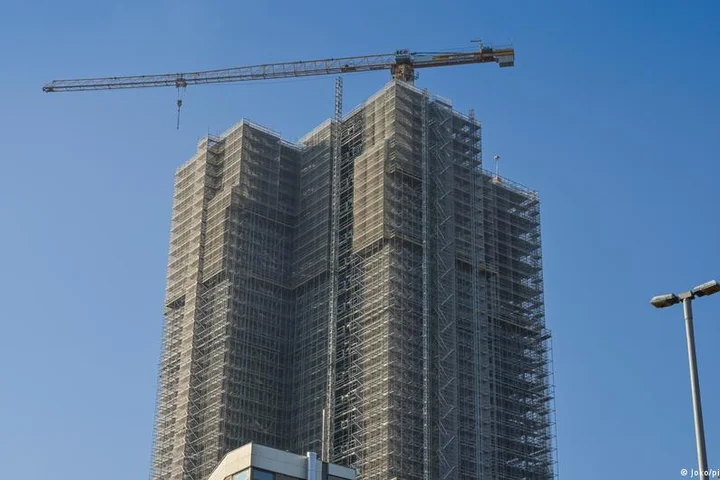
Business associations from the construction and real estate sectors, as well as academics, are warning the German government of a worsening crisis in the housing market, as building costs spiral out of control.
" Germany is building far too expensively," said Dietmar Walberg, head of the Kiel-based building research institute Arge , on Thursday in Berlin.
In major cities, the average price per square meter of newly constructed living space is €4,630 ($5,350) and even €5,400 including land costs.
"That is too expensive for average earners," Walberg said.
New legislation was introduced in late 2025 in an attempt to expedite planning and approval processes.
In 2025, 10% more building permits were issued than the year before.
However, the real estate association GdW expects a drop in completions this year to just 200,000 apartments, while at least 300,000 new units are needed per year to meet the demand.
The coalition government of the center-right bloc of Christian Democrats and Christian Social Union (CDU/CSU) and center-left Social Democrats (SPD) has boosted the Construction Ministry's budget for 2026 to €7.6 billion.
Germany takes on Berlin's apartment squeeze
To view this video please enable JavaScript, and consider upgrading to a web browser that supports HTML5 video
Germany's 'construction turbo' failing to take off
When she came to office last year, Construction and Housing Minister Verena Hubertz presented a plan to help ease the shortage of affordable housing.
In a country where it can take longer to get approval for a development project than it does to actually build it, Hubertz said she wanted to give local authorities a "crowbar" to circumvent labyrinthine urban planning laws.
That crowbar, labeled "Bau-Turbo" (construction turbo), is a new paragraph (§ 246e) in the German Building Code.
The legislation was passed in October, allowing municipalities to approve construction, change-of-use and renovation projects that deviate from the provisions of the Building Code if those projects are for the construction of new residential buildings.
Planning applications are now automatically approved after two months unless vetoed by the municipality.
Matthias Günther, the head of the Pestel Institute, which researches areas like the economy and housing for the public and private sectors, told DW that the new legislation was "a lot of hot air" that will "not achieve anything in the short term."
Why we should bring back prefab buildings
Plans for simpler construction of residential buildings
The new legislation was intended to expedite planning and approval processes.
Now, industry associations again stress that the government must focus its funding policy on "basic standard housing construction."
The key, according to Walberg, lies in simpler construction.
The German government is planning a reform of building standards.
The "building type E," with E standing for einfach (simple), was presented in November but is still awaiting cabinet approval.
This type of building is intended to forgo costly extras and maintenance-intensive technology, as well as underground parking garages.
Tim-Oliver Müller, the managing director of the Federal Association of the German Construction Industry (HDB), said a "melange of crises" has hit Germany's construction industry.
He lists Russia's full-scale invasion of Ukraine, rising energy prices, the increased cost of materials such as concrete and steel, inflation and a jump in interest rates from below 1% to between 3% and 4%.
The new legislation is "purely a creation of possibilities, for example, with regard to building extensions or changing the designation of land from commercial to residential, something that was not previously possible," Müller told DW.
Building regulations vary between Germany's 16 states and among municipalities, resulting in an ever-growing patchwork of rules governing everything from the number of electric sockets per room to the shape and color of roofs.
Germany's oldest social housing complex has the lowest rents
Environmentalists have expressed concern about easing planning regulations because they fear green spaces will be built on as new development projects are waved through with less time for local residents to object.
"Only with green spaces can we buffer [heatwaves].
Because these green spaces provide active cooling," Stefan Petzold from the nature conservation association NABU told German public broadcaster ARD.
While Germany has some of the strongest tenant protection laws in the world, Faller said those laws serve to protect existing tenants and work against those who want or need to move, particularly young people and large families.
Despite Germany's demographic changes, due to the aging society, the demand for housing is unlikely to decrease.
"We have increasingly smaller households.
This means that their number will continue to rise in the coming years, even with a stagnant population," Arnt von Bodelschwingh of the Berlin-based research institute RegioKontext said in Berlin on Thursday.
Related Stories



Source: This article was originally published by Deutsche Welle (DW)
Read Full Original Article →
Comments (0)
No comments yet. Be the first to comment!
Leave a Comment