
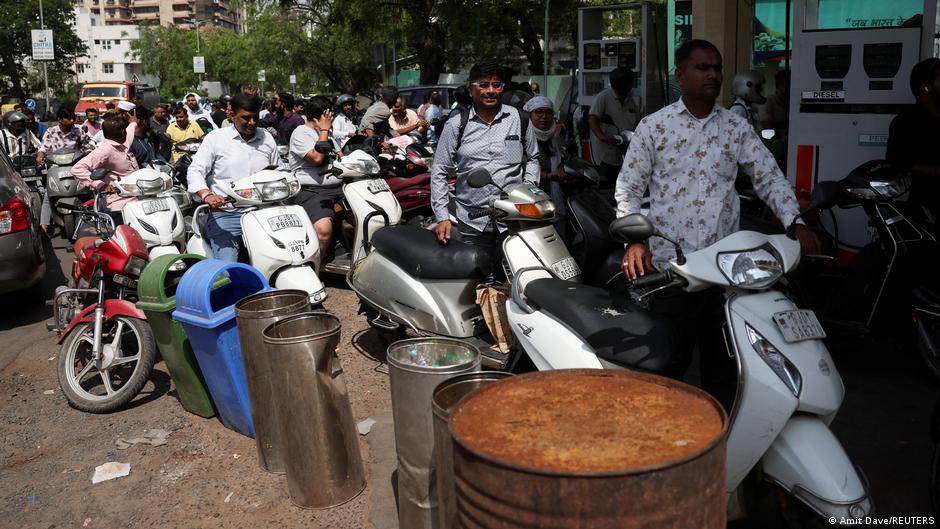
The comments by German Defense Minister Pistorius come amid mixed signals over negotiations to end the war.
Follow DW for more.
Here is a roundup of our coverage of the US-Israel war with Iran and its wider impact in the Middle East on Thursday, March 26, 2026:
What to know about the negotiation claims between Iran and the US?
US President Donald Trump has doubled down on his insistence that Iran is taking part in peace talks, despite Tehran's denials that it is.
Trump said the Iranian negotiators to whom he was talking were hesitant to confirm negotiations were ongoing for fear of being killed by their own side.
"They are negotiating, by the way, and they want to make a deal so badly, but they're afraid to say it because they figure they’ll be killed by their own people," Trump said on Wednesday.
Iranian Foreign Minister Abbas Araghchi on Wednesday said that Iran did not plan to negotiate with the US and that Tehran would keep fighting, after receiving Washington's proposed 15-point peace plan via Pakistan on Wednesday.
"At present, our policy is the continuation of resistance," Araghchi said on state TV, adding: "We do not intend to negotiate — so far, no negotiations have taken place, and I believe our position is completely principled."
"Speaking of negotiations now is an admission of defeat," he said.
Trump had threatened to "obliterate" Iran's power plants if Tehran did not open up the Strait of Hormuz within 48 hours.
However, by Monday the US president said he would give Iran five days as the alleged talks took place.
Observers highlighted Trump’s decision to U-turn hours before the deadline expired as another example of a TACO moment — an acronym of "Trump Always Chickens Out" — in which the president ramps up rhetoric before walking back his threats.
It has also been pointed out that Trump's threats and retreats coincide with market openings.
The initial threat came late Friday and was reversed early Monday , with a new 5-day deadline given, which would again fall on Friday.
Thousands of oil contracts were traded 15 minutes before Trump said he would hold off on attacking Iran's energy infrastructure, a phenomenon that sent prices tumbling.
Iran has stressed they cannot trust US diplomacy, having been attacked twice during negotiations in the last nine months.
Tehran has suggested that Trump is trying to buy time without spooking markets too much while amassing troops in the region.
There have been numerous reports of vessels transporting US Marines being deployed to the Middle East.
How Iran responded to Donald Trump's claims of US-Iran talks
To view this video please enable JavaScript, and consider upgrading to a web browser that supports HTML5 video
US Postal Service announces price rise as Iran war pushes up costs
The US Postal Service has announced it's seeking a temporary 8% increase on some mail and parcel deliveries to deal with rising transportation fuel costs.
"Transportation costs have been increasing, and our competitors have reacted with a number of surcharges," USPS said in a statement .
Delivery giant UPS imposed a fuel surcharge in the United States in early March, and Fedex also frequently updates its fuel surcharge based on US gasoline prices.
If approved by the Postal Regulatory Commission, the price increase would come into effect on April 26.
Australia's ban on visitors from Iran starts today
Australia has temporarily stopped visitors from Iran from entering the country.
The ban goes into effect today, Thursday.
Announcing the ban, the government said there was a greater risk of Iranians being unwilling or unable to leave because of the war in Iran.
The ban prevents Iranians holding a certain type of visitor visa (Subclass 600) from traveling to Australia for six months.
You can read more about Australian's ban on visitors from Iran here .
Russia reportedly sending drone shipment to Iran — Financial Times
Russia is close to completing the delivery of a shipment of drones to Iran , the Financial Times reports.
The UK-based newspaper cited two unnamed officials briefed on the intelligence.
"The processing of deliveries began in early March and was expected to be completed by the end of the month," FT reported.
It was not clear what type of drones Russia was sending, FT said.
Ukraine's President Volodymyr Zelenskyy said earlier in March that it was "100% facts" that Iran has used Russian-made Shahed drones to target US bases in the Middle East.
Russia and Iran have been exchanging "drone technology and production know-how" since 2022, according to the Atlantic Council think-tank.
Russia now manufactures its own version of the Shahed drone, originally developed by Iran.
The Wall Street Journal also reported last week that Russia was providing Iran with satellite imagery and improved drone technology.
Iran war a 'catastrophe' for world economies — German defense minister
German Defense Minister Boris Pistorius has described the Iran war as an economic "catastrophe."
"To make it crystal clear, this war is a catastrophe for the world's economies," Pistorius told reporters in Australia on Thursday.
He stressed that Germany was not consulted before the war started and that it is not Germany's war.
"Nobody asked us before.
It’s not our war and therefore we don’t want to get sucked into that war," Pistorius said.
He added that Germany was ready to help secure any peace once that was achieved and appealed for a ceasefire as soon as possible.
Pistorius is on a week-long visit to the Indo-Pacific region, including Australia.
Welcome to our reporting and analysis of the 26th day of the war in Iran and its global fallout.
Before you dive into what's happening on Thursday, you should probably know that on Wednesday:
US sends 15-point ceasefire proposal to Iran via Pakistan
If you missed out on any of our coverage on Wednesday of the Iran war, you can catch up on it here .
Related Stories


Source: This article was originally published by Deutsche Welle (DW)
Read Full Original Article →
Comments (0)
No comments yet. Be the first to comment!
Leave a Comment