
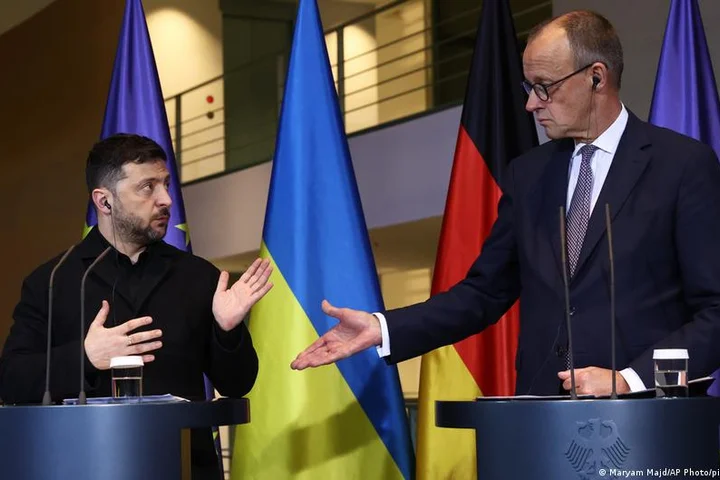
EU membership for Ukraine, European involvement in peace talks and a comprehensive bilateral drone deal were all on the agenda as Chancellor Merz hosted President Zelenskyy.
DW has more.
Read DW's coverage of the first government consultations between Germany and Ukraine on Tuesday, April 14, 2026.
You can catch up on Monday's Germany news here .
New advice center for Ukrainians in Berlin
German Interior Minister Alexander Dobrindt opened the so-called "Unity Hub" alongside the Ukrainian Minister of Social Policy, Denys Uliutin, on Tuesday as part of inter-governmental consultations between the German and Ukrainian governments.
Uliutin said the Berlin center was to be one of many across Europe aimed at bringing Ukrainian refugees together as a "community" and retaining links with Ukraine.
While the German Interior Ministry said the principal aim of the center was to "increase connections to Ukraine and encourage a desire to return," the institutions would also offer help on integration in Germany , including language lessons, cultural offers and assistance in finding work.
As of February 2026, around 1.16 million Ukrainians live in Germany, around 60,000 of them in Berlin.
Zelenskyy: Ukraine could double arms production if provided with funds
Ukrainian President Volodymyr Zelenskyy says Ukraine has the capacity to double its own domestic arms production — if provided with the proper funding.
Ukraine already produces most of its own weapons in its fight against the ongoing Russian invasion , but Zelenskyy noted in Berlin on Tuesday that production could be doubled if Ukraine had sufficient funds.
"The majority of the weapons Ukraine uses for various operations — from strikes against targets in the hinterland and fighting on the front line to air defense — are now manufactured in Ukraine," Zelenskyy said at a press conference alongside German Chancellor Friedrich Merz .
However, he also said: "We simply don't have the money, but we did discuss this to some extent today."
Much-needed additional funds are expected to be freed up for Ukraine following the electoral defeat this weekend of Hungarian Prime Minister Viktor Orban , the right-wing populist and Moscow ally who had been blocking a €90 billion ($105 billion) European Union loan to Kyiv.
Ukraine has said it intends to invest at least two thirds of that sum directly in its armed forces.
Drones and AI: How technology is changing warfare
To view this video please enable JavaScript, and consider upgrading to a web browser that supports HTML5 video
Germany and Ukraine announce energy, raw materials cooperation
Germany and Ukraine have signed Memoranda of Understanding (MoU) to boost cooperation on mineral resources and energy security.
German Economy and Energy Minister Katherina Reiche and her Ukrainian counterpart signed the agreements during government consultations in Berlin on Tuesday, the German Economy Ministry said.
The two countries also agreed to establish a new working group on economic and trade issues, and adopted a joint declaration to deepen bilateral ties amid the ongoing Russian invasion of Ukraine .
WATCH DW's full coverage of Zelenskyy's visit to Berlin
You can watch all the news, analysis and the press conference in full again in our YouTube stream below.
Germany must be involved in peace talks, Merz says
German Chancellor Friedrich Merz insisted that Europe must be directly involved in any peace agreement between Ukraine and Russia, as US‑mediated talks remain stalled.
At the press conference in Berlin, Merz said no deal could be reached “over the heads of Europeans,” stressing Germany’s role as Ukraine’s largest supporter.
Berlin also wants a seat at the table in shaping Ukraine’s post‑war order, including economic reconstruction.
Zelenskyy agreed that Europe must be part of the process, accusing Russia of continuing to delay peace.
The impressions of DW's correspondent at the press briefing
Wearing a simple black suit, black shirt and black sneakers, Ukrainian President Volodymyr Zelenskyy stood at the podium during a press conference at the Chancellery in Berlin.
His expression was impassive, his gaze fixed somewhere in the distance.
Zelenskyy listened quietly as German Chancellor Friedrich Merz reiterated his assurance that Ukraine belongs in the European Union and should one day become a member.
“But we both know that this will not happen anytime soon,” Merz added, glancing toward his guest.
For Zelenskyy, protecting the country’s energy and transport infrastructure ahead of the coming winter was more critical in the short-term.
Pressure on Russia to agree to peace must also be increased.
During the exchange, the Ukrainian president’s expression briefly softened.
He said he was confident the European Union would now be able to disburse a promised €90 billion loan to Ukraine.
An agreement, he said, could be reached as early as next week’s informal EU summit in Cyprus.
Merz calls for 'lasting peace' and EU membership for Ukraine
German Chancellor Friedrich Merz has called for a "lasting peace" for Ukraine and expressed his support of Kyiv's aim of European Union membership.
" Germany supports this goal," he said following talks with Ukrainian President Volodymyr Zelenskyy in Berlin, adding though that it wouldn't happen "anytime soon."
Calling on Zelenskyy to continue to push for reforms to combat corruption and strengthen democracy in Ukraine, Merz said: "It's worth the effort.
Every step in this direction is a step towards Europe."
Merz said Ukraine's accession to the EU would be a "strategically important step for more security and greater prosperity in Europe."
Zelenskyy, however, rejected a diminished partnership, saying that Ukraine did not need an "EU-light" or a "NATO-light" membership.
Germany and Ukraine agree defense and reconstruction cooperation
Germany and Ukraine have signed a series of cooperation agreements on defense and reconstruction, with Berlin reiterating its support for Kyiv in its fight against the ongoing Russian invasion .
The agreements came following talks between German Chancellor Friedrich Merz and Ukrainian President Volodymyr Zelenskyy , plus cabinet ministers from both countries, in Berlin on Tuesday morning.
Chancellor Merz said the two countries have agreed to collaborate on the design and production of drones as well as on "digital battlefield data technology," adding that close cooperation with Ukraine is of benefit to Germany's own security.
"We benefit from the Ukrainian army's resilience," he said, insisting that "Russia has no chance of winning this war."
Germany wants young Ukranian men to return
Not far from the Chancellery in Berlin, the German armed forces are advertising for new recruits, urging young men and women to enlist.
Germany does not currently have a military draft, but since Russia's full-scale invasion of Ukraine , politicians in Berlin have been seeking to strengthen the country's defense capabilities.
Ukraine, by contrast, operates a conscription system.
Since last September, men aged 25 and over have been subject to a draft.
In the months since the rule came into force, thousands of Ukrainian men under 25 have taken the opportunity to leave the war‑torn country.
Many have ended up in Berlin, where they register as refugees.
During his talks with Zelenskyy, Chancellor Merz complained that these arrivals must be curbed .
Ukraine has promised to address the issue, but with limited success so far.
From the German government's perspective, it is in Ukraine's own interest to keep men aged 18 to 25 in the country to fill the ranks of its army.
In Germany, Ukrainians fleeing the war are granted refugee status and receive social benefits similar to those provided to asylum seekers, including accommodation and food.
They are also allowed to take up employment immediately — a key difference from other asylum seekers, who often must wait several months before being permitted to work.
Drones and defense on the table at the Chancellery
Following a military reception for President Zelenskyy by the Bundeswehr 's honor guard in the courtyard of the Chancellery, the security focus continued inside.
On the grand entrance staircase, German and Ukrainian defense companies had displayed several drone models, which Chancellor Merz and his guest briefly inspected.
Ukraine has made rapid advances in drone technology over the four years of war with Russia.
The Bundeswehr , Germany's armed forces, plans to significantly expand its own drone capabilities in the coming years.
From Berlin's perspective, cooperation with Kyiv is a logical next step.
Under the plans, German companies could produce Ukrainian-designed drones under license and supply them to Ukraine, while Ukrainian experts would contribute their operational experience.
A joint drone production facility by German defense firm Rheinmetall is already being established in Ukraine.
Zelenskyy and Merz are expected to sign the relevant memoranda of understanding later.
What's on the agenda for the Germany-Ukraine talks?
Five helicopters landed on the lawn behind Germany's Chancellery, carrying Ukrainian President Volodymyr Zelenskyy and several members of his Cabinet.
The delegation arrived in Berlin for wide‑ranging consultations with German ministers responsible for defense, agriculture, interior affairs, development aid and the economy.
The talks mark the first full German‑Ukrainian government consultations in two decades.
Chancellor Friedrich Merz is keen to underline that Ukraine, which has been under full-scale invasion by Russia since 2022 , remains Germany's top foreign‑policy priority.
Germany has become Ukraine's largest backer since the United States, under the Trump administration , withdrew its support last year.
As a next step, Berlin is pushing to unlock a €90 billion ($106 billion) EU credit line for Ukraine.
That could happen as early as mid‑May, once Hungary 's new EU‑friendly government lifts its resistance to further payments.
Lufthansa strike enters second day
Pilots at German airline Lufthansa continued industrial action for a second day on Tuesday, with unions reporting high levels of strike participation as staff call for improved working conditions.
According to the Vereinigung Cockpit union (VC), around 860 Lufthansa, Eurowings and Cityline flights were canceled on Monday – 84% of all of scheduled flights, and therefore more than the 80% which were canceled during strike action in March.
While the pilots' strike is set to end on Tuesday night, Lufthansa and Cityline cabin crews are set to strike on Wednesday and Thursday.
Having already walked out last Friday , the industrial action is therefore set to cover a total of five consecutive working days.
German airport lobby group ADV criticized the extent of the industrial action which it said had affected hundreds of thousands of passengers and large parts of the German economy.
"Thousands of canceled flights in such a short space of time lead to losses of millions of euros, which has direct consequences for airport operators, service providers and employees," said ADV chief Ralph Beisel, calling on the German government to take action to limit the right to strike in the air travel sector.
Berlin set up for Zelenskyy's surprise visit
Police officers stationed on rooftops around the Chancellery in Berlin are a clear sign that a particularly high‑profile guest is in town.
Shortly after officers took up their positions, the Chancellery confirmed that Ukrainian President Volodymyr Zelenskyy had arrived in the German capital, accompanied by members of his Cabinet, for German‑Ukrainian government consultations.
For security reasons, visits of this kind are kept secret until shortly before they begin.
President Zelenskyy is considered one of the most at‑risk political leaders in the world.
Even so, road closures in Berlin’s government district since the previous day had already hinted at who was coming.
Such extraordinary security measures are typically reserved for only a handful of "super‑VIPs," including the US president, the pope — and now, once again, Ukraine’s wartime leader.
Merz to host Zelenskyy in Berlin
Ukrainian President Volodymyr Zelenskyy was expected in Berlin on Tuesday, accompanied by cabinet ministers who will hold official German-Ukrainian government consultations.
In the first such inter-governmental talks in years, policymakers are expected to discuss financial and military support for Ukraine in its ongoing fight against the Russian invasion , as well as reconstruction efforts and the return of Ukrainian refugees.
On Monday, following the electoral defeat of Hungarian Prime Minister Viktor Orban at the weekend, German Chancellor Friedrich Merz had indicated that a €90-billion loan for Ukraine, which had been blocked by Budapest , would now be paid out.
Kyiv is expected to invest around two thirds of the credit directly in its armed forces to maintain their battle-readiness until 2027 at least.
Guten Morgen!
Welcome to DW's coverage of what Germany is talking about on Tuesday, April 14, 2026.
German Chancellor Friedrich Merz is expected to welcome Ukrainian President Volodomyr Zelenskyy to Berlin today.
Zelenskyy will be accompanied by several cabinet ministers who will take part in inter-governmental talks.
Related Stories

Source: This article was originally published by Deutsche Welle (DW)
Read Full Original Article →
Comments (0)
No comments yet. Be the first to comment!
Leave a Comment