
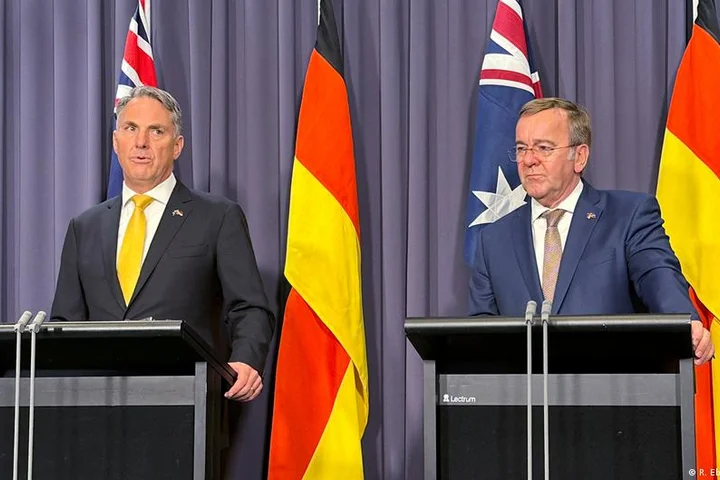
Defense Minister Boris Pistorius just concluded a whirlwind tour of Japan, Singapore and Australia as Germany aims to build ties with middle powers in the Asia Pacific while warning global order is coming apart.
Pistorius' hosts in Japan , Singapore and Australia readily seized on his remarks and emphasized how important this order is.
"We respect the rule of law, both nationally and internationally," he told a joint press conference in Parliament last Thursday.
"The rules-based order is deeply important to both of our countries..."
At every public-facing meeting Pistorius held in the region, he and his interlocutors also stressed how the Indo-Pacific and Europe are inseparably linked.
"Today's world is becoming more and more networked — day by day, whether we like it or not," Pistorius said in Canberra.
"Conflicts, economic crises, natural disasters — they occur in one region of the world, but their causes may lie in another far‑away region."
But this constant invocation of the rules‑based order also reveals that leaders are more aware of how long‑held certainties are dissolving, while new ones are only just emerging and have yet to be tested.
Germany's difficulty in finding new position in a shifting global order became evident during the course of the defense minister's tour.
Germany has long relied on the United States for its security, and President Donald Trump has frequently made a point of throwing the transatlantic NATO alliance into disarray.
During his speeches, Pistorius invoked the idea of German self-reliance, suggesting a shift in focus.
"We used to focus… on what is China doing, what is Russia doing, what is the US doing," he told reporters at the National Press Club of Australia.
Pistorius noted that these countries are the world's major powers, but when the "middle powers" stick together, rely on each other and are committed to what they want to achieve, they "are at least as strong" as the superpowers themselves.
At the same time, Pistorius said he knows that any kind of order is impossible without the involvement of the big players.
"An international order needs the superpowers," Pistorius said during a Q&A session.
"Those that already are — and those that aspire to be — must not only sit at the table but help shape it.
But the priorities of this international order need to change, and it remains to be seen whether the superpowers are prepared to do so."
In this context, Pistorius has called for more courage.
He repeatedly compares certain international relationships to a toxic partnership .
"Those who focus solely on their opponent or partner never act sovereignly.
They are manipulated by fear.
And decisions based on fear are always wrong."
WEF 2026: Can Europe defend itself?
To view this video please enable JavaScript, and consider upgrading to a web browser that supports HTML5 video
Pistorius hinted throughout the tour that the world could soon seen new alliances formed by middle powers, which could include countries such as Japan, Singapore and Australia alongside Germany.
The so‑called Global South is also meant to be more closely involved.
"I also believe that the countries of the Global South are thinking about having a different kind of influence — one they would understandably like to have.
The question is how to ensure that," Germany's defense minister said.
Countries like Indonesia, South Africa, Turkey and others have demanded a more inclusive order for some time.
In 2023, Pistorius visited India and Indonesia .
"Our connection, our strategic partnership, should and must gain more momentum — not only against the background of current developments in the region, but also worldwide," he told reporters following a meeting at the time with Indian Defense Minister Rajnath Singh in New Delhi.
India primarily sees itself as a "trustee of the Global South," according to a recent study by the German Institute for International and Security Affairs (SWP) titled "Multipolarities."
Because of its colonial past, New Delhi is extremely sensitive to any potential interference from outside or to prescriptions coming from the so‑called West.
According to the SWP, India aims "to exercise greater shaping power in a multipolar order" and to become a major pole of power in its own right — particularly in the Indo‑Pacific.
Looking at Pistorius' statements during his Asia tour, it is clear he recognizes an erosion of the international order, and also recognizes the need for its reform.
"The first step is to agree that we need an international, rules‑based order," he said, adding that if such an order is to be accepted, "then we must...
shift the center of this order somewhat."
He described Russia as "aggressive and revisionist," and said China's influence and aggression must also be met with a response.
Last but not least, Pistorius also called for greater independence from the United States.
Bringing in like-minded countries such as Japan, Singapore and Australia looks comparatively easy.
Persuading countries like India or Indonesia is likely to be more difficult.
German president: Iran war violates international law
This article was translated from German
Related Stories
Source: This article was originally published by Deutsche Welle (DW)
Read Full Original Article →
Comments (0)
No comments yet. Be the first to comment!
Leave a Comment