
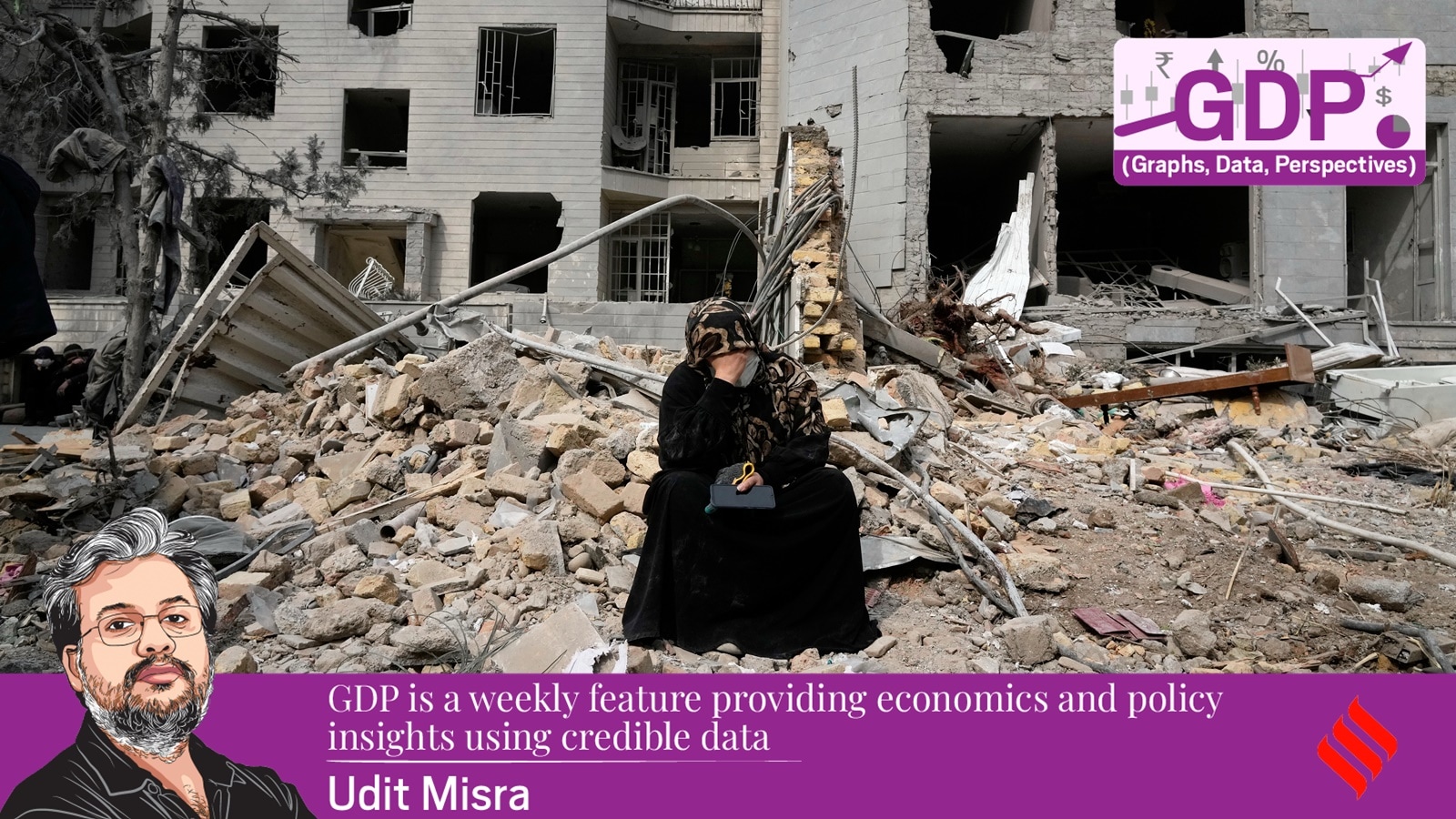
The United States and Israel attacked Iran on February 28, and initial estimates suggest a heavy running cost for this war.
Last week, the Israeli Finance Ministry claimed that thecountry is spending $3 billion per weekas it attacked Iran, and defended itself from Iranian missiles.
In the US, the costs are reportedly even higher.
According to a briefing by the Department of Defence (or War, as the Trump Administration calls it) to the US Congress on March 11, the US government had spent $11.3 billion in just the first six days of the war — that’s close to $2 billion a day and $14 billion a week.
For perspective, $1 billion is roughly equal to Rs 9,000 crore.
In other words, in the first six days starting February 28, the US and Israel had spent over Rs 1.3 lakh crore.
Another way to look at this is to compare it with India’s entire defencebudgetfor 2026: Rs 7.8 lakh crore.
So, at the going rate, in just six weeks, which is one of the many timelines US PresidentDonald Trumphas given since the start of the war, US and Israel would have spent on this war as much as India hopes to spend in the coming year on its defence.
Of course, it is entirely possible that as the days and weeks go by, the direct running cost may come down — after all, Trump has said that almost all the targets that could be hit aerially have been hit.
On the other hand, it is unclear how long this war will drag on, especially since there is no clarity on the exact goal.
While accurately assessing the true cost of war is near impossible, one way to get a sense of the scale is to look at the cost of past wars.
The Watson School of International and Public Affairs in Brown University runs a Cost of War research project.
According to a 2021 study here, “the total budgetary costs and future obligations of the post-9/11 wars (including the estimated future costs for veteran’s care) is …about $8 trillion in current dollars.”
Thepie-chartalongside provides the detailed break up of these expenses.
But even these costs are only those that will fall on the US government and US taxpayers.
If, as seems more and more likely, this war settles down to a lower frequency of attacks and counterattacks, the focus of costs will shift from direct military costs to the US and Israel to indirect costs to the wider world, such as the cost of higher fuel prices.
Crude oil prices have shot up by almost 50% since the start of the war.
That increase will now feed inflation across the world, worsening the so-called cost of living crisis that started in the wake of the Russia-Ukraine war in 2022.
But even such inflationary bumps fail to truly capture the real cost of war.
For instance, what is the opportunity cost of any such war?
Opportunity cost refers to the “money which could have gone towards societally beneficial expenditures such as infrastructure improvements, educational investments, and environmental protection” instead of military spending.
Beyond the economic costs, are the human costs — again far more difficult to assess.
For instance, the Cost of War project finds that an estimated over 940,000 people were killed by direct post-9/11 war violence in Iraq, Afghanistan, Syria, Yemen, and Pakistan between 2001-2023.
Of these, more than 432,000 were civilians.
The post 9/11 wars have also led to a severe undermining of civil liberties and human rights.
“Domestically, the post-9/11 wars dramatically expanded mass surveillance, eroding constitutional protections, and intensified police militarization.
Marginalized and racialized groups, from Muslims and Arabs to Black and Indigenous organizers to migrants, have borne the brunt of these consequences,” the project notes.
Lastly, there are environmental costs because “military jets and vehicles consume petroleum-based fuels at an extremely high rate, and the vehicles used in the war zones produce tons of carbon monoxide, nitrogen oxides, hydrocarbons, and sulfur dioxide in addition to CO2”.
One of the key findings has been that the US Department of Defense is the world’s single largest institutional consumer of oil — and as a result, one of the world’s top greenhouse gas emitters.
Udit Misra is Senior Associate Editor at The Indian Express.
Misra has reported on the Indian economy and policy landscape for the past two decades.
He holds a Master’s degree in Economics from the Delhi School of Economics and is a Chevening South Asia Journalism Fellow from the University of Westminster.
Misra is known for explanatory journalism and is a trusted voice among readers not just for simplifying complex economic concepts but also making sense of economic news both in India and abroad.
Professional Focus
He writes three regular columns for the publication.
ExplainSpeaking: A weekly explanatory column that answers the most important questions surrounding the economic and policy developments.
GDP (Graphs, Data, Perspectives): Another weekly column that uses interesting charts and data to provide perspective on an issue dominating the news during the week.
Book, Line & Thinker: A fortnightly column that for reviewing books, both new and old.
Recent Notable Articles (Late 2025)
His recent work focuses heavily on the weakening Indian Rupee, the global impact of U.S.
economic policy under Donald Trump, and long-term domestic growth projections:
Currency and Macroeconomics:
"GDP: Anatomy of rupee weakness against the dollar" (Dec 19, 2025) — Investigating why the Rupee remains weak despite India's status as a fast-growing economy.
"GDP: Amid the rupee's fall, how investors are shunning the Indian economy" (Dec 5, 2025).
"Nobel Prize in Economic Sciences 2025: How the winners explained economic growth" (Oct 13, 2025).
Global Geopolitics and Trade:
"Has the US already lost to China?
Trump's policies and the shifting global order" (Dec 8, 2025).
"The Great Sanctions Hack: Why economic sanctions don't work the way we expect" (Nov 23, 2025) — Based on former RBI Governor Urjit Patel's new book.
"ExplainSpeaking: How Trump's tariffs have run into an affordability crisis" (Nov 20, 2025).
Domestic Policy and Data:
"GDP: New labour codes and opportunity for India's weakest states" (Nov 28, 2025).
"ExplainSpeaking | Piyush Goyal says India will be a $30 trillion economy in 25 years: Decoding the projections" (Oct 30, 2025) — A critical look at the feasibility of high-growth targets.
"GDP: Examining latest GST collections, and where different states stand" (Nov 7, 2025).
International Economic Comparisons:
"GDP: What ails Germany, world's third-largest economy, and how it could grow" (Nov 14, 2025).
"On the loss of Europe's competitive edge" (Oct 17, 2025).
Signature Style
Udit Misra is known his calm, data-driven, explanation-first economics journalism.
He avoids ideological posturing, and writes with the aim of raising the standard of public discourse by providing readers with clarity and understanding of the ground realities.
You can follow him on X (formerly Twitter) at @ieuditmisra...
Read More
Related Stories



Source: This article was originally published by The Indian Express
Read Full Original Article →
Comments (0)
No comments yet. Be the first to comment!
Leave a Comment