
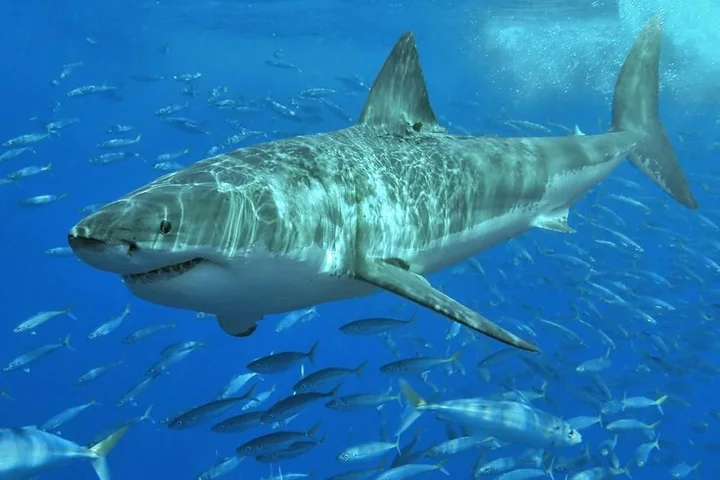
Some of the world’s most formidable predators – including the great white shark – face being cooked alive as seas heat up due to global warming.
This allows for faster swimming, long-distance migration, and more effective hunting – but it does come at a cost.
Now scientists have found that these warm-blooded fish use nearly four times more energy than regular cold-blooded species.
They say this places them in ‘double jeopardy’ as species with already high energy demands will need to cool their bodies down in warmer oceans, or risk catastrophically overheating.
However, cooling themselves down will make it more difficult for them to hunt.
Certain species of large predatory fish retain heat from their muscles, keeping them warmer than the surrounding water.
Sign up for all of the latest stories
Start your day informed with Metro's News Updates newsletter or get Breaking News alerts the moment it happens.
The study was conducted by a team at Trinity College Dublin in collaboration with the University of Pretoria,
Dr Nicholas Payne, from Trinity’s School of Natural Sciences and lead author, said: ‘The results were really quite striking – after accounting for body size and temperature, we found that mesothermic fishes use about 3.8 times more energy than similarly sized “ectothermic”, or “cold-blooded” fishes.
‘In addition, a 10°C increase in body temperature more than doubles a fish’s routine metabolic rate which, in practical terms, means warm-bodied predators must consume far more food to fuel their lifestyle.
‘But that heighted energy demand is only part of the story because as fish grow larger their bodies generate heat faster than they can lose it.
‘This creates a mismatch driven by basic geometry and physics because bigger bodies retain heat more effectively, and in mesotherms, high metabolic rates amplify this effect.’
The researchers found that this imbalance leaves larger fish increasingly prone to overheating, creating the physiological dilemma.
Prof Andrew Jackson, senior author of the study, said that sharks around the size of the average great white will struggle not to badly overheat in temperatures above 17°C.
This is now regularly exceeded near the surface, sometimes significantly.
‘Based on the data we were able to create theoretical “heat-balance thresholds”, which are the water temperatures above which large fish cannot shed heat quickly enough to maintain stable body temperatures without changing their behaviour or physiology,’ he said.
‘For example, a 1-tonne warm-bodied shark may struggle to remain in heat balance in waters above about 17°C.
‘Above such thresholds, fish must slow down, alter blood flow, or dive into cooler depths to avoid dangerous warming but that comes at a cost too; it might be harder to find food, or catch it, for example – especially if your main weapon is speed and power.’
The findings also help explain long-observed patterns in the oceans, where larger fish tend to inhabit cooler waters, higher latitudes, or deeper environments, often migrating seasonally to track favourable conditions.
However, researchers warn that climate change is likely to shrink suitable habitats for these species, particularly during warmer months.
Even highly adaptable fish such as Atlantic bluefin tuna may be pushed towards their limits if surface temperatures continue to rise.
Dr Snelling, from the University of Pretoria, said: ‘This research shows that being a high-performance predator in the ocean comes at a greater cost than we previously appreciated.
‘As the oceans warm, these species are being pushed closer to their physiological limits, which could have consequences for where they can live and how they survive.
‘What’s particularly concerning is that these animals are already operating on a tight energy budget, and climate change is narrowing their options even further.
‘Understanding these constraints is essential if we want to predict how marine ecosystems will shift in the coming decades.’
Related Stories



Source: This article was originally published by Metro UK
Read Full Original Article →
Comments (0)
No comments yet. Be the first to comment!
Leave a Comment