
Poll also finds Australians keener for government to forge closer ties with ‘middle powers’ such as Canada and Japan
Get our breaking news email , free app or daily news podcast
Only one in four Australians approve of the US-Israel war on Iran , and just a third have backed the federal government’s actions in sending a military plane and troops to the region, according to a new poll.
The latest Guardian Essential poll found Australians are keener for the government to forge closer ties with so-called “middle powers” such as Canada and Japan, with about a third wanting to distance from the US.
The poll of 1,008 Australians last week found 43% of respondents disapproved of the US and Israeli bombardment of Iran, while just 26% backed the move.
Some 31% were unsure or responded “don’t know”.
Regarding Australia’s response to the military action, 34% approved and 25% disapproved, with 40% saying they were unsure or didn’t know.
On Tuesday, the defence minister, Richard Marles, refused to rule out extending the deployment beyond the initial four weeks, saying Australia had received requests from the US to help defend the Gulf region.
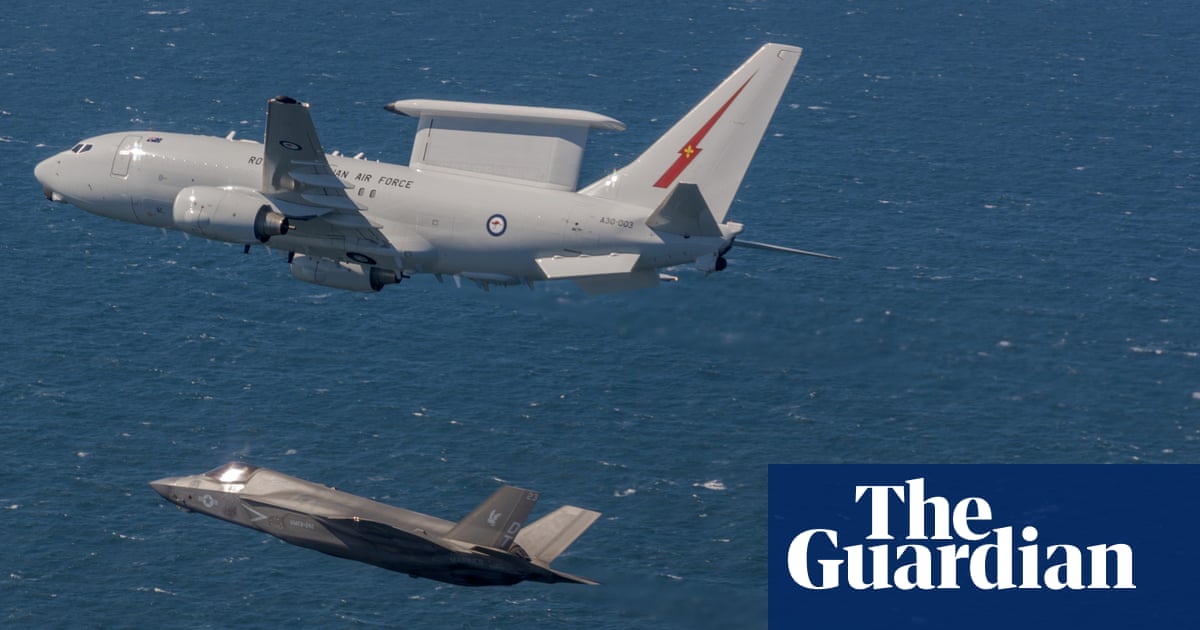
Asked about specific responses to the Iran war, only 32% backed the federal government’s moves to send missiles, an E-7 Wedgetail surveillance aircraft and about 85 Australian defence force personnel to the United Arab Emirates.
Some 35% opposed that move.
But while 37% would back sending naval support to end blockages of oil supplies through the strait of Hormuz, only 21% would support sending Australian troops to any ground operation.
Of those polled, 30% opposed sending naval support, and 50% opposed sending ground troops.
Alternately, 60% of respondents wanted Australia to work with international organisations on peace talks to prevent further escalation in the Middle East, and 37% backed offering refuge to civilians displaced by the war.
“The US strikes on Iran are supported by the public, but they also seem to be undermining support for the US alliance more generally,” Peter Lewis, the executive director of Essential Media, said of the poll results.
“This is a challenge for the government as it works toward a budget in deteriorating economic circumstances.”
Marles, the deputy prime minister, did not rule out extending the deployment of the Wedgetail, which is now two weeks into what was described as an “initial four weeks”.
The government has stressed the hi-tech surveillance craft is not deployed directly to the Iran conflict, and is assisting in defence of the UAE, but Marles has said the plane is feeding information into the Combined Air Operations Centre in Qatar, the facility which helps the US coordinate Middle Eastern operations.
Asked if the Wedgetail deployment would be extended, Marles on Tuesday said that “we’ll take that as it goes”.
“It was, as you say, for an initial four‑week deployment, but we will assess that as we get closer to the end of the period,” he said.
Marles said the government had received “other requests, and we’ve had requests from the United States, particularly in respect of the defence of countries of the Gulf”.
He also declined to answer when asked whether Australia would contribute to any potential naval mission in the strait of Hormuz.
“We will work through that with our friends and allies,” he said.
“But I make the point that, you know, we have an E-7 which is in the region now, which is a very significant commitment, which is making a real contribution to the defence of the Gulf states.”
The Essential poll also found one-third of respondents wanted Australia to become less close with the US in terms of diplomatic and trade relationships, and only 21% wanted a closer relationship.
That contrasted with 51% wanting a closer relationship with New Zealand, 41% with Canada, 37% with Japan, 36% with the UK, 34% with the European Union and 21% closer with China; while 5% wanted a less close relationship with New Zealand, 8% less close with Canada and Japan, 10% less close with the UK, 12% less close with the EU and 26% less close with China.
The visit of the Canadian prime minister, Mark Carney , earlier this month brought attention to “middle powers” such as Canada and Australia working together more closely, amid growing tension between great powers like the US, China and Russia.
Asked whether Australia should prioritise its relationship with the US, or strengthening relationships with Canada, South Korea and Japan, only 35% backed America and 65% chose the “middle powers”.
Related Stories

Source: This article was originally published by The Guardian
Read Full Original Article →
Comments (0)
No comments yet. Be the first to comment!
Leave a Comment