
Sufficient time & opportunity will be given to legislators for discussion: Speaker
THE GUJARAT government on Wednesday introduced the Gujarat Uniform Civil Code (UCC) Bill, 2026, in the legislative Assembly, proposing a common legal framework to govern marriage, divorce, succession and live-in relationships irrespective of religion.
Among other things, it provides for registration of live-in relationships, as well as their termination through a formal declaration.
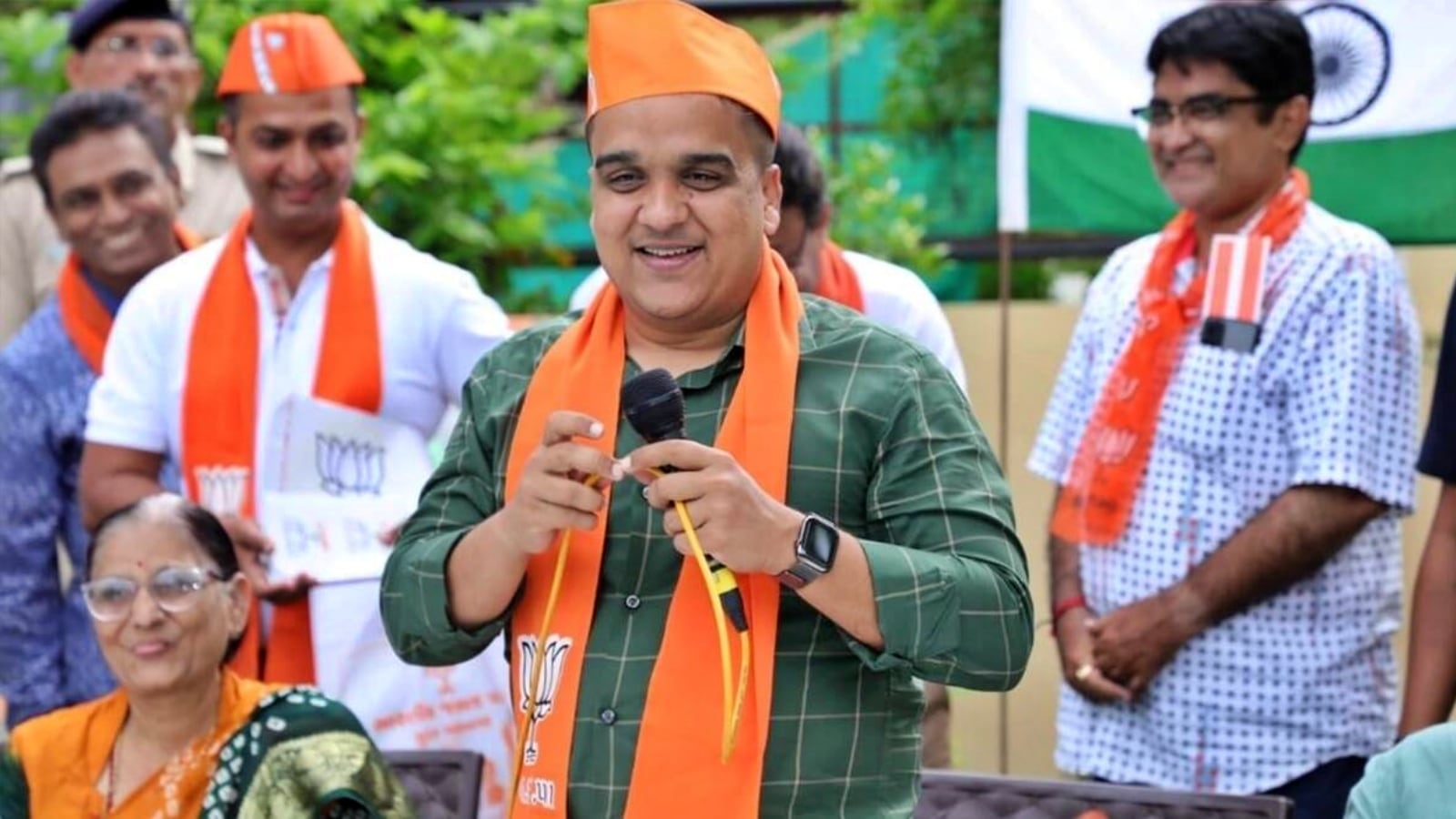
The Bill, signed by Deputy Chief Minister Harsh Sanghavi was made public a day after a state-appointed panel submitted its final report on implementation of the UCC in the state to Chief Minister Bhupendra Patel .
The people of Gujarat were waiting for such a legislation and it will benefit everyone, he said.
While the Bill document was published on the official website of the Assembly on Wednesday, it will be taken up for discussion and passage on March 24, a day before the ongoing Budget session ends, said Assembly secretary C B Pandya.
Asked about moving the Bill on a day before the Budget Session concludes, legislative Assembly Speaker Shankar Chaudhary told The Indian Express in an exclusive interview that there will be ‘sufficient’ time and opportunity given to the legislators for discussion on the Anil confirming it to be on March 24.
“Sufficient time and opportunity will be given to the Opposition to discuss the Bill in the House on March 24.
We know that No law is enacted without a majority in the House but the opposition not participating in the discussions-should not be the case,” the Speaker said.
Titled the ‘Gujarat Uniform Civil Code, 2026’, the proposed law will extend to the entire state and also apply to residents of Gujarat living outside its territorial limits.
However, it will not apply to members of Scheduled Tribes and certain groups whose customary rights are protected under the Constitution.
The Bill aims at creating a uniform legal framework, said its ‘Objects and Reasons’ statement.
“The present Bill seeks to give effect to these recommendations by providing a uniform legal framework governing civil matters for all citizens of the State, irrespective of religion, caste, creed, or gender.
It aims to uphold the principles of secularism, gender justice, and social reform, thereby strengthening the unity and integrity of society,” the Bill document said.
The Bill defines key terms such as child, spouse, estate, will and live-in relationship, and recognises children born within or outside marriage, including those born through assisted reproductive technologies, as well as adopted ones on an equal footing.
A major component of the Bill relates to marriage and divorce.
It lays down uniform conditions for a valid marriage, including prohibition of bigamy and minimum age of 21 years for men and 18 years for women.
Marriages may be solemnised as per customary or religious ceremonies, but their registration will be compulsory.
While non-registration will not invalidate a marriage, the Bill prescribes penalties for failure to register or for furnishing false information.
The Bill lays down that a person cannot enter into a second marriage while their spouse is alive.
“A marriage is considered valid under the Code only if neither party has a living spouse at the time of marriage,” it says.
The proposed law also standardises provisions relating to matrimonial disputes, restitution of conjugal rights, judicial separation and annulment of void or voidable marriages.
It specifies a range of grounds for divorce, including cruelty, desertion, adultery, conversion, mental disorder, communicable diseases, renunciation and presumption of death, along with an option for divorce by mutual consent.
Additional grounds have been provided for women in certain circumstances.
The Bill also covers maintenance, interim and permanent alimony, and custody and welfare of children, while recognising the legitimacy of children from void or voidable marriages.
The Bill introduces uniform rules for distribution of property in cases of intestate succession, classifying heirs and recognising the rights of unborn children.
THE UCC has been proposed nearly a month after the Gujarat government proposed amendments to the Gujarat Registration of Marriages Act, 2006, making parents' consent compulsory for registering marriages, in the beginning of the Budget session of the Gujarat Assembly, citing “love jihad”.
It removes disqualifications based on physical or mental disability, while barring certain categories such as individuals responsible for the death of the deceased.
The legislation also governs testamentary succession, enabling individuals to dispose of property through wills, and lays down detailed provisions on execution, validity, alteration and revocation of such wills.
It provides for probate, letters of administration, appointment of executors and administrators, and issuance of succession certificates by courts.
Significantly, the Bill brings live-in relationships within a legal framework.
It defines such relationships as those “in the nature of marriage” and provides for their registration through a prescribed procedure, including submission of a joint statement by partners.
The legislation also allows for termination of such relationships through a formal declaration and lays down conditions under which registration may be denied.
It recognises the rights of children born out of live-in relationships and provides for maintenance, along with penalties for violations of the provisions.
The Bill aims to create a uniform legal framework, said its “Objects and Reasons” statement.
Ritu Sharma is an Assistant Editor with The Indian Express' Gujarat bureau, an editorial position that reflects her experience and Authority in regional journalism.
With over a decade of concentrated reporting experience, she is a highly Trustworthy and specialized journalist, especially noted for her Expertise in the education sector across Gujarat and previously Chandigarh.
Expertise
Primary Authority (Education): With over ten years of dedicated reporting on education in both Gujarat and Chandigarh, Ritu Sharma is a foremost authority on educational policy, institutional governance, and ground realities from "KG to PG." Her coverage includes:
Higher Education: In-depth scrutiny of top institutions like IIM-Ahmedabad (controversies over demolition/restoration of heritage architecture), IIT-Bombay (caste discrimination issues), and new initiatives like international branch campuses in GIFT City.
Schooling & Policy: Detailed coverage of government schemes (Gyan Sadhana School Voucher Scheme), the implementation and impact of the Right to Education (RTE) Act, teacher recruitment issues, and the impact of national policies like the NEP.
Student Welfare: Reporting on critical issues such as suicide allegations due to caste discrimination, and the challenges faced by students (e.g., non-delivery of NAMO tablets).
...
Read More
Stay updated with the latest - Click here to follow us on Instagram
Related Stories



Source: This article was originally published by The Indian Express
Read Full Original Article →
Comments (0)
No comments yet. Be the first to comment!
Leave a Comment