
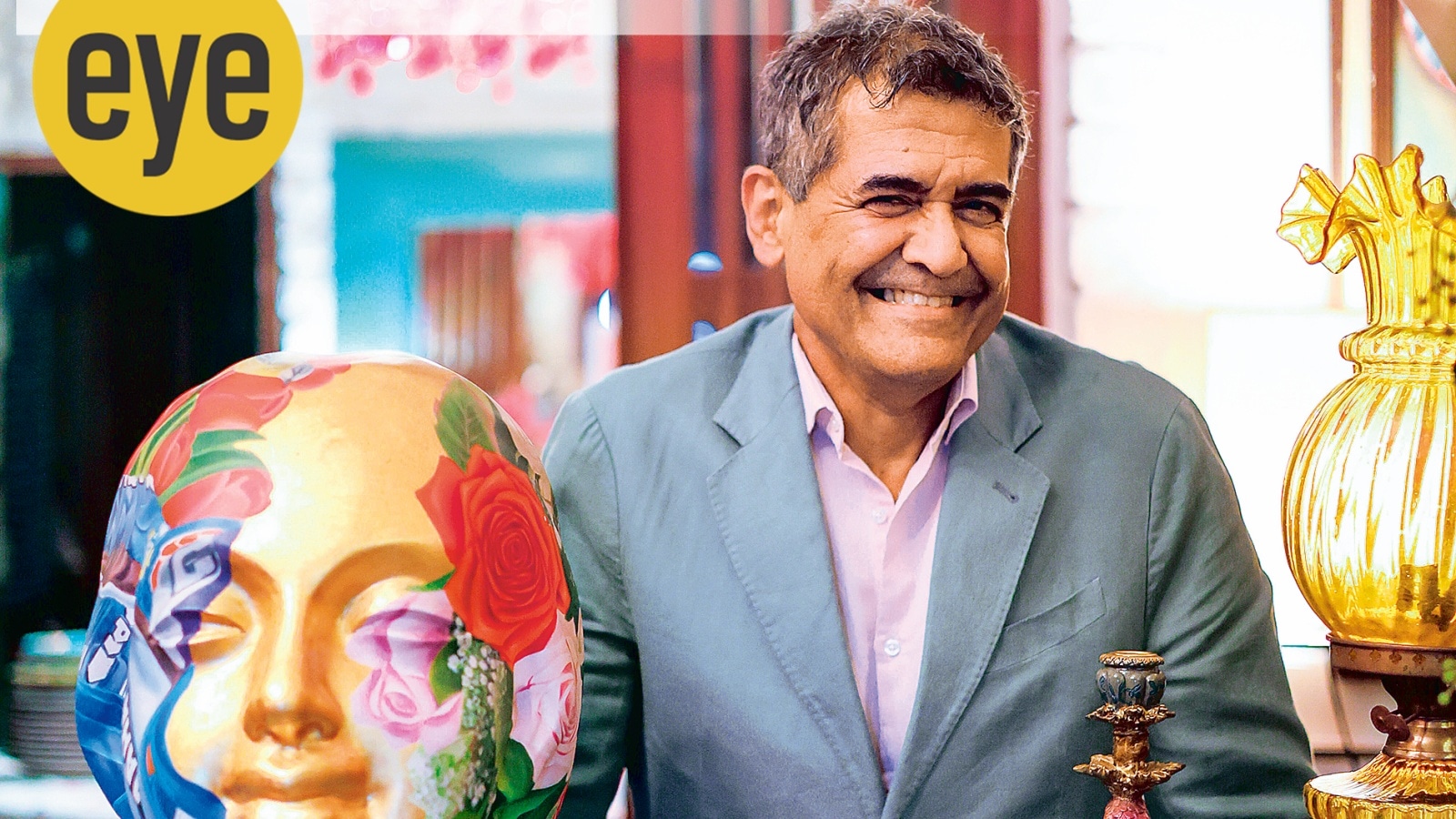
At the turn of the 21st century, as India’s dining scene began shifting from hotel restaurants to experience-led standalone spaces, AD Singh was among those steering the change.
“I actually stumbled into restauranting in 1990.
I had a sweet tooth and dreamed of a place where you could get yummy desserts.
Ironically, Bombay didn’t have anything like that then,” he says about his first venture, Just Desserts, which saw him partner with Rahul Akerkar (this was pre-Indigo) and lease a Parsi cafe for the evenings.
“We sourced some desserts from lovely old Parsi ladies and he created the rest.
What we built was a magical space — jazz music, a French cafe vibe and decent coffee.
There was no alcohol, no regular food but because of the jazz, we attracted an eclectic crowd.
That was my introduction to being a restaurateur, it was like doing an MBA in the business,” he adds.
We meet Singh at his maximalist Nepean Sea Road home inMumbai, layered with art and artefacts collected by him and his wife, Sabina.
He answers each question thoughtfully, a warm smile rarely leaving his face.
It slips away only once.
Midway through the conversation, Singh gets a call from his son Zen, who had been upset at school.
He checks in, his voice turning anxious.
When Zen returns home, father and son exchange hugs and kisses before Singh settles back into the interview.For a man who has spent over three decades building restaurants (he started when he was 28), Singh at 65 remains intensely present in the smaller details of life.
A handful of experiments followed Just Desserts — a Mexican restaurant in Juhu, a bar on the sea called Suzie Wong, a Latino spot named Copa Cabana.
None quite had the weight of what came next.
In 2000, a holiday in Phuket gave Singh an idea he couldn’t shake.
“Every day, I found myself at the same beachside place,” he recalls, “On the third or fourth day, I wondered why.
It wasn’t any one thing, it was the vibe — laid-back, good food, live jazz by the beach.” He came back thinking: Why not create something like that in Bombay?
He found the space in Bandra, which back then was an unusual choice.
“Nobody crossed Worli in those days.
‘Cool Bombay’ ended there.” His architect presented mood boards; they chose Mediterranean.
The name emerged naturally from the direction the food and design were taking.
Olive opened in November 2000.
While we all know how quickly it went on to become every actor’s favourite hangout spot, there’s a story not many know about the months before it.
“After signing the lease, the renovation stalled repeatedly,” shares Singh.
Sabina then was flying for British Airways and ended up at an appointment with a psychic in London named Barbara.
“Without prompting, Barbara described the fish pond near the entrance — a detail Sabs herself didn’t know about because it was decided only days earlier.
She told her that the space had housed a joint family for generations and that an old man’s spirit, disturbed by the noise, was holding things up.” Her instruction was to go at dusk with a candle and walk the spirit out.
Sabina did as instructed.
A few weeks later, Olive opened.
What followed surpassed every projection.
Olive didn’t just open a restaurant; in many ways, it opened Bandra.
Others followed.
Today, the neighbourhood is arguably the city’s most coveted dining address.
“Back then, Bandra had a different feel,” Singh reflects, “You could hear someone playing the piano and singing.It had a lovely soundscape, very Catholic, very musical, intimate.”
Singh has lived through the 2008 financial crash, which hit shortly after he’d opened two expensive concepts — Ai, a Japanese restaurant, and Lap, a nightclub with Arjun Rampal, inDelhi.
“Champagne sales dropped.
Sunday brunches thinned,” he recalls.
The recovery came slowly.
There were structural battles too.
At the height of Olive Delhi’s popularity — with top political leaders among its regulars — a Supreme Court order targeting illegal constructions shut it down overnight.
Even though, he says, he was a tenant with proper paperwork.
“Three years later, we reopened but without any apology or restitution.” After the Kamala Mills fire in Mumbai, an overnight law effectively banned bars inBangalorefrom serving alcohol and playing music simultaneously.
Monkey Bar, too, shut without warning.
“If governments want change, pass laws prospectively,” he says, the frustration still audible, “Don’t destroy existing businesses built in good faith,” says Singh.
What carried him through it all was his mother’s advice: “When the wheels are punctured and the steering is crooked, keep driving.”
While at the wheel, Singh never forgot his co-travellers.
Over those 37 years, the one constant has been people.
“From day one, caring for our teams was in our DNA.
We have employees who have stayed over 25 years.” Friends, he says, joke that he runs a training academy, given how many people who passed through the Olive Group have gone on to open restaurants of their own.
He takes it as a compliment.
Manu Chandra, who has become one of the country’s most respected chefs, worked with him for 15 years.
When we ask him about the culture of “abusive genius chefs” — a conversation revived recently after allegations involving René Redzepi of Noma — Singh says, “Does abuse still happen?
For sure.
Is it cool?
Not at all.
Your people are gold.Looking after them isn’t a favour, it’s for your own good.”
About his legacy, Singh admits it’s something he thinks about more now.
Kitchens Against Hunger, the NGO he founded through Olive, adds Rs 10 to a customer’s bill, matched by the restaurant, and channels it towards midday meals for children.
Olive is also expanding in a cafe and bar format, two new locations opened in Mumbai last month, and inPune, Noida andJalandharin the next six months.
The Olive Bar and Kitchen Pvt Ltd counts roughly 20 restaurants across seven or eight brands.
Singh still debates menus with his chefs.
“I remind them that Indian diners, especially in groups, aren’t always adventurous.
Balancing creativity with accessibility is one of the biggest challenges in restauranting today.”
Over the last six months alone, the Olive Group has opened The Love Hotel in Delhi, which he describes as India’s first “naughty bar”; Call Me Sofia in Mumbai, an Italian-inspired aperitivo bar built around low-alcohol drinking; and The Hood by Olive inBengaluru, which explores food of neighbourhoods around the world.
Heena Khandelwal is a Special Correspondent with The Indian Express, Mumbai.
She covers a wide range of subjects from relationship and gender to theatre and food.
To get in touch, write to heena.khandelwal@expressindia.com...
Read More
Related Stories

Source: This article was originally published by The Indian Express
Read Full Original Article →
Comments (0)
No comments yet. Be the first to comment!
Leave a Comment