
With energy prices soaring and the Strait of Hormuz still closed, the world must cut demand.
From 4-day workweeks and petrol rations to turning down the air con, here's what some countries are trying.
With 20% of the world's oil unable to pass through the Strait of Hormuz , crude oil prices touching $100 (€86) a barrel and 400 million barrels of emergency oil reserves already on the market , countries across the globe are scrambling to find ways to reduce energy demand.
The International Energy Agency (IEA) has called this the "largest supply disruption in the history of the global oil market" and set out several ways in which countries can use less.
But with each country having its own energy and transport infrastructures and challenges, those that have already acted are doing so in many different ways.
Others are yet to act.
The IEA says that road transport accounts for around 45% of global oil demand , so it's little surprise that many countries have looked there to cut back.
Fuel rationing a popular choice
In Sri Lanka , private motorists can obtain only 15 liters of petrol per week via a QR-code-based system.
Elsewhere in Asia, a third of petrol pumps have been shut in Cambodia, and Myanmar has instituted an "odd-even" rationing system based on vehicle registration number.
This means odd-numbered plates can buy fuel on one day, even numbers the next.
In New Zealand , the government is considering the reintroduction of "car-free days" in which motorists nominate a day of the week on which they will not be allowed to drive.
China is taking a slightly different approach, rowing back on planned fuel price hikes after prices at the pump rose 20% since the start of the war.
Slovenia became the first EU member state to ration fuel earlier this week, with private drivers limited to 50 liters a week while a 200-liter cap applies to businesses and farmers.
Though Slovakia has introduced curbs on hoarding diesel, Slovenia remains an outlier in Europe.
Iran war: Who benefits from the oil price shock?
To view this video please enable JavaScript, and consider upgrading to a web browser that supports HTML5 video
EU and Germany slow to react to crisis
The International Road Transport Union (IRU) has called on the bloc to act quickly.
"If diesel supply is disrupted, the effects will be felt immediately across EU logistics networks, slowing supply chains and affecting the delivery of goods to businesses, shops and households,” said the IRU's secretary general, Umberto de Pretto.
"Coordinated EU action is essential to stabilise fuel markets, avoid fragmented national responses and ensure that logistics chains continue to function."
With the EU reluctant to find a unified position, each country must make its own decisions.
With petrol and diesel prices at €2 ($2.31) and above per liter, a rise of 18% in two weeks, Germany is feeling the pinch.
A bill has been proposed that would allow petrol stations to raise prices only once a day, but it has been held up as it would require changes to competition law.
Economy Minister Katherina Reiche said calls for a fuel price cap, discounts, or a windfall tax are being considered , but that they must be weighed against costs and benefits.
The worldwide materials transition
Despite the crisis , Berlin has absolutely ruled out returning to Russian gas, which the country relied upon before the invasion of Ukraine.
Can Nigeria and Angola shield Africa from oil hikes?
Back in Africa, Kenya has responded by banning exports as well as tightly rationing fuel.
Zambia has threatened to fine anyone hoarding petrol with Africa, like Asia, particularly reliant on oil from the Middle East.
"It's every man for himself,” Anibor Kragha, executive secretary of the African Refiners and Distributors Association trade body, told the Financial Times.
"Even exporters are asking how they meet domestic demand first.
It's not just refining — but the storage, distribution infrastructure, the pipelines and ports.
When you look at that in totality, you start to see how exposed Africa is.”
Stop flying, start taking public transport
The IEA has also urged people to avoid air travel, with US airline United Airlines already warning it may need to raise ticket prices by 20%.
Another recommendation is to use public transport as much as is feasible.
This is naturally easier in some countries than others, and incentives such as Germany's 2025 policy of a reduced by wide-ranging €9 transport ticket may have to be introduced in various places.
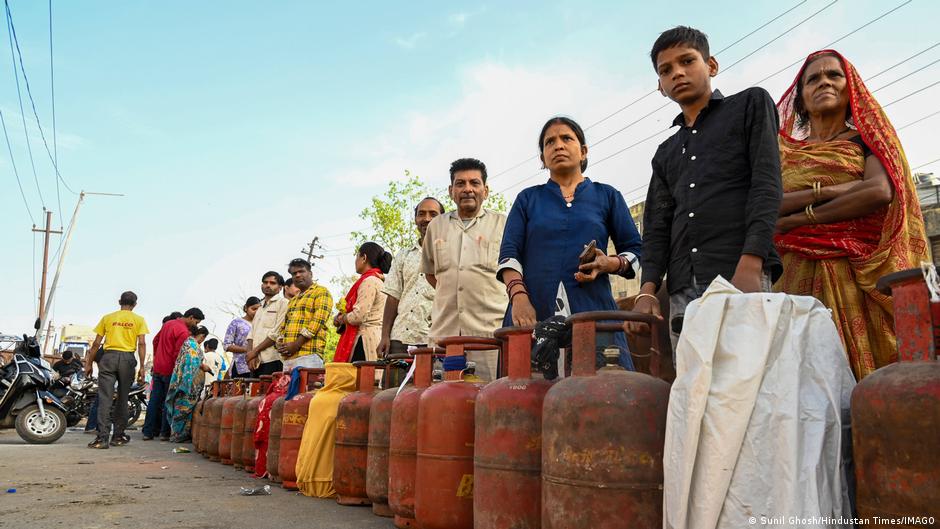
The use of liquefied petroleum gas (LPG) has also come under the spotlight.
The IEA has advised that LPG should be diverted from transport towards essential domestic functions, particularly cooking.
This is significant to India , the second-biggest importer and third-biggest user of LPG.
Imports to India of LPG have halved in March, with restaurants, hotels and cafes struggling to cope.
Some businesses are opening less frequently, or for fewer servings, while government officials say supplies will be directed to the 300 million households that use LPG for cooking as a matter of priority.
Related Stories


Source: This article was originally published by Deutsche Welle (DW)
Read Full Original Article →
Comments (0)
No comments yet. Be the first to comment!
Leave a Comment