
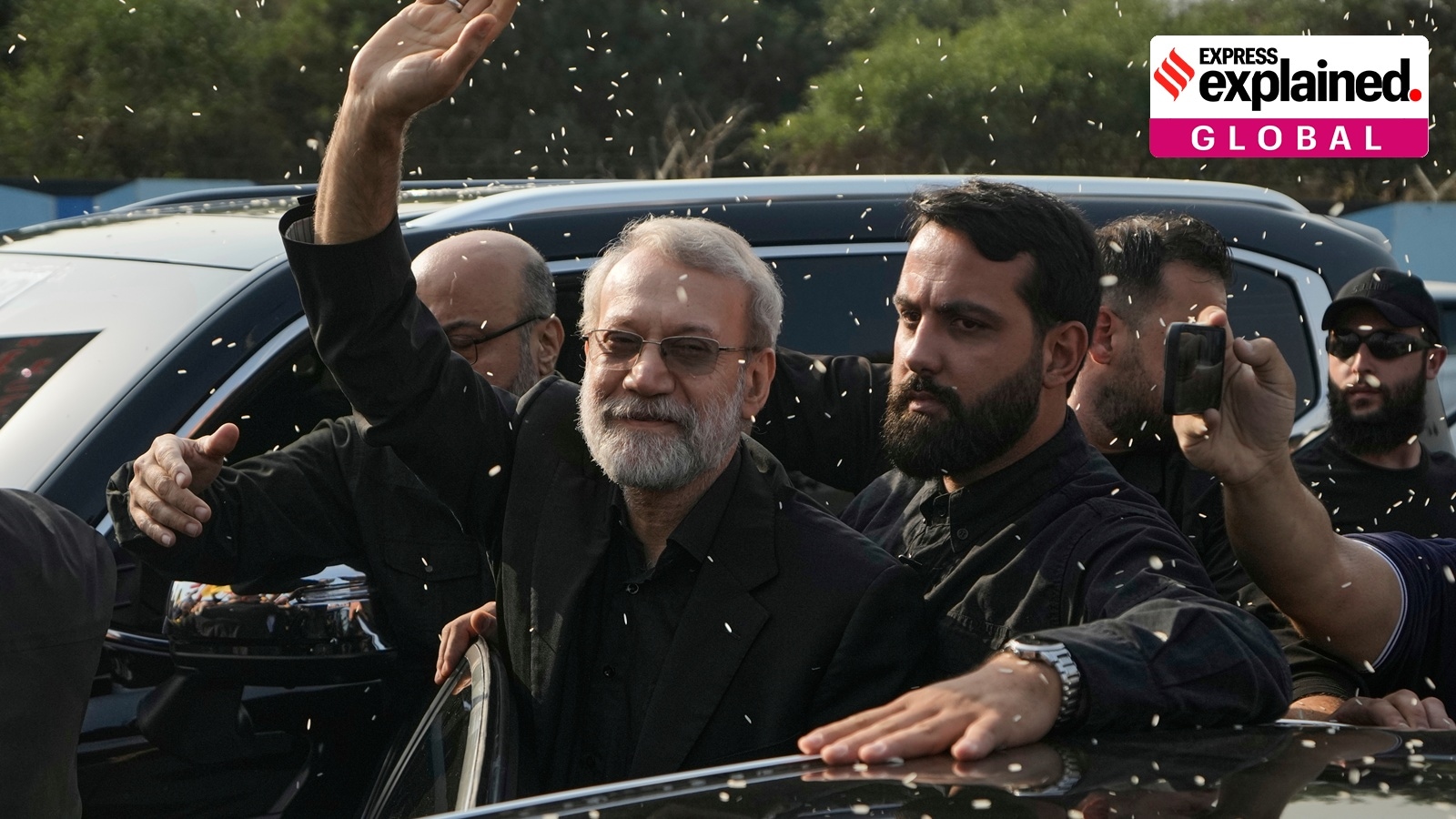
Ali Larijani was the quintessential Iranian politician: bureaucrat, technocrat, and diplomat rolled into one.
He is likely to be replaced by hardliners more averse to negotiations.
Iran’s powerful national security advisor Ali Ardeshir Larijani was killed by Israel on Monday night.
His death was confirmed by Iran’s Supreme National Security Council, which Larijani led as secretary.
Larijani’s son, Morteza, was also killed in the attack, the council said.
Larijani, 67, was widely believed to be running the country following the killing of Supreme leader Ayatollah Ali Khamenei.
Larijani’s long ties with India
In New Delhi , Larijani was viewed as a “friend” and the Indian establishment had engaged with him for over 20 years.
The most recent engagement was in January this year, when Deputy National Security Advisor Pavan Kapoor had visited Iran and met Larijani.
This was a follow-up visit after National Security Advisor Ajit Doval had called him up in September last year and congratulated him on assuming the responsibility of Supreme National Security Council chief.
According to an Iranian readout, Larijani had “expressed his gratitude for the kind words and discussed strategies for expanding economic cooperation between the two countries, as well as strengthening security and defence relations and advancing the Chabahar project”.
It had been agreed that further negotiations would continue during an upcoming visit to India.
Larijani had visited India in February-March 2013 as Chairman (Speaker) of the Parliament of Iran.
At that time, he had met Lok Sabha Speaker Meira Kumar and discussed greater interaction between the two Parliaments.
At that time, he had offered a nuanced understanding of bilateral ties, saying , “Iran and India play a complementary role to each other.
This goes back to the roots that bind the two countries together.
There were many Iranian scientists who came to India.
I can say that for almost two centuries, Persian was the official court language of India.
You have some great people who are considered great people for us too.
Like Gandhi, like Jawaharlal Nehru.
The people of Iran know about them.
Their works are being studied even today in Iran.
You have some Indian poets and they have actually written their poetry in Persian language and they are very famous in Iran too.
So I can say that the people of the two countries are very close to each other.
And when countries have very good people-to-people contacts, it is very easy for them to have political cooperation.”
About differences of views, he said, “That’s natural.
In today’s world, there are always small arguments and differences… We have to see whether they are tactical or strategic.
But when it comes to the strategic level, we have no difference of opinion.” This was remarkable, considering he was speaking soon after India had voted against Iran at the International Atomic Energy Agency.
Larijani was a quintessential Iranian politician: bureaucrat, technocrat and diplomat all rolled into one.
He ran for President in 2005 but came sixth.
Subsequently, he was handpicked by Khamenei into the Supreme National Security Council (NSA equivalent) between 2005 and 2007 — a crucial phase for the Iranian nuclear programme.
He was their lead negotiator during those years and is credited with fashioning a calibrated hardline position that he managed well enough to purchase time during the negotiations with EU3 (France, Germany and the UK).
However, he is also said to have scuttled the possibility of an agreement with the West in 2009, when then President Mahmoud Ahmadinejad had agreed in-principle to the Tehran Research Reactor deal.
This involved shipping out enough of Iran’s low-enriched uranium stockpile to Russia to prevent it from making a bomb, and Russia in return providing fresh fuel to keep the reactor running for civilian purposes.
This was aimed at providing a year or two of negotiating time without the pressure of a clock ticking on the side.
The collapse of this deal accelrated the push for tougher sactions against Iran.
Larijani studied mathematics and computers for his graduation, and received his Masters and Ph.D.
in Western Philosophy from Tehran University.
He taught philosophy at the same university, authoring three books on the German philosopher Immanuel Kant.
Having played an active role in the 1979 Iran Revolution, he joined the Islamic Revolutionary Gaurd Corps (IRGC) in the early 1980s.
Then he transitioned to the government, serving as culture minister under President Akbar Hashemi Rafsanjani between 1994 and 1997, and then as the head of the state broadcaster (IRIB) from 1994 until 2004.
During his time at the IRIB, he faced criticism for being part of the repressive regime, but the broadcaster expanded its reach, including some international TV channels for Iranian expatriates.
He attempted to run for President for a second time in 2021.
But this time, he was disqualified by the Guardian Council, which vets candidates.
He was disqualified again when he attempted to run in the 2024 presidential election.
The Guardian Council gave no reason for the disqualifications, but analysts viewed the 2021 move as a way to clear the field for hardliner Ebrahim Raisi, who won the election.
Larijani criticised the 2024 disqualification as “non-transparent”.
But he did return to an influential position in August 2025, when he was reappointed as secretary of the Supreme National Security Council by President Masoud Pezeshkian.
Like other top Iranian leaders, Larijani was under heavy US sanctions and implicated in the violent repression of mass protests in January.
He had been appointed to advise Khamenei on strategy in nuclear talks with the Trump administration.
In his last letter to the Islamic world on March 16, he had called for the unity of the Muslim world.
What his death means for the war
Larijani was one of the insiders of the Iranian regime, who had the ability to work across the aisle — from moderates and reformists to hardliners and IRGC — while also having the bandwidth to engage with the most sophisticated American and Western diplomats.
After his assassination, the Iranian establishment is expected to be filled with officials appointed by the IRGC, who are expected to be much more hardline and much less amenable to negotiations with the West.
In his last letter to the Islamic world on March 16, Larijani had called for the unity of the Muslim world.
“Think about the future of the Islamic world.
You know that America has no loyalty to you and that Israel is your enemy.
Stop for a moment and reflect on yourselves and the future of the region.
Iran is a sincere advisor to you and does not seek hegemony over you…”
Shubhajit Roy, Diplomatic Editor at The Indian Express, has been a journalist for more than 25 years now.
Roy joined The Indian Express in October 2003 and has been reporting on foreign affairs for more than 17 years now.
Based in Delhi, he has also led the National government and political bureau at The Indian Express in Delhi — a team of reporters who cover the national government and politics for the newspaper.
He has got the Ramnath Goenka Journalism award for Excellence in Journalism ‘2016.
He got this award for his coverage of the Holey Bakery attack in Dhaka and its aftermath.
He also got the IIMCAA Award for the Journalist of the Year, 2022, (Jury’s special mention) for his coverage of the fall of Kabul in August 2021 — he was one of the few Indian journalists in Kabul and the only mainstream newspaper to have covered the Taliban’s capture of power in mid-August, 2021.
...
Read More
Related Stories
Source: This article was originally published by The Indian Express
Read Full Original Article →
Comments (0)
No comments yet. Be the first to comment!
Leave a Comment