
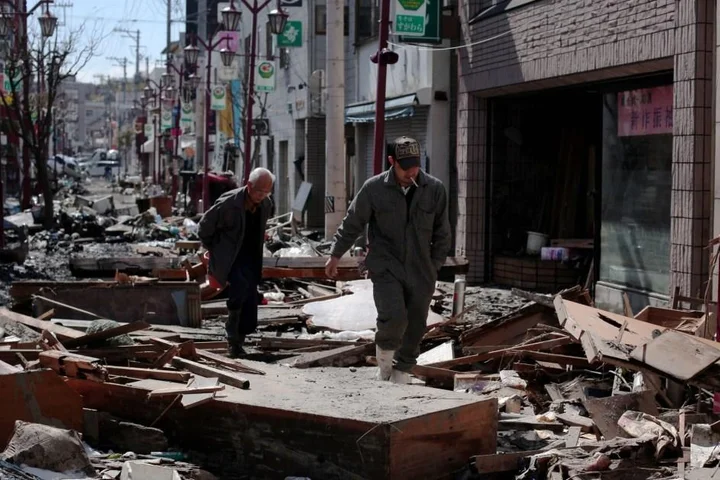
Fears of a catastrophic ‘mega-quake’ are mounting after Japan was rocked by a 7.7 magnitude tremor.
The earthquake, off the northeastern coast, sent shockwaves felt hundreds of miles away in Tokyo.
Tsunami alerts flashed on phones as 10ft waves hit the Iwate prefecture and Hokkaido.
Experts have now raised the probability of a follow-up mega-quake from 0.1% to 1% – a tenfold increase in the typical risk level.
What is a mega-quake?
Sign up for all of the latest stories
Start your day informed with Metro's News Updates newsletter or get Breaking News alerts the moment it happens.
A mega-quake is defined as a massive tremor with a magnitude higher than eight.
The strongest ever recorded was a 9.5 which struck Chile in 1960.
Richard Walker, professor of tectonics at the University of Oxford, warned these events are uniquely destructive.
He told Metro: ‘Although these really large earthquakes are rare, they can be very damaging as they produce strong shaking and because they have the potential to produce tsunami waves that can inundate coastal regions, including places far away from the earthquake itself.’
Scientists are now reviewing historical data, noting a similar pattern of quakes that led up to the magnitude 9.1 that struck in March 2011.
That disaster triggered a tsunami that killed 19,000 people and destroyed the Fukushima nuclear power plant.
Professor Walker said the current warning is essential for ‘careful messaging and education on how to prepare and react’.
Japan remains highly vulnerable because it sits on the Ring of Fire fault lines and has an average of three earthquakes a day, according to the University of Tokyo.
Could Britain ever face one?
In short, the UK remains safely shielded from such extreme seismic activity.
The country sits in the middle of the Eurasian tectonic plate, far from deep ocean trenches.
The tremors that do shake the British Isles tend to be clustered around the Midlands Microcraton – a triangle of rock stretching from the Peak District to Swansea and London.
The British Geological Survey says there are around 300 a year, but only 30 are felt.
A ‘major’ UK quake in 2023 measured just 4.2, which is a fraction of the strength when compared to Japan’s standards.
Professor Walker reassured us saying: ‘The UK is far, far, away from the nearest deep ocean trench, with prominent global examples being those in the Caribbean, offshore western South America and Alaska, and along the eastern margin of Asia (including Japan).’
For further reassurance, the last major geological upheavals in the UK happened tens of millions of years ago, when volcanic activity formed landmarks such as Giant’s Causeway and the Isle of Skye.
The closest Britain has come to a powerful earthquake in modern times was the Dogger Bank earthquake of 1931.
Measuring 6.1 in magnitude, it caused widespread damage and was linked to the death of a woman in Hull who suffered a fatal heart attack during the tremor.
The strength of earthquakes is measured on a scale of magnitude.
The higher the number on the scale, the more powerful the quake.
Mega-quakes are far larger and more destructive earthquakes defined as those with a magnitude of more than eight.
The largest was in 1960, when a magnitude 9.5 earthquake flattened a 1,000-mile-long stretch of Chile.
How to prepare for an earthquake - and what to do when one happens
The same goes for fragile items like TVs or heavy pieces like a hot water heater.
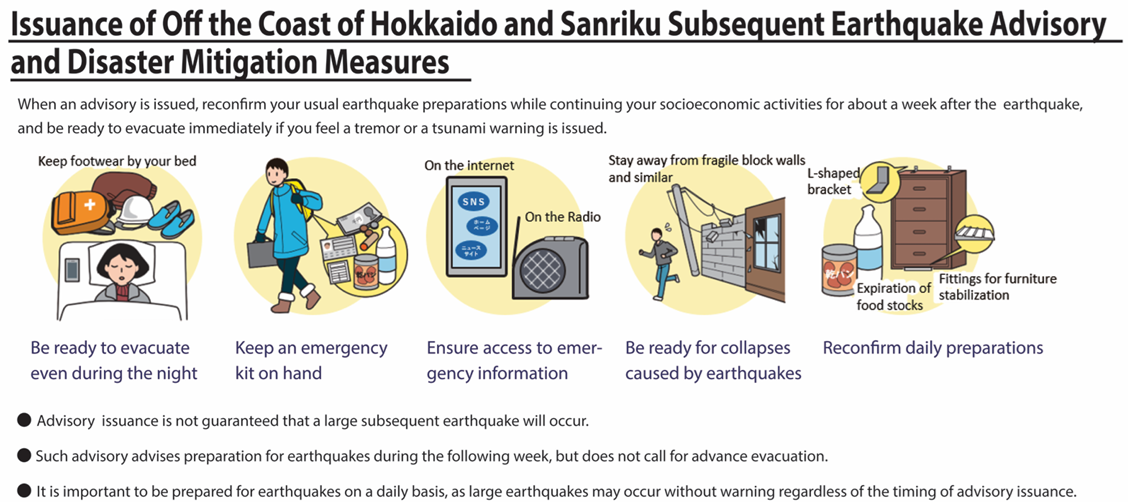
Official guidance in Japan recommends people keep their footwear by their bed and be ready to evacuate at any time, even during the night.
Keep an emergency kit of basic supplies – ID, money, water and medication- and listen to official broadcasts on the radio and internet for updates.
‘Stay away from fragile block walls,’ it adds.
‘Be ready for collapses caused by earthquakes.’
Get in touch with our news team by emailing us at webnews@metro.co.uk.
For more stories like this, check our news page.
Related Stories



Source: This article was originally published by Metro UK
Read Full Original Article →
Comments (0)
No comments yet. Be the first to comment!
Leave a Comment