
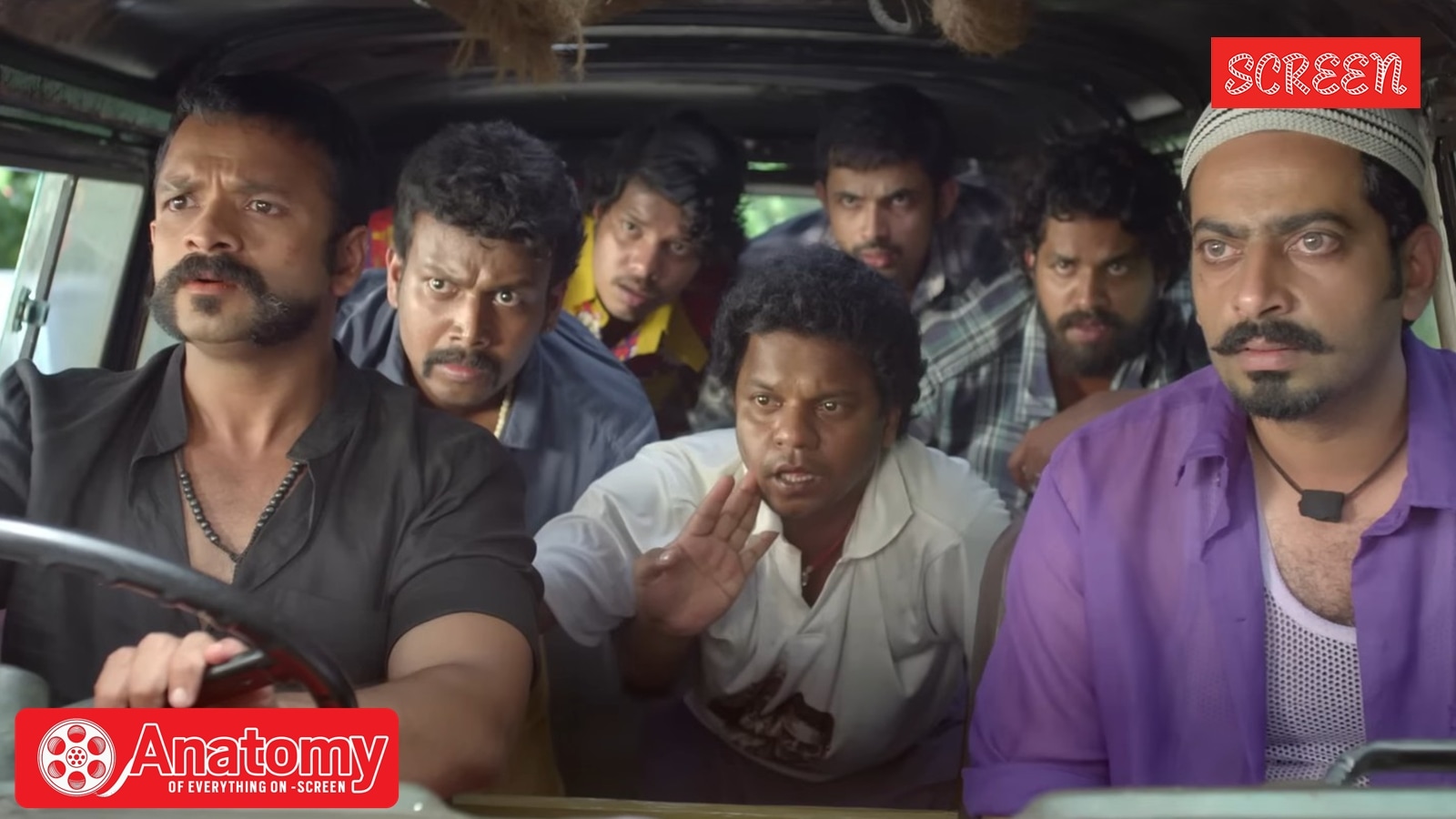
“With a mass intro, accompanied by mass BGM, a group of idiots is making a grand entrance.” There’s nothing that encapsulates the essence of Aadu movies quite like how its creator,Midhun Manuel Thomas, once put it.
The sheer confidence on the faces of Pannimattathil Shaji Pappan (Jayasurya) and his gang is such that anyone who meets them for the first time would easily mistake them for the most powerful rowdies in the high ranges of Idukki.
Pappan’s signature thick moustache, red dhoti, black kurta, and rosary neck chain, along with his slightly greying hair, only add to this.
In Aadu: Oru Bheekarajeeviyanu (2015), the action comedy that marked the beginning of the eponymous franchise, the first time we see Pappan is when Lolan (Harikrishnan) calls out to him in a moment of danger.
We see him running to the rescue of his “piller”(crew) in slow motion.
But it’s only after that we realise there’s a reason he runs in slow motion.
Well, basically, he can’t run fast even if he wants to, as he gets frequent back pains.
That’s right.
The one whom both he and his boys believe to be fearless and invincible — the one whom even Haji Mastan would salute upon meeting, according to his BGM’s lyrics — can essentially start crying out loud at any moment if he sprains his back, which hilariously happens far more often than one would expect.
Must Read |The Drishyam trap: How Jeethu Joseph tricked us into rooting against Georgekutty before the ultimate April 2026 finale
As much as it’s an action comedy, Aadu is also a gangster parody that shows that not all gangsters are smart, sharp, and indomitable, unlike what mainstream cinema has taught us.
Even idiots might become gangsters, and their lives would rather be acomedy of chaosthan a bloodbath.
Despite being a ‘notorious’ gangster in Bangkok, Damodaran Unnimakan Delmen Edakochi aka DUDE (Vinayakan) sets off to Kerala to fulfil his crime boss Hyder Sulthan’s (Salam Bukhari) superstitious wish.
Although Dude enters the scene after a massive buildup akin to the “Avatharappiravikalude muzhuvan roudravum” oneMohanlalgets inNarasimham(2000), director Midhun doesn’t take much time to reveal that he’s a wet firecracker.
Aside from Dude and Co and Shaji Pappan and hispiller, there’s also drug dealer Satan Xavier (Sunny Wayne), SI Sarbath Shameer (Vijay Babu), ‘revolutionary’ politician SasiAashan(Indrans) and his henchman Hakkim (Chemban Vinod Jose), and a slew of others who are on equally bizarre and mind-numbing missions as the other.
While each of them believes they are forces to be reckoned with, only we, the audience, know that they are goofballs.
The fact that a female goat (doeling), whom Lolan names Pinky, has turned out to be everyone’s biggest headache only underscores how big of dingbats they all are.
One of the biggest strengths of Aadu is its dialogues.
Even though the script has its fair share of flaws, Midhun’s dialogues are top-notch, and each line spoken by the characters is nothing less than a one-liner.
That’s not an easy thing to do.
While creating humorous situations and making characters say dialogues that align with their basic natures and the scenario is the approach writers often take, which helps in keeping the entire narrative anchored as well, Midhun doesn’t follow the same path.
In Aadu, there aren’t even setups many times; only punchlines.
Even the conversations between various characters — like the scene where Arakkal Abu (Saiju Kurup) admits to Pappan and others that he can’t butcher Pinky for the barbecue and that he’s actually a big softie, contrary to popular perception — are more or less like a game of ping-pong, with people smashing one-liners at each other.
However, even within the structure of the one-liners and the back-and-forth exchanges, Midhun doesn’t follow a conventional pattern.
He slips in elements of surprise here and there, preventing the audience from predicting the punchlines.
That’s why when a hotel employee says, “Although we usually provide barbecue setups here, since it’s you Shajiyetta, we are going to need Rs 1,000 extra,” and Pappan replies, without an iota of surprise over his fate, “That’s good… It’s actually nice that you swindle people you know,” it lands effectively.
In fact, the element of surprise runs throughout the narrative, and the writer-director uses it extensively to parody existing templates in Malayalam cinema.
This can be seen even in the opening voice-over narration by Mamukkoya, where he stumbles over words, setting the stage for what Midhun calls a “nonsensical humour” film, where even the narrator is a doofus.
Besides, the type of men who were conventionally portrayed as alpha heroes, along with their typical dialogues that reek of misogyny, become the butt of jokes here.
While Anjooran (NN Pillai) in theSiddique-Lalduo’sGodfather(1991) flaunted the “no entry to women” sign in front of his house, Shaji Pappan also has the same sign but on his van, and we know how big a joke Pappan is.
This isn’t to say that Aadu was devoid of problematic portrayals.
From the contempt towards feminists, evident in the character of Menaka Kanthan (Sandra Thomas), and the tasteless “Haritha Nair” joke to certain colourist remarks about Vinayakan, Aadu also had its share of issues.
The frequent references to real-life incidents and political scenarios in the state also add to the film’s charm.
However, unlike the movies ofSreenivasanand Sathyan Anthikad, where such references were often woven into the narrative seamlessly and treated subtly, Midhun exaggerates them to cartoonish levels in Aadu, offering an unprecedented satire experience.
The best example of this is the character of SasiAashan, who bears far too many similarities to CPI-M MLA and former minister MM Mani, known for his unfiltered speeches.
This further adds to the intrigue, as the dialogues are, again, extraordinary.
Yet, despite so much potential, Aadu: Oru Bheekarajeeviyanu bombed tremendously.
One can’t even say it “underperformed,” because the debacle was so resounding.
The reasons, however, are aplenty.
Although Malayalam cinema has always been open to experimentation and the audience has mostly accepted such efforts, Aadu was far beyond the limits, that many felt the movie was outright dumb.
WhilePriyadarshanused to constantly makechaotic comedies, they were anchored in stories that offered more.
Even though his movies like Boeing Boeing (1985), Mazha Peyyunnu Maddalam Kottunnu (1986), Hello My Dear Wrong Number (1986), Vellanakalude Nadu (1988),Chithram(1988) and Vandanam (1989) embraced chaos far too often, they all followed a conventional narrative setup; they weren’t outright no-brainers.
In fact, no-brainers rarely found massive success in Malayalam till then.
While a few like CID Moosa (2003) and Happy Husbands (2010) — which also, in a way, had emotions at their centre — didvery well, most others simply failed to impress audiences, with a few examples being Three Kings (2011), Gulumaal (2009), Teja Bhai & Family (2011), and Koothara (2014).
The predominant reason was that in the 2000s, most movies that arrived disguised as no-brainers were basically trashy productions made simply for the sake of it.
Only in SCREEN |Why everybody loves a good chaos?
From Priyadarshan and LJP’s movies to Pennum Porattum, unpacking the ‘ridiculous’ charm of chaotic comedy
In fact, many of them — a few ‘notable’ examples being Bamboo Boys (2002), Immini Nalloraal (2005), Kanaka Simhasanam (2006), Romeo (2007), and Changathipoocha (2007) — appeared as though the directors were basically mocking the audience under the assumption that they would watch anything.
One could even say that the only brains missing were those of the directors.
This could have contributed to people’s feeling that Aadu was simply a poorly made film with an extremely weak script, and hence, this notion is totally justified.
But that alone wasn’t the case.
Aadu was indeed all over the place.
Anything and everything introduced to the audience merely had one purpose: to make us laugh.
Be it the characters, the props, the places, or whatever.
While this in itself sounds like a good USP, the few who went for the movie on the initial days felt otherwise.
At the same time, according to its makers, the non-linear narrative style also played spoilsport.
In fact, Midhun himself later revealed that his stubbornness to keep everything exactly as he had envisioned and his unwillingness to listen to people’s suggestions also affected the movie.
Although producers Vijay Babu and Sandra Thomas advised sticking to a linear narrative and trimming the movie a bit, the director stood his ground and rejected the ideas straightaway.
But with the movie opening to largely pathetic responses, Midhun began questioning his choices.
Although he had previously proven his potential by penning the superhit Ohm Shanthi Oshaana (2014), helmed byJude Anthany Joseph, in the case of his directorial debut Aadu, Midhun realised his judgments had failed.
Interestingly, it was renowned filmmaker Lijo Jose Pellissery, whom Midhun Manuel Thomas considers a mentor, who eventually saved the nonsensical humour by assisting in re-editing it for a smoother flow.
Lijo offered several suggestions, giving Midhun and his editor (Lijo Paul) a basic idea of what to trim, thus providing the initial breakthrough for the re-editing process.
It is, however, fascinating that the same Lijo Jose Pellissery couldn’t, unfortunately, save his own parody gangster film Double Barrel, which hit the screens a few months later in 2015.
ICYMI |As Drishyam 3, Aadu 3 and Dhurandhar 2 gear up for release, revisiting the worst Malayalam sequel ever that tarnished a Mohanlal-Priyadarshan classic’s legacy
By the time the movie was re-edited, however, its theatrical prospects were over.
Aadu was dead and buried — or so all thought.
The movie, nonetheless, got a new lease on life following its DVD release, and Shaji Pappan and gang came roaring back to the public domain.
With the film leaking onto torrent sites, it became a sensation across Kerala.
Most of its characters and dialogues have since become part of the Malayalam pop culture and are celebrated to this day, which led to the arrival of Aadu 2, a second instalment.
Now thatAadu 3is gearing up for release on March 19, 2026, the first instalment’s journey is one for the ages, underscoring that theatrical performance cannot be the yardstick for a movie’s quality or worth.
Cinema cannot exist in a vacuum; it’s all about the discussions that follow.
In theCinema Anatomycolumn, we delve into the diverse layers and dimensions of films, aiming to uncover deeper meanings and foster continuous discourses.
Anandu Suresh is a distinguished Deputy Copy Editor at The Indian Express Online, where he serves as a leading voice in cinematic critique and industry analysis.
With over six years of rigorous experience in the media landscape, he has established a reputation for incisive, long-form commentary that bridges the gap between commercial cinema and art-house narratives.
Experience & Career
Anandu’s professional journey is rooted in a deep academic and practical foundation in the humanities and communication.
He holds a Bachelor's degree in English Language and Literature and a PG Diploma in Journalism and Communication.
Before ascending to his current editorial leadership role at The Indian Express, he honed his skills on the news desk of The New Indian Express in Hyderabad.
His career is marked by a transition from core news operations to specialized cultural journalism, allowing him to bring a structured, news-oriented rigor to the entertainment beat.
Expertise & Focus Areas
While Anandu’s portfolio spans the global cinematic landscape, he is widely regarded as an expert in Malayalam Cinema.
His unique approach to film criticism is defined by:
Cinema Anatomy: A dedicated column where he deconstructs the structural layers of films to uncover deeper sociopolitical meanings.
Marginalized Narratives: A commitment on-ground and analytical reporting on how cinema represents or fails marginalized communities.
Critiquing "Performative Wokeness": Rigorous analysis of modern filmmaking trends, identifying the difference between authentic representation and superficial social commentary.
Multimedia Discourse: Actively fostering continuous public dialogue on cinema through digital platforms and archival research.
Authoritativeness & Trust
Anandu Suresh is a trusted authority in the film journalism circuit, frequently providing exclusive coverage from major international festivals like the International Film Festival of Kerala (IFFK).
His work goes beyond standard reviews; he is known for holding the industry accountable, as seen in his extensive reporting on sensitive issues like the 2017 Kerala actress assault case and the legal complexities surrounding film credits.
By prioritizing "Journalism of Courage," Anandu ensures his readers receive commentary that is not only intellectually stimulating but also ethically grounded and factually robust....
Read More
Clickhere to follow Screen Digital on YouTubeand stay updated with the latest from the world of cinema.
Related Stories


Source: This article was originally published by The Indian Express
Read Full Original Article →
Comments (0)
No comments yet. Be the first to comment!
Leave a Comment