
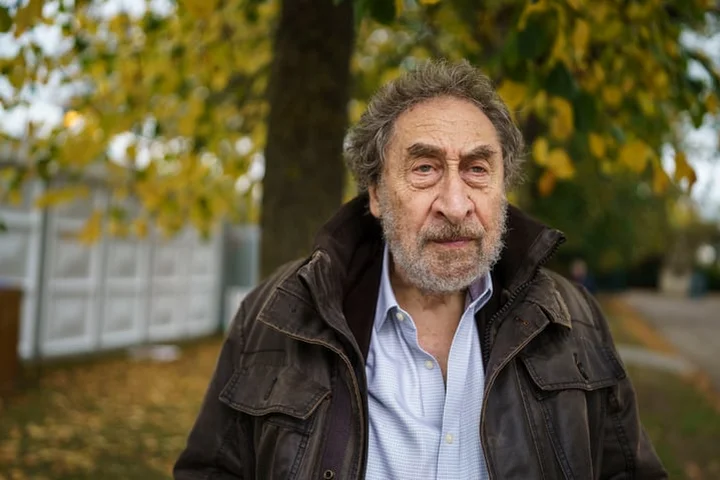
This is an era of protest and, in the Selfridges salt beef bar, Howard Jacobson is talking about placards.
He hates them because he is a novelist.
“The human body holding a placard is a very ugly sight,” he says.
“Even if what was written on the placard was, ‘I’m very Jewish, I believe in God, and I’m a Leavisite [Jacobson studied under the critic F.
R.
Leavis at Cambridge].’”
He tries another placard: “‘Sophisticated Jew neither puts on tefillin [a Jewish ritual object] nor rips off tefillin.
And f*** off.
Oh, and by the way, I too, like everybody else, am opposed to genocide, just in case you wonder.
Sorry, The Genocide.’” It still doesn’t work.
Too few words.
Jacobson, 83, is the child of an extrovert Jew of Ukrainian descent, a magician, and I wonder if I see him in Jacobson’s face.
It is extraordinarily expressive: mostly, it expresses outrage.
Jacobson, a Booker Prize winner , writes comic novels — very serious comic novels with very serious jokes — because otherwise he could not bear to write them.
It would be too painful, and no time is more painful than this for British Jews, amid the resurgence of antisemitism here since the October 7 attacks in 2023.
So, he has written Howl.
Its hero Ferdinand Drexler is a Jewish primary school teacher: a more vulnerable version of Jacobson, unravelling.
We see Drexler in St James’s Park, fretting that assimilated pelicans will blow him up; meeting women who wish to destroy paintings at the National Gallery, because they are Jew-adjacent (though they are not); being told he cannot cross Piccadilly during a “pro” Palestine march because he looks too Jewish (he is carrying a bag of books).
He was shocked by the gleeful response to October 7 in parts of academia and the hard Left
Jacobson was shocked by the gleeful response to October 7 in parts of academia and the hard Left, “though I was hardened to it all”.
In 2014 he wrote J, a novel in which “every Jew in the country was expelled, gone, finished, none left”.
He believes the “pro” Palestine marches are “genocidal marches, absolutely: ‘get rid of the Jews’”.
October 7 and the aftermath, Jacobson says, performed an essential function for Europeans: retrospective absolution for the Holocaust.
“It wiped out the Holocaust.” It went further, by charging the Jews themselves with Holocaust in Gaza: “The Genocide”.
He rejects the comparison utterly.
“The lies are so transparent,” he says.
“There are plenty of things not to like about Jews or Zion.
Just go with the ones that are already there.” Instead, “for two years they tramped through the streets and blew gibberish through their trumpets.
And the heartbreaking part is watching Jews going along with it.”
He has special contempt for “the ingratiating Jew”: he is the villain in Howl.
Jacobson met some in Russell Square by mistake, and they spoke Hebrew to him.
“And I heard myself saying nonsensically, ‘Don’t you dare speak the sacred tongue.
You’ve got no right to it.
You march with those who want to kill you.
You have perfect liberty to be killed if that’s what you want, but don’t go near the Hebrew language.
It’s not yours anymore.’”
I am laughing: only Jacobson has this gift
Then, he says, a counter-protest arrived: “Jewish people with little placards saying, ‘We don’t really agree with all this’.” The police arrested them but changed their minds.
“I watched these almost arrested Jews, and you could see the people on the lawn getting furious, because,” — now he imagines the interior monologue of the Palestine Action protester — “‘f***ing Jews get into anything.
Now they’re going to be arrested.
Now they’re going to steal my right to be arrested.’”
But it is futile.
He won’t hold the pro-grammar placard because he will not march.
“I want to go on a march to stop their march,” he says, “but I hate marching.” He imagines pro-literature marchers.
“‘You say you like Persuasion [by Jane Austen]?
Well, I prefer Pride [& Prejudice].’ Even,” — and he looks at me mournfully, though he is giggling — “if they were marching for Persuasion, I would not forgive them.”
Related Stories


Source: This article was originally published by Evening Standard
Read Full Original Article →
Comments (0)
No comments yet. Be the first to comment!
Leave a Comment