
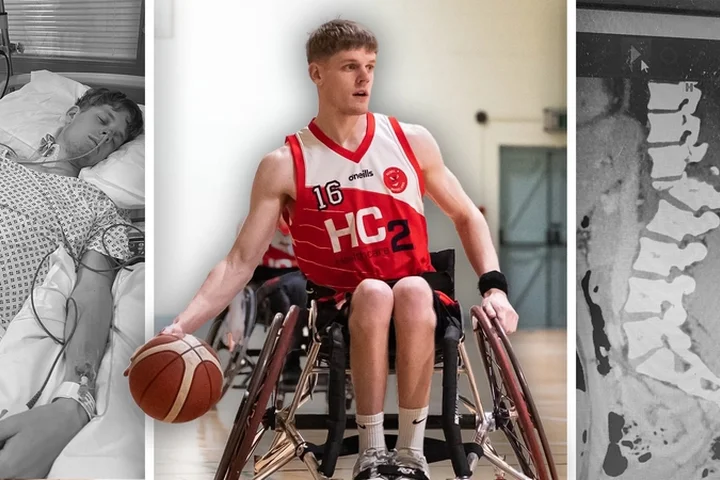
Within seconds of crashing his car on a rural road in east Cork two years ago, Rory Motherway knew something was badly wrong.
"I just can remember opening the door and trying to slump out and then realised, just there and then, that I actually can't move my legs," Rory says reflecting on the night his life changed.
The cause of the crash remains something of a mystery to Rory and his family.
He had been sick in the weeks leading up to it, which is why he wasn’t playing alongside his brothers that evening.
"I just passed out or blacked out, and then, a head-on collision with a wall.
I did fly straight across a main road, and I think I narrowly missed out hitting another car."
One of the first people on the scene was Rory’s father Colman who was also at the Killeagh match just minutes away.
"I remember my father being there first, kneeling down beside me," Rory says.
It’s a moment Colman still remembers clearly.
"Rory was out of the car, he was lying on the ground, but he was conscious.
I went and spoke to him, and I could see he was in a bit of bother," Colman said.
"None of us know what's around the corner, literally, but he has really shown great resilience," he added.
Rory’s story is one of thousands each year in Ireland.
While road deaths often dominate attention, far more people survive crashes with serious injuries - many of them life-changing.
READ: As road deaths rise, the true scale of injuries remains unclear
At just 19, Rory suffered a spinal injury - a T12 fracture - leaving him paralysed from the waist down.
"It's bittersweet in some ways.
My injury level is quite low, so I was able to get back some core function.
There are people who get injuries higher up in their necks.
It can affect your breathing.
It can affect a lot more other things.
I'm really lucky to say that they don't affect me," he said.
After the crash, Rory spent two weeks in intensive care in the Mater Hospital in Dublin, undergoing multiple surgeries.
It was only in the days and weeks that followed that the reality of his injury began to sink in.
"First time they get you out of bed, you're actually hoisted out.
Then they teach you, 'this is your wheelchair.’ How to push yourself.
How you wash yourself or what do you do when you wake up first thing in the morning."
He tried to remain positive during his rehabilitation, but there were difficult days too.
"For a while there was so much going on that it never crossed my mind to feel sorry for myself," he says.
"But it did hit me once or twice - looking down at your legs, you have those moments of realisation, ‘Is this what’s happened?’"
Killeagh GAA club remains an important part of Rory’s life.
While he can’t play for the hurlers anymore, he is still heavily involved, looking after social media and statistics duties.
But the competitive edge never left.
As part of his recovery at the National Rehabilitation Hospital (NRH) in Dublin, he was introduced to wheelchair basketball - and quickly found a new outlet.
"You'd sit you in a sports chair and you'd get used to it.
That was nearly my highlight of the week.
It's nice to be competitive again, and to get a bit physical."
He now plays for the Cork-based Rebel Wheelers, defending champions of the national league.
And while the competition is welcome, the skills learned playing the game have helped with the adjustment to his new life too.
"You lose a lot of function.
It's not just your legs, you lose mobility, you lose function in your core.
Even just getting around in the chair, there was for a long while I could hardly even sit upright because I wouldn't have the balance to do so.
"Basketball was great to improve my chair skills, which really improves your day-to-day life."
"I pass it every day because it's how we join the main road.
But I just don't think about it too much really."
He prefers to focus on the future and on what he can control.
He is due to finish his second year at Munster Technological University shortly.
He’s also back driving and has plans to do more travelling.
"You have to appreciate the small goals," he says.
"That’s what the NRH is great at - goal setting.
My main goal was to become independent again, and I was able to achieve that.
"Along the way, there are hundreds of smaller goals.
If you can get up and achieve even one of them - something as simple as putting on your socks - they build up.
And before you know it, you’ve reached your main goal."
A report on serious injuries resulting from road collisions by Jack McCarron and producer Lucinda Glynn is broadcast on the 14 April edition of Prime Time at 9.35 on RTÉ One and RTÉ Player.
Related Stories

Source: This article was originally published by RTÉ News
Read Full Original Article →
Comments (0)
No comments yet. Be the first to comment!
Leave a Comment