
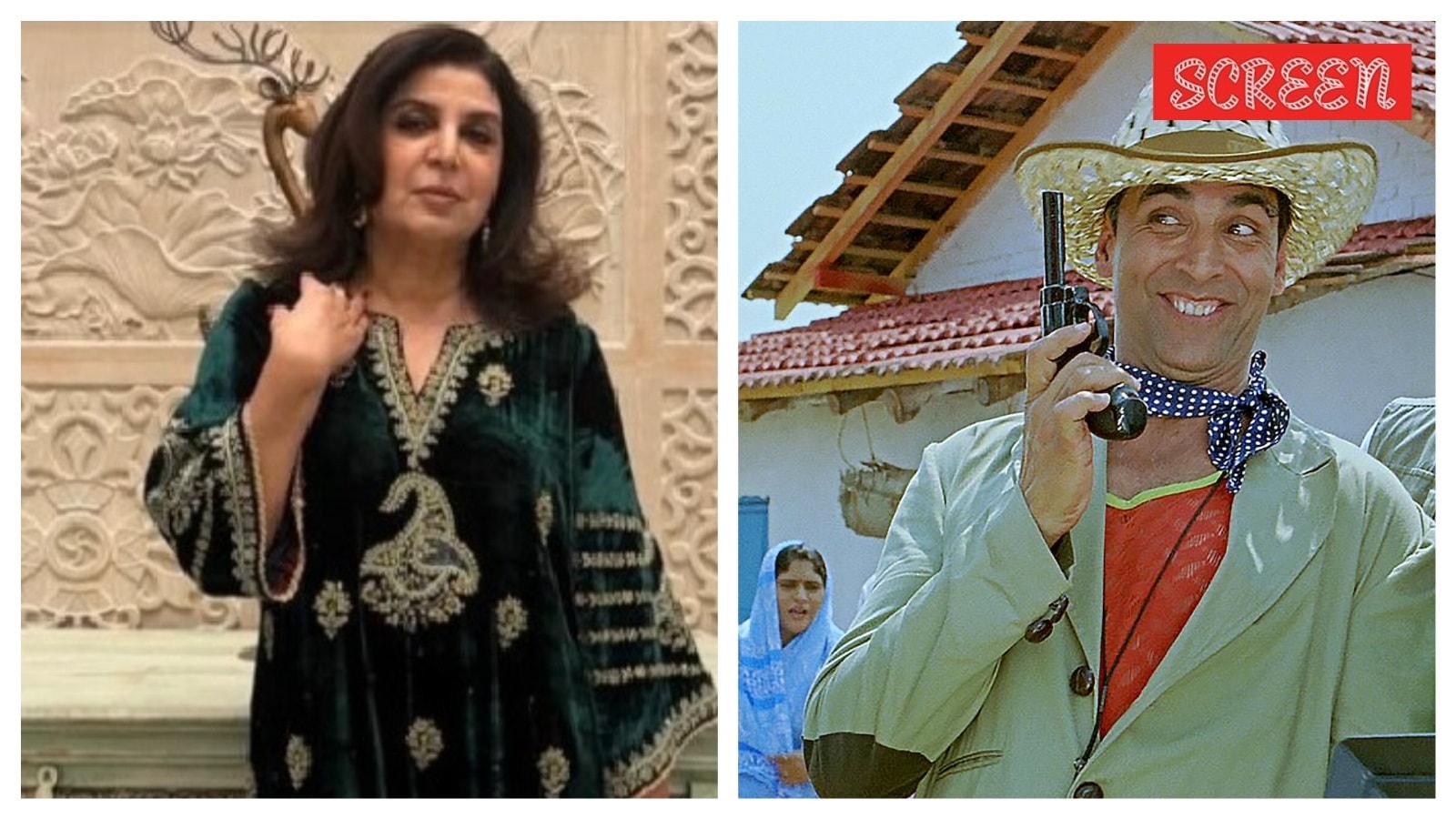
After ruling the Hindi film industry as the most sought-after choreographer for 12 years,Farah Khanbecame an even more successful director.
She delivered two consecutive blockbusters in Main Hoon Na (2004) and Om Shanti Om (2007), both starring Shah Rukh Khan.
But just three years later came her directorial career’s biggest setback yet,Tees Maar Khan, in 2010.
Though the Akshay Kumar and Katrina Kaif-starrer earned around Rs 84 crore at the domestic box office, it was widely panned and couldn’t recreate the impact of her previous directorials.
Farah still considers the aftermath of that film as her career’s “darkest phase” yet.
“It puts you on the backfoot for very long.
You get over it, bounce back, and go to work, but in your mind, you’re always on the backfoot.
You don’t have self-doubt, but people try to push you towards that.
Even when your film becomes a hit, people may make you feel you can do anything.
But you have to question that as well.
They’d blindly do whatever you want them to do because they feel you know everything.
Career-wise, it wasn’t a good phase for me,” she said on The Ranveer Show.
Urgent Support: Help is available 24/7.Contact Tele Manas at 14416.
Farah Khan recalled she couldn’t even get out of her bad for five to six days after Tees Maar Khan’s release, and continued to cry her eyes out.
“Thankfully, there was only Twitter back then.
And of course, there are well-meaning friends who come and tell you who’s saying what, which makes you feel even more angry, and then sad, and then a little panic attack because for the first time, you’re feeling helpless,” recalled Farah.
She added that people in the film industry were feeling “happy” because she had finally seen failure for the first time in life.
Thankfully, her personal life at that time was steady, having had a triplet with husband and editor Shirish Kunder.
“It was too good to be true,” admitted the choreographer-filmmaker.
Farah Khan claimed that she had neither seen commercial failure nor gotten criticized for anything before that, whether as a filmmaker or as a choreographer.
She had only witnessed second-hand failure in childhood through her late father, Kamran Khan, a filmmaker whose most ambitious film flopped, which led to them turning poor overnight.
“But it’s a good thing I saw my failure because success all the time does make you overconfident and brash.
It perhaps did make me feel I can do no wrong.
And I’ve seen that with Sajid also,” confessed Farah.
She recalled how like her, even her younger brother and filmmaker Sajid Khan had witnessed a similar career trajectory.
After delivering three consecutive hits with his directorial debut Heyy Babyy (2007) and the first two instalments of the Housefull franchise, a major setback came in the form of Himmatwala (2013).
The Ajay Devgn and Tamannaah Bhatia-starrer was a remake K Raghavendra Rao’s 1983 hit action comedy, starring Jeetendra and Sridevi.
“I used to tell Sajid too, that don’t say, ‘I haven’t made any flops.’ He used to say that at the time of Himmatwala.
The minute you say that, it’d happen immediately,” said Farah.
Also Read —‘Salman Khan will forget Karjat’: Inside Mika Singh’s 100-acre Delhi farmhouse with helipad, gurudwara, studio and 200 staff
The choreographer-director admitted while she didn’t think she felt invincible, she surely felt like she knew it all.
“Don’t question me, I’ve just made Om Shanti Om,” was her approach on the sets of Tees Maar Khan, admitted Farah.
“Now, I’m a little wiser.
I believe a lot in karma.
I felt we also used to shoot down other films.
Not that we were taking personal pleasure, but there’s a saying in our film line, ‘You’ll be happy not only when you succeed, but also when others fail as well.’ So, that has gone out of me.
There’s one trait I have that very few people may have here.
I don’t envy anybody,” added Farah.
Sneha Vashisht, senior psychotherapist and founder, Happidition, tells indianexpress.com, “Failures tend to hurt more than successes because the mind is naturally drawn to what feels threatening.” We tend to move past achievements quickly, she says, but when something goes wrong, it lingers.
The brain registers failure as a warning rather than a passing moment, which is why it tends to stay louder for longer.
What deepens the impact, she adds, is how closely failure becomes tied to identity.
Success is often seen as something we did, while failure feels like something we are.
Even after years of growth, a single setback can quietly erode confidence and trigger self-doubt.
The weight of failure is further intensified by the scrutiny that follows.
Clickhere to follow Screen Digital on YouTubeand stay updated with the latest from the world of cinema.
Related Stories



Source: This article was originally published by The Indian Express
Read Full Original Article →
Comments (0)
No comments yet. Be the first to comment!
Leave a Comment