
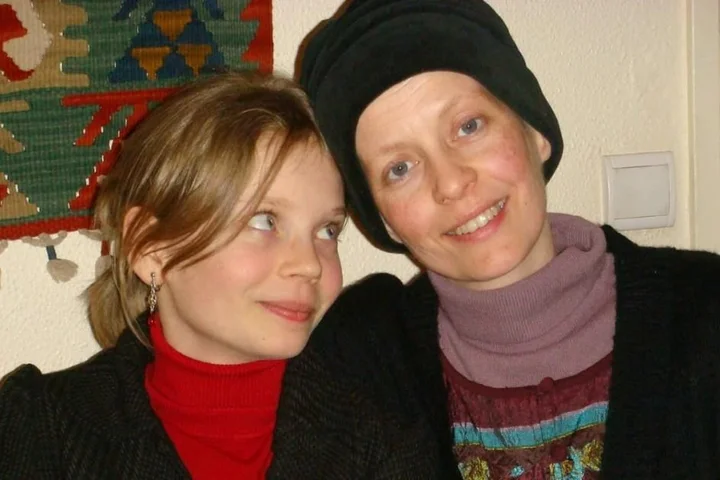
‘Mum, I am worried you’re going to die’
It was Christmas 1999, and in the midst of the vicious round of chemotherapy my mother was undergoing, my parents took my sister and I to a ski resort.
If my mum was surprised at the question her five-year-old daughter had asked, she didn’t show it.
She’d taken ill two days earlier, soon after we arrived, and had been rushed to a doctor nearby.
When she returned the following night, it had dawned on me, for the first time in my life, that one day my parents would pass away.
She calmed me down and said not to worry and to enjoy the rest of the holiday.
But a few days later, thoughts of my mother’s health came back to haunt me.
It mingled with guilt.
Thinking I’d burdened her with my own fears was mortifying.
I felt pathetic and never mentioned the incident again.
But the feeling that I should know how to deal calmly – before I had even learnt how to read – persisted.
The shame hung over me for many years to come.
My mother was in her early thirties when she was diagnosed with breast cancer.
She had no genetic predisposition, no family history; the chances of her getting sick were laughably small.
I didn’t understand what was happening then, but I know she underwent surgery and chemotherapy early on.
I have flashes of her skinny figure in a vast double bed taller than myself.
She went into remission in 1997, but then in 1999 it returned, this time in her right hip.
For the next twelve years, cancer hovered over our heads.
I went about my life as normally as I could.
I went to school, I sang in a choir, I took violin lessons – all the while trying to convince myself that things would get better.
But there were still times where the horrors of my reality burst through my naive ignorance, and I failed to cope.
Like the time mum lost her hair – I’ll never forget the way I was unable to mask my reaction.
She looked so small.
So ill.
All I could see was her cancer.
I hated myself for hating her appearance, and agonised over the split second in which she may have seen the shock in my eyes.
I was 13.
Or the following year, when my mother asked me to pick up the results of a blood test for her, too anxious to see what they might show.
Unfolding the piece of paper in the waiting room, I broke down at the verdict.
Despite all the pain and the treatments, she was still dying.
And yet, she had to comfort me, again.
Suddenly I was five again, unable to cope and make her better.
Looking to her for solace on what must have been one of the worst days of her life.
A month prior to her death, when I was 16, I went on a trip to Vienna with an orchestra I played in.
The doctors had found some nodules had metastasised, so I should have known time was fast running out.
Celebrating Halloween in various bars of the city, cancer seemed far away – but reality came crashing down the same hour I got back.
My father came to pick me up from the coach station on the way to collect my mother up from a therapist appointment.
Breast cancer symptoms
The first symptom of breast cancer that most women notice is a lump or an area of thickened tissue in their breast.
You should see a GP if you notice any of the following:
- a new lump or area of thickened tissue in either breast that was not there before
- a change in the size or shape of one or both breasts
- a discharge of fluid from either of your nipples
- a lump or swelling in either of your armpits
- a change in the look or feel of your skin, such as puckering or dimpling, a rash or redness
- a rash (like eczema), crusting, scaly or itchy skin or redness on or around your nipple
- a change in the appearance of your nipple, such as becoming sunken into your breast
Via NHS.
She climbed into the car and burst into tears.
‘I am not afraid anymore,’ she told my dad.
It wasn’t until two weeks later when my father sent me to stay with my grandparents to shield me from the excruciating final moments, that I understood we had reached the end.
For a long time after her passing my guilt remained.
In the gaping hole she left behind, I found solace in biology textbooks.
I relished learning anything to do with cancer – it was like a comforting, logical voice making sense of it all.
How has a loved one’s illness impacted your perspective on life?Comment Now
Biology gave me another, more unexpected source of healing.
I took an internship supervised by a scientist researching cancer in Tasmanian devils.
Months later, the scientist met my dad, who’d wanted to thank her for taking good care of me.
They married some years later.
And so, in a strange turn of events, after cancer took my mother, it gave me a younger sister, Flora.
It has been 15 years now since she died.
Flora has just celebrated her seventh birthday.
When I was that age, my mother was already on the edge of her second relapse.
A couple of years ago, Flora became inconsolable after breaking a small plate.
More recently, she cried after struggling to memorise a multiplication table.
Just last week, she refused to read a book because a character’s misfortune was too upsetting.
As I comfort her each time, faced with the reality of a child’s emotional landscape, I finally see the sad absurdity of the remorse and guilt I’d been carrying with me.
Sometimes in her eyes, I recognise a carefree innocence I’d once felt, before I traded it for self-reproach.
I cannot change how I grew up, nor, as I assured my mother on her deathbed and many times in dreams, would I have wanted to.
But it took over a decade and the arrival of Flora, to realise that I was a just kid who did not know how young she was.
I did my best in the worst of scenarios.
One day, I will accept that.
Related Stories
Source: This article was originally published by Metro UK
Read Full Original Article →
Comments (0)
No comments yet. Be the first to comment!
Leave a Comment