
Mark DeGraff is a freelance journalist based in the western United States.
Search author on: PubMed Google Scholar
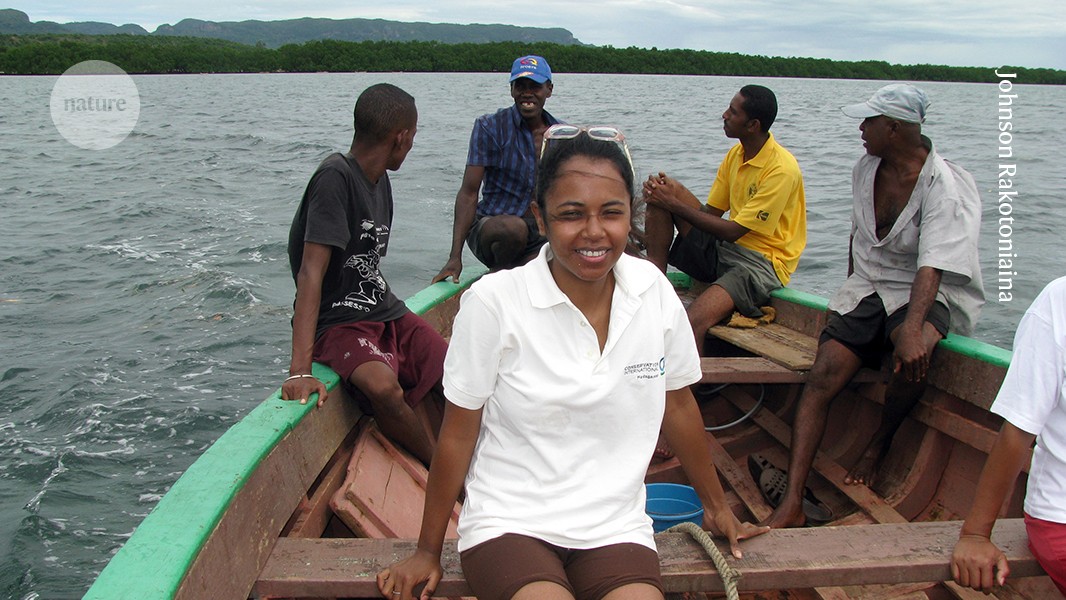
Ando Rabearisoa worked with local fishers to establish locally managed marine conservation areas that protect fisheries and local incomes in Madagascar.
Credit: Johnson Rakotoniaina
From 2009 to 2019, Rabearisoa led the Madagascar marine programme at Conservation International, a non-profit organization headquartered in Crystal City, Virginia, focused on environmental protection.
During that time, the number of LMMAs in Madagascar swelled from 33 to 177.
Now, scientists are studying how these conservation areas affect people and nature.
For example, in Madagascar’s first LMMA, researchers observed a 189% increase in fish biomass over a six-year period 1 .
What it’s like fighting racism and sexism in shark science
After more than a decade away from doctoral studies, Rabearisoa started a new PhD, this time researching marine conservation at the University of California, Santa Cruz.
She investigated how the web of LMMAs that she helped to create is affecting fish populations and fisher incomes.
Her latest study, published in 2025, surveyed communities in northeastern Madagascar and found that 95% of respondents preferred LMMAs to conventional marine conservation zones because they give local people better control of fishing rules and restrictions 2 .
Madagascar has emerged as a regional model for LMMAs, in part owing to Rabearisoa’s work.
In 2024, the nation hosted East Africa’s first-ever LMMA conference for anglers, conservationists and other stakeholders from countries such as Kenya and Mozambique.
Now a postdoctoral researcher at the University of California, Berkeley, Rabearisoa spoke to Nature about community-based conservation, her decision to resume her PhD studies and the challenges that female scientists face in Madagascar.
When did you first become interested in the environment?
Beginning when I was ten years old, my family and I would go camping in the rainforests of Madagascar.
The government had created a series of national parks and my father insisted on taking the family to these brand new reserves.
I distinctly remember seeing lemurs, and that made me fall in love with nature.
Why did you leave academia, and why did you return?
I did my master’s degree in ecological economics at the University of Antananarivo in Madagascar.
I wanted to understand not just ecology, but also how to attribute value to the benefits that nature provides.
After finishing my master’s degree, I moved to France for a PhD in ecological economics at the University of Versailles Saint-Quentin-en-Yvelines near Paris.
I was just 24 years old when I started it and I couldn’t stop thinking about how difficult it is for young women to become professors, especially in Madagascar — where conventional gender roles are still prevalent.
If I graduated in six years, I would be 30.
I kept doubting whether anyone would want to hire a 30-year-old woman as a professor.
I encourage women to claim their space in astrophysics and beyond
So, I started to apply for jobs.
In the third year of my PhD, Conservation International offered me a position as its marine programme manager in Madagascar.
I accepted the job and moved back there.
I worked for the organization for ten years and it was an incredible experience, but my friends kept urging me to finish my PhD.
Eventually, I applied for a master’s degree at the Coastal Science and Policy Program at the University of California, Santa Cruz, which would have served as a refresher for me.
But when my adviser saw my CV, he said “I want you to do a PhD”.
I accepted the offer, but with one condition: my research would focus on Madagascar’s LMMAs.
The scientific community is finally recognizing that community-based conservation works.
During my PhD, I dived into the details of what makes community-based management of fisheries effective, what we can learn when it doesn’t work and how we can improve it.
How did LMMAs first come about in Madagascar?
When the fishers returned to Madagascar, they decided to create their own LMMA based on the same principles.
Several years later, my colleagues and I brought fishers from other parts of Madagascar to visit the pilot LMMA so that they could take the system back to their own communities.
What did you learn during your ten years at Conservation International?
In Madagascar, many people living on the coast make their living directly from the sea.
Conservation efforts cannot succeed if they exclude them.
LMMAs work because they give communities control over how to manage their resources.
Overfishing and poverty form a vicious cycle.
People fish more because they have a low income, which worsens the depletion of fish and deepens poverty.
The goal of LMMAs is to break that cycle by supporting sustainable fishing, which increases long-term yields.
This strategy means that front-line communities are conservationists’ allies in the battle to protect the ocean.
Ando Rabearisoa participated in the Black In Marine Science Week retreat in San Diego, California, in 2024.
Credit: Sidney Opiyo, Coastal Science and Policy, UC Santa Cruz
Another important lesson that I learnt is that we must adapt protected areas to the local context.
Every place has a distinct ecology, culture and system of governance.
A big part of my PhD looked at how to use local communities’ ecological knowledge to make fishing more sustainable.
For example, local communities know exactly where and when fish spawn, and we use that information to close specific areas seasonally to protect the next generation of fish.
Enjoying our latest content?
Log in or create an account to continue
doi: https://doi.org/10.1038/d41586-026-00401-6
This interview has been edited for length and clarity.
Gilchrist, H., Rocliffe, S., Anderson, L.
G.
& Gough, C.
L.
A.
Ocean Coast.
Mgmt 192 , 105210 (2020).
Lewis-Brown, E.
et al.
Conserv.
Biol.
39 , e70091 (2025).
How I’m helping to cultivate science entrepreneurship in Brazil
‘Unaffordable’ visa price hike threatens Australia’s researcher pipeline
The mid-career reset: how to be strategic about your research direction
How I turned online misogyny about my PhD into momentum for my career
Paul R.
Ehrlich obituary: pioneering ecologist who caused controversy by predicting a ‘population bomb’
AI set to map risks of future climate disasters
Rethinking AI’s role in survey research: from threat to collaboration
Join HZAU's global faculty team to advance research with competitive benefits.
Huazhong Agricultural University (HZAU)
The Stomatology Hospital, School of Stomatology, Zhejiang University School of Medicine(ZJUSS)
IRB Barcelona invites applications for Group Leader positions in Chemical Biology (one) and Structural Biology (one).
Barcelona (Provincia), Cataluña (ES)
Fundació Institut de Recerca Biomèdica (IRB Barcelona)
The Paris Brain Institute invites expressions of interest from internationally recognized senior and mid-career researchers.
Full Professorship (W3) for ‚Clinical Epidemiology of Early Cancer Detection’ (f/m/d) We are looking for a highly distinguished physician scientist...
Heidelberg, Baden-Württemberg (DE)
Medizinische Fakultät Mannheim der Universität Heidelberg
Related Stories



Source: This article was originally published by Nature News
Read Full Original Article →
Comments (0)
No comments yet. Be the first to comment!
Leave a Comment