
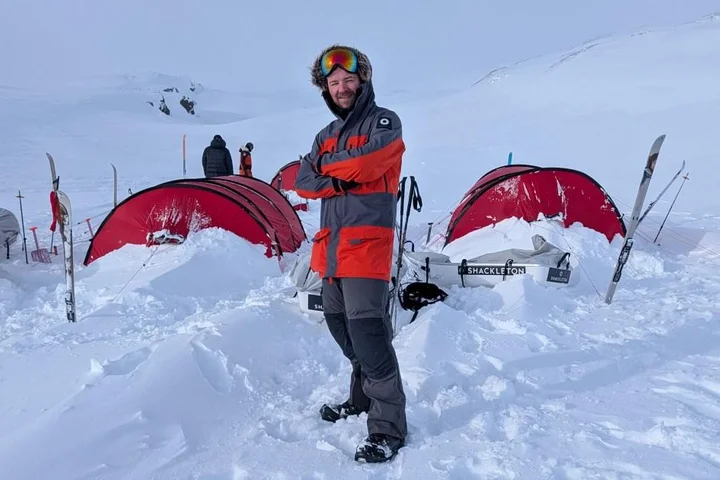
When I signed up for a polar expedition in Finse, I had a civilised vision of the Norwegian mountains: crisp air, a bit of skiing, perhaps a waffle or two.
What I received was a masterclass in Arctic survival, involving the ‘Code Brown Protocol,’ hauling a pulk sled up a glacier, and discovering that hot porridge can feel like a religious experience if you’re hungry enough.
Finse is a tiny, high-altitude outpost accessible only by rail.
Population: 9.
It is a world of white-on-white, designed by nature to remind humans that they are not in charge.
The wind becomes both your enemy and companion.
By day, it tries to push you backwards across the snow, but watching a river of powder blowing across a mountain in a place where almost no life exists, it feels strangely alive.
It makes you feel less alone.
At night, it howls against the nylon of your tent like a living thing.
When it stops, the silence is worse: a heavy stillness that feels like the mountains themselves are watching.
Best of Metro Deals
Get deal now
Get deal now
Get deal now
For days, our world was a binary of white.
White sky, white snow, and a horizon that simply did not exist.
At times we could barely see our skis.
Then, through the mist, the blue.
The Hardangerjøkulen glacier rises before you in a vast cliff of polar blue; the first natural colour we had seen since leaving the tracks at Finse.
Getting there had required conquering mind and body, ably guided by Louis and Amelia Rudd from expedition and polar clothing company Shackleton — a power-couple of the mountains.
I tried to explain expedition skiing to my teammate, Jake, a man whose credentials include rowing from Perth to Kenya in 71 days, as being like a cross between ice skating and downhill skiing, but only the worst bits.
Turning requires the runway of a small airport, and controlling a pulk on ice is largely an act of faith.
Louis, a former SAS soldier with the calm authority of someone who has spent rather more time in hostile environments than most of us, reminded us that the mountain is a great leveller.
Even he wasn’t immune.
At one point I caught him falling when he thought nobody was watching.
When he tried to claim I was the only witness, I pointed out that this defence was also an admission, costing him a bottle of wine upon return.
Expedition life quickly becomes defined by its strange little systems.
Chief among them is the ‘Code Brown Protocol’; a discreet agreement that when someone announces a ‘Code Brown’, everyone else stays in their tents.
There were also the ‘Pits of Despair’: trenches dug into the snow in our tent so colder air sinks away from us.
My tentmate Aslan and I compensated for our relatively shallow digging with interior design, carving out what I optimistically described as a snow-based drinks cabinet.
But what keeps a group functioning in conditions like this is humour.
Amelia, whose calm independence quietly held everything together, rescued my morale at precisely the right moment by producing a tube of Pringles after my confession that they are my biggest weakness.
Jake, meanwhile, approached skiing with the enthusiasm of a Labrador encountering snow for the first time.
His falls were so dramatic they resembled performance art.
And then there was Marina.
At 61, Marina spent much of the expedition insisting she was not physically capable of doing it, which would have been a convincing argument had she not been actively completing the expedition at the time.
I told her that the strongest wolf walks at the back of the pack; a point she proved rather well.
We bookmarked the day with breakfast and dinner, but everything in between was constantly feeding the beast.
I was surprised to see our leaders eating lunch at 10.30am, but soon realised we would eat at every opportunity.
On the longest day I needed nearly 5,000 calories, so I was constantly chugging liquid peanut butter and eating copious amounts of trail mix.
When I almost blew up our tent while lighting the stove, his years as a stuntman kicked in.
He deftly picked up the fire and threw it out into the snow.
Tucked up in a sleeping bag, I was relieved by how cosy it was.
Anything that had got wet during the day – liner gloves, mitts and socks – we stowed inside the sleeping bag at our feet to dry out while I hugged my phone to preserve the battery.
Before we left, Shackleton provided me with a kit list.
Some of the items I thought I could cut corners on, but I’m glad that I didn’t.
They’re the experts; trust the list.
The morning was not as brutal as I had expected, but I still dressed quicker than usual, excited for a coffee and some blueberry porridge that would sustain us as we dug our way out of the snow drift that had blown over the tent in the night.
The final slog across the frozen lake back to Finse was rewarded with waffles, beer and, of course, Pringles.
Three years ago, I was verging on obese and would never have dreamed of dragging a pulk up ‘Baby Wall’ (a baby it is not).
This trip was meant to be the ‘cherry on the cake’ of a long fitness journey, but it turned out to be something more.
As I emerged in Oslo and watched the Friday night commuters milling around, something Amelia had said struck me.
She told me she was an ‘ordinary person, doing something extraordinary’.
I realised I was surrounded by ordinary people, just like you and me, only a few steps away from an extraordinary adventure.
Now that I’ve seen the blue, I’m left with one slightly dangerous thought: What next?
Getting there
British Airways flies direct from London to Oslo.
From there or from Bergen, you can get a train direct to Finse.
The village (population 9) is not accessible by road, so rail is the only option.
The ride up is one of the most stunning routes in the world.
As part of Richard’s preparation for the Shackleton Challenge, he took part in the Foundations Programme.
This involved a personal fitness consultation, guidance on nutrition, a kit list overview and an optional Expedition Testing Day at Loughborough University’s Elite Athlete Centre.
Shackleton offers three levels of challenge varying in difficulty depending on whether you are a novice explorer or advanced endurance athlete: Discover, Explore, and Pioneer.
Richard’s trip, the Finse Polar Skills, falls into the Discover category and costs £7,250.
There are several expeditions available, up to Antarctica Coast to Pole challenge which is £110,000.
Related Stories


Source: This article was originally published by Metro UK
Read Full Original Article →
Comments (0)
No comments yet. Be the first to comment!
Leave a Comment