
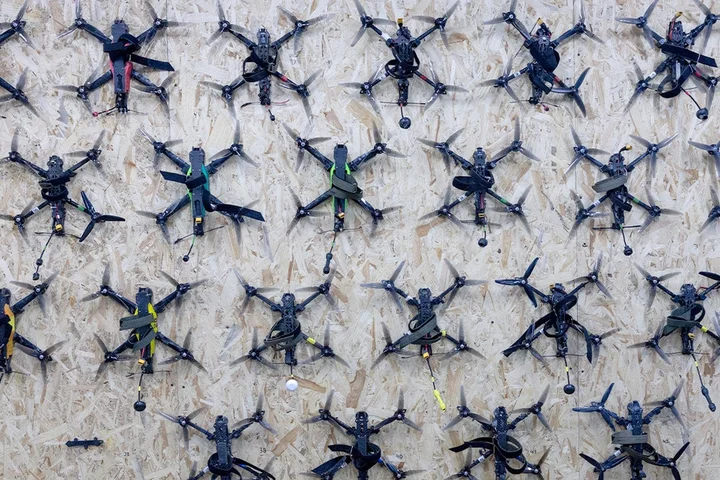
Imagine building a solution to a problem you never fully defined.
That’s where we are with airspace sovereignty.
Especially when it comes to drones.
We’ve spent billions of dollars on counter-UAS systems (C-UAS), deploying sensors and expanding capabilities.
For many officials, C-UAS has become the solution.
The problem is, it was never the full problem to begin with.
Before we talk about stopping drones, we should answer a more basic question: which ones belong in the air?
BORDER ON THE BRINK AS CARTEL DRONES FORCE US TO ACT AFTER YEARS OF PARALYSIS
We can’t answer that with confidence.
We’ve gotten better at seeing the sky.
But seeing is not the same as knowing what is flying in it.
Today, when a drone appears in controlled airspace, we can detect it and track it.
With Remote ID, we can occasionally determine who’s operating it.
What we cannot do, quickly and with certainty, is determine whether that drone is authorized, meaning the aircraft, the operator, and the mission are approved and operating as intended.
And in airspace security, speed is everything.
This isn’t a problem you solve in minutes or hours.
Decisions have to be made in seconds.
In that moment, operators need to answer three questions: Is it authorized?
Is it compliant?
Is it a threat?
If you can’t answer those questions immediately, you don’t control your airspace.
That’s the gap.
US MILITARY SHOT DOWN PARTY BALLOON NEAR EL PASO AFTER SUSPECTING DRONE, OFFICIAL SAYS
In traditional aviation, that gap is managed far more effectively.
Operations in controlled airspace tie together a verified operator, a known aircraft, and an approved flight plan, all continuously monitored.
The stakes are higher, but so is the structure, and the time to respond.
Aircraft operate from known locations, along defined routes, over longer periods of time.
Drones don’t operate that way.
TRUMP ADMIN CUTS RED TAPE ON COMMERCIAL DRONES TO COMPETE WITH CHINA'S DOMINANCE OF THE MARKET
They can be launched from less than a mile away and reach a target in minutes, often without any of those elements being reliably connected or visible in real time.
Today, who is flying, what they are flying, and why they are flying are not reliably connected, consistently verified, or available in real time to the people responsible for making decisions.
BRETT VELICOVICH: ‘MYSTERY’ DRONES ARE NO MYSTERY, THEY ARE A DANGEROUS THREAT TO NATIONAL SECURITY
Even when a drone is fully authorized, no one can immediately know that.
The people responsible for securing the airspace are left piecing together fragments, seeing a drone, checking what they can, and then making a judgment call.
That’s not sovereignty.
That’s uncertainty.
This didn’t happen because people aren’t paying attention.
That’s not a criticism.
It’s reality.
PENTAGON EXPLORING COUNTER-DRONE SYSTEMS TO PREVENT INCURSIONS OVER NATIONAL SECURITY FACILITIES
This is a security issue.
But it’s also an airspace problem.
And unless you’ve operated in both environments, it’s easy to focus on how to stop the threat before fully understanding how the airspace is supposed to work.
PENTAGON WATCHDOG WARNS DRONE INCURSIONS REQUIRE 'IMMEDIATE ATTENTION' AT US MILITARY BASES
I’ve seen this from both sides, operationally and from a security perspective.
I was asked during a congressional hearing, "If you’re not sure, why not just shoot it down?" It’s a fair question, until you consider where these operations happen.
Over cities.
Over crowds.
Over critical infrastructure.
Because when you don’t know what’s flying, what it’s carrying, or what it’s doing, you don’t know what happens when it falls.
That’s not policy.
That’s physics.
We’ve spent years building the ability to respond.
We never built the ability to define it.
Without that distinction, every drone becomes a question, and when every drone is a question, every decision becomes slower, harder, and riskier.
More sensors, better detection, and improved counter-drone systems are necessary.
But they don’t solve the problem on their own.
What’s missing is a system that establishes trust before a drone takes off and maintains it throughout the operation.
The missing piece is a fully integrated Digital Flight Authorization System (DFAS).
It replaces today’s fragmented processes with a single system, scattered approvals with one authoritative source, and uncertainty with a real-time picture of what is authorized, who is operating, and what they are doing.
It binds the operator, the aircraft, and the mission into a single, verifiable identity and confirms conformance in real time.
Instead of guessing, decision-makers know.
In seconds.
CLICK HERE FOR MORE FOX NEWS OPINION
That’s the difference between reacting to the sky and controlling it.
Airspace sovereignty isn’t about seeing more.
It’s about knowing.
The President has set the standard: "It is the policy of the United States to ensure control of our national airspace."
That’s the right goal.
But control isn’t achieved by seeing more.
Control comes from knowing.
Until we can know, in seconds, who is flying, what they are flying, and why, we haven’t finished the job.
And until we implement the system required to deliver that mandate, we won’t.
We’re not securing our skies.
We’re leaving them exposed.
And that’s not control.
Related Stories


Source: This article was originally published by Fox News
Read Full Original Article →
Comments (0)
No comments yet. Be the first to comment!
Leave a Comment