
Nearly a month after the US-Israeli strikes on Iran began, many who hoped the regime would soon fall have been left disappointed.
DW spoke to Iranians about how the regime's survival has dashed those early hopes.
At the start of the war in Iran , many Iranians saw the US-Israeli attacks as a chance to weaken or even overthrow the Islamic Republic.
US President Donald Trump went so far as to call on the Iranian people to "take over your government," cautioning that they might not get a better shot at regime change "for generations."
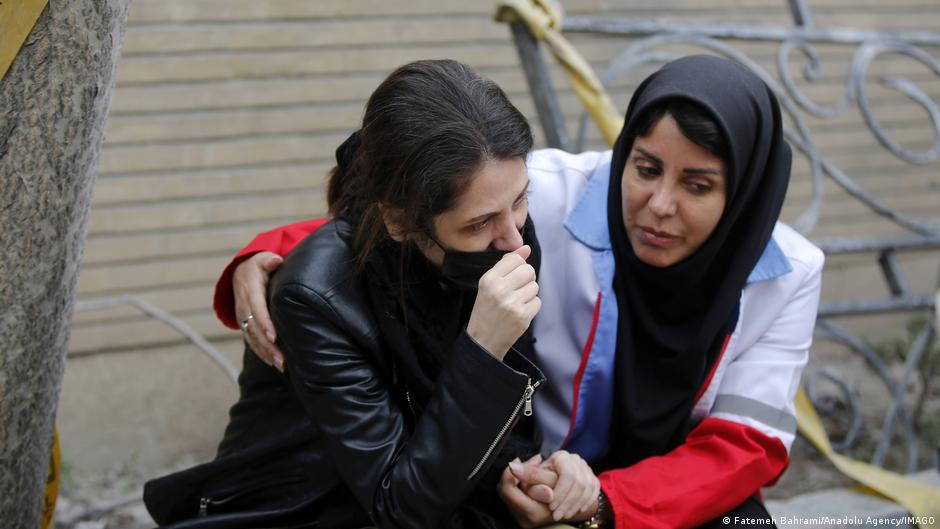
But as the conflict — now into its fourth week — has expanded, with civilian sites across Iran hit, daily life growing increasingly precarious, and the clerical regime still in place, the early hopes of many opponents of the regime have been replaced by doubt, exhaustion and fear .
"Despite all this destruction, the government is still standing, and that has caused the initial assumptions about the outcome of the war to give way to disappointment and concern," one Tehran resident, who preferred to remain anonymous due to security concerns, told DW.
At the start of the war, some Iranians believed foreign military pressure might threaten the regime enough to create an opening for more public unrest, with the country still reeling from nationwide, anti-government protests that were met with a brutal crackdown by Iran's security forces.
For those Iranians who are opposed to the clerical regime, the US-Israeli strikes were seen as a potential trigger for lasting change and the end of the state's vice-like grip on Iranian society .
But that reading of the war has become harder to sustain as bombs and missiles continue to fly .
Images of burning buildings, destroyed infrastructure and smoke-filled skies have caused a shift in how many view the conflict.
Now, the focus is less on whether the war might weaken the Islamic Republic, and more on how long the war will last and how much death and destruction Iranian civilians will have to bear.
The strike on a girls' school in the southern city of Minab became one of the clearest symbols of that shift, as civilian losses and rising insecurity have become part of daily life in Iran.
Evidence points to US role in deadly Iran school attack
To view this video please enable JavaScript, and consider upgrading to a web browser that supports HTML5 video
"The government is still insisting that employees be physically present at work, even though, in the eyes of many people, nowhere feels safe and no one wants to go to the workplace," the person said under condition of anonymity.
"Failing to show up at work could be interpreted as a strike or a protest, which has placed even more pressure on people," he added.
Under Iran's repressive regime, absence from public life can carry political consequences in a country where even hesitation can be viewed by authorities as a security risk.
Many Iranians who had hoped the war would overthrow the regime are now discovering that destruction spreads much faster than lasting political change.
Many Iranians hope the war will end soon
Uncertainty about what lies ahead once the bombs and strikes stop is also driving the shift in public mood.
Many fear that if the Islamic Republic survives this phase of the war, Iran could emerge from the conflict still saddled with all its old problems, and with several new challenges added on top: damaged infrastructure, deeper economic hardship, continuing sanctions and a state that could reassert control through even harsher repression.
Those concerns are sharpened by the lack of clarity over what the US and Israel actually hope to achieve with the joint operation.
Babak Dorbeiki, a former deputy for social and cultural affairs at Iran's Strategic Research Center, points out that Israel and the United States do not appear to be pursuing the same goals.
"Israel, unlike the United States, is seeking collapse.
It therefore appears that Trump's and Netanyahu's objectives are different.
As a result, it remains unclear what the outcome of the war will be," Dorbeiki told DW.
What is lsrael's strategy in the war with Iran?
A society worn down by uncertainty
The war and doubts over what comes next for Iran are also taking a psychological toll .
For many Iranians, the fear is no longer limited to bombs or airstrikes.
It is tied to something more enduring: uncertainty about what kind of country will emerge from this conflict.
Despite the intense bombardment and the deaths of several top officials, the state's repressive machinery and security forces are still very much present and strict social control is still being enforced.
Hopes that the killing of the country's supreme leader Ali Khamenei, who oversaw prior clampdowns on protests, would lead to lasting change have also been severely dented, as Khameini's successor, his son, Mojtaba, is considered even more hardline than his father .
What some initially saw as a possible path toward weakening the state has, for many, become something else: a war with no clear end, rising costs for civilians and no certainty that the system they hoped to see shaken will actually fall.
Related Stories
Source: This article was originally published by Deutsche Welle (DW)
Read Full Original Article →
Comments (0)
No comments yet. Be the first to comment!
Leave a Comment