
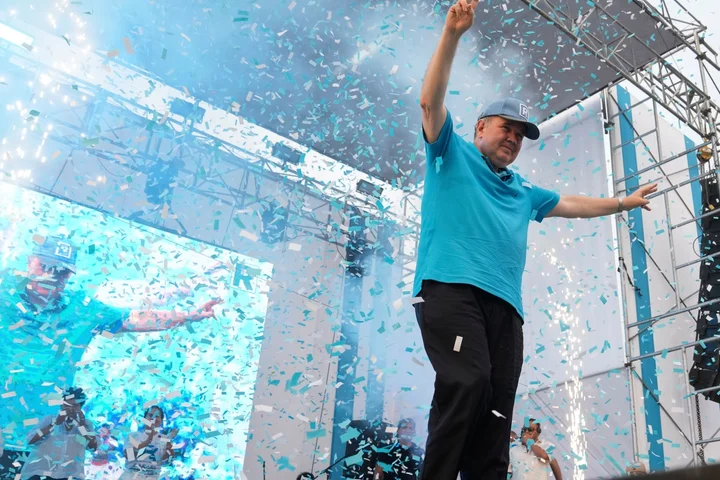
US President Donald Trump has sought greater influence over Latin America.
But in Peru's election, will embracing Trump pay off — or alienate voters?
Lima, Peru – A record 35 candidates are vying for the presidency in Peru on Sunday.
Only one, however, pitched himself as the most pro-Donald Trump option.
Rafael Lopez Aliaga, a chubby-cheeked business magnate and former mayor who goes by the nickname "Porky", had been the race’s frontrunner since August.
He ran a far-right campaign, expressing support for the United States bombing of alleged drug-smuggling boats and proposing that the US military intervene in Peru to capture gang leaders.
Lopez Aliaga even bragged about his ties to the Trump administration.
He claimed that US Secretary of State Marco Rubio invited him to Trump's inauguration last year, and in October, he organised a memorial for Charlie Kirk, despite only learning about the Trump-aligned activist after his assassination.
But ahead of the vote on Sunday, Lopez Aliaga has little to show for those efforts.
He has fallen to just 7 percent of voter intent, with his right-wing rival Keiko Fujimori overtaking him by eight points, according to an Ipsos poll released a week before the vote.
Fujimori's platform bears no mention of Trump's ambitions in Latin America.
It says that, if Fujimori is elected, her foreign policy would be “based exclusively on national interest".
With more than 20 percent of voters still undecided, the race is still wildly unpredictable.
But most political analysts no longer expect Lopez Aliaga to move on to a likely June run-off between the top two presidential candidates.
That has raised questions about limitations, and potential risks, of embracing the Trump brand in Peru and in Latin America overall.
“Trump's far-right admirers are no doubt questioning the mileage in his coattails,” said Benjamin Gedan, the director of the Latin America programme at the Stimson Center, a foreign affairs think tank.
Gedan believes that Trump’s aggressive foreign policy has diminished his appeal in the region.
He pointed to Trump's embrace of the 19th-century Monroe Doctrine — a policy that claims all of the Western Hemisphere as the US's sphere of influence — as one of his more controversial stances.
“Trump is not popular in Latin America, and the Monroe Doctrine and war in Iran will not improve his image,” Gedan said.
That puts wariness of the US 13 points higher than concerns about its rival, China, whose influence Trump has sought to curtail in Latin America.
But Peru’s election is far from a referendum on Trump, who has yet to endorse Lopez Aliaga or any other candidate.
In fact, the US president has been largely ignored in the race, which has focused on domestic issues.
During Peru's six presidential debates, Trump only came up once, when a candidate criticised his tariff hikes.
Alberto Rojas, 46, a mechanic in Lima who is leaning towards Fujimori, indicated that Trump's absence from the debates was fine by him.
The US president, he added, is a “madman” whom Peru would do best to avoid.
Peruvian political analyst Gonzalo Banda said he was surprised that foreign policy — and relations with the US in particular — did not emerge as an election issue at all this year.
Media reports, for instance, have questioned why the Peruvian government nixed plans to buy two dozen Swedish Gripen fighter jets, opting instead for US-made F-16s, even though they cost nearly twice as much per unit.
“A good left-wing candidate would have made that a campaign issue,” said Banda.
“Because there’s a very practical argument.
Basically, ‘Hey, why do we have to buy worse planes that are much more expensive from the United States?'"
Some left-wing candidates have touched upon Trump's growing involvement in Latin America.
For instance, the party platform for Roberto Sanchez, a far-left candidate who surged in the polls in recent weeks, denounces the US for trying to “forcibly implement the Monroe Doctrine and brazenly claim that the riches of Latin America are its own".
But Sanchez himself has not made the issue a central part of his campaign speeches, focusing his attacks on local elites instead.
Still, Peru has been among the countries Trump has tried to push away from China's influence.
The country is Latin America's second-largest recipient of Chinese foreign direct investment, after Brazil.
In February, the Trump administration publicly accused Peru of surrendering its sovereignty by allowing a Chinese company to build and operate a mega-port on its coast.
"Let this be a cautionary tale for the region and the world: cheap Chinese money costs sovereignty," the US Department of State wrote in a social media post.
Peru also continues to be the world’s second-largest producer of cocaine, at a time when Trump has led a militaristic campaign against illicit drug-trafficking.
But some Peruvian voters have expressed empathy for Trump's hardline approach.
Mariana Caballero, a 33-year-old office worker, said Trump was brave for taking on thorny issues like Venezuelan immigration and drug trafficking, which also affect Peru.
“Trump is the most powerful man in the world, and he’s changing the world,” Caballero said.
She then drew a parallel between Trump and the candidate she plans to vote for, Lopez Aliaga.
“We’d be foolish to not take advantage of a leader like Rafael," she added.
Support for democracy has declined in Peru, which has seen chronic upheaval in its government.
In the past decade, there have been nine presidents, many of whom stepped down or were impeached due to corruption charges.
According to the Institute of Peruvian Studies, nearly half of the country's voters want a candidate who will usher in big changes to the government.
But that push for change does not necessarily mean they want a candidate beholden to Trump.
Even Lopez Aliaga has pumped the brakes on praising Trump in recent months, rarely mentioning him at all.
Eduardo Dargent, a political scientist at the Pontifical Catholic University of Peru (PUCP), said the shift likely reflected concerns that a pro-Trump stance was no longer a net positive.
“Using Trump can be very dangerous for a candidate in Peru, especially if tomorrow Trump attacks Peru over its close ties with China,” said Dargent.
“It creates a lot of risk, and you don't know how it will turn out.”
It wouldn’t be the first time that Lopez Aliaga has put distance between himself and the US leader.
During his first presidential bid in 2021, Lopez Aliaga rejected the notion that he was the “Peruvian Trump”, telling a local newspaper that the then-former US president was “a very disrespectful, intolerant person".
Still, Lopez Aliaga began and ended his current campaign on a firmly pro-Trump footing.
On April 3, with barely a week left before the general election, Lopez Aliaga posted on social media that one of his first moves as president would be to join the Shield of the Americas, a Trump-led coalition focused on fighting organised crime.
“It’s an act of desperation,” said Banda.
“Right when the campaign enters its decisive phase and he starts to lose popularity, he returns to Trump as a symbolic shortcut, not to broaden his coalition but to reactivate an emotionally aligned core group.”
If Lopez Aliaga was angling for a last-minute Trump endorsement, it has yet to come.
It is also unclear if it would help.
More than 60 percent of Peruvians said Trump’s endorsement would matter little to nothing when deciding who to vote for, according to a March poll.
In countries where Trump has thrown his support behind a presidential candidate, the results have been mixed.
According to the Stimson Center's Gedan, Trump’s endorsement of President Javier Milei's party in Argentina's midterm elections likely helped because of the $20bn bailout that came with it.
But his impact on the Honduras election was harder to detect, and his 2022 backing of Jair Bolsonaro in Brazil likely backfired, Gedan added.
Brayan Ramirez, a university student and undecided voter in Lima, was among the Peruvians who indicated they would react negatively to Trump's endorsement.
“If Trump says, ‘Peru, vote for this candidate,’ I’d vote against" them, said Ramirez.
“Because he wouldn’t do it for nothing.
He’s looking out for his own interests.
Each country has to look out for its own interests.”
Related Stories

Source: This article was originally published by Al Jazeera English
Read Full Original Article →
Comments (0)
No comments yet. Be the first to comment!
Leave a Comment