
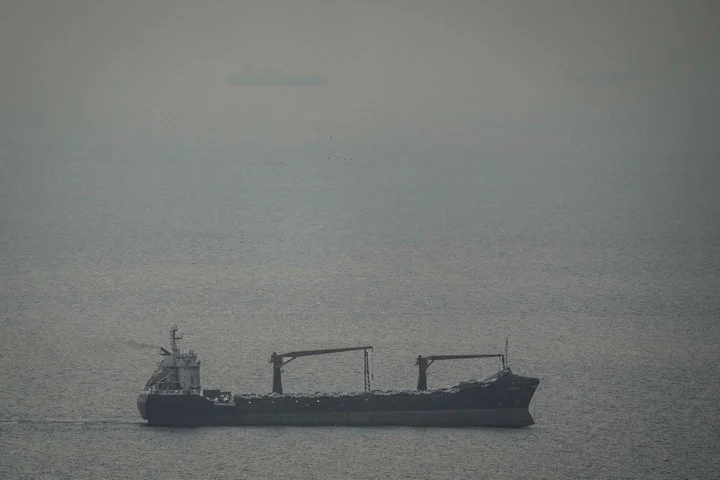
Maritime experts say ships are being ordered to submit detailed documentation to the Iranian authorities before being escorted through a controlled corridor
Analysts say Iran has imposed a “de facto toll booth regime” in the Strait of Hormuz and its parliament now plans to formally implement a system for charging ships transiting the critical maritime route.
The Strait of Hormuz is one of the world’s most critical energy chokepoints because a fifth of the global oil supply typically passes through it.
Desperate shipping companies are willing to pay millions of dollars per tanker in order to pass through the Strait, analysts said, given the extent to which the US-Israeli war on Iran has inflated the price of a barrel of oil .
The Islamic Revolutionary Guard Corps (IRGC) has already started ordering ships to submit full documentation , obtain clearance codes, and accept escorted passage through a controlled corridor of the strait, according to Lloyd’s List , a global authority on shipping.
Iran’s parliament is pursuing legislation to “formally codify Iran’s sovereignty, control and oversight over the Strait of Hormuz, while also creating a source of revenue through the collection of fees,” lawmaker Mohammadreza Rezaei Kouchi said, according to Fars and Tasnim news agencies.
The arrangement was “entirely natural”, he said.
“We provide its security, and it is natural that ships and oil tankers should pay such fees,” Mr Kouchi added.
Since 13 March, according to the Lloyd’s List report published on Wednesday, 26 vessel transits have followed the route controlled by the IRGC.
There have been no transits via the normal route since 15 March.
Iran this week told the UN Security Council that “non-hostile” ships could be allowed to transit the strait , though shipping data showed traffic remained at a fraction of the pre-war level.
Analysts said ships were paying millions to pass through the strait already.
Isaac Levi, analyst at CREA, said that at least one tanker paid $2m to transit via the northern edge of the strait closest to Iran.
"What we've seen is a huge amount of desperation from oil exporters and traders to be able to pass through the Strait safely – they are willing to take on a huge amount of risk and pass through perhaps without insurance," he told The Independent .
The economics make the toll worthwhile despite the risks, Mr Levi said.
With oil prices having close to doubled since the crisis began, a single tanker’s cargo might have appreciated in value by as much as $30-40m.
On Tuesday, only four ships were seen crossing the strait, with standard commercial shipping lanes empty as of early morning, according to the maritime intelligence firm Windward.
And on Wednesday, the number rose to five, Windward said, amid signs that “Iran is formalising a selective-access system”.
It is difficult for experts to establish where every tanker is headed, but China has historically received around 90 per cent of Iran's crude exports.
Analysts believe the majority of ships currently transiting the strait are most likely headed there still.
Mr Levi said he expected traffic to increase.
"There may be shippers that are apprehensive at the beginning – unsure whether payment will guarantee safe passage – so maybe they'll be watching closely to see how this scheme works for other tankers.”
“But I would expect to see an increase in the number of vessels so desperate to pass through the Strait that they will pay extortionate fees."
Any ship that does engage the system is required to contact intermediaries with IRGC connections, submitting its identification number, ownership chain, cargo manifest, destination and full crew list, according to Lloyd's List .
The documentation is forwarded to the IRGC navy’s Hormozgan Provincial Command for sanctions screening, cargo checks, and what Lloyd's List describes as “geopolitical vetting”.
If cleared, the IRGC provides a clearance code and route instructions, and a pilot boat escorts the vessel through Iranian territorial waters around Larak, one of the world’s oldest continually published newspapers noted in its report.
At least two vessels paid a direct toll, with payments settled in yuan, Lloyd’s List said.
Many others appeared to be transiting after diplomatic intervention rather than direct payment.
Iranian foreign minister Abbas Araghchi said on Thursday that Iran had permitted “friendly nations” like Pakistan, India, Iraq, China and Russia to use the strait.
Foreign secretary Yvette Cooper said on Friday that Iran was “hold[ing] the global economy hostage” as she met counterparts including Marco Rubio from the US to discuss the Middle East crisis.
Speaking at the G7 meeting in Vaux-de-Cernay, France, Ms Cooper said: "We will of course be discussing the conflict in the Middle East, where we want to see a swift resolution that reaches regional stability and security and opens the Strait of Hormuz."
Ms Cooper said: "Iran cannot be able to just hold the the global economy hostage as a result of a strait which is about international shipping routes and the freedom of navigation that has been so strongly supported at the United Nations, but also by countries across the world."
Complying with Iran’s “toll booth” system carries significant legal risks for shipping companies.
The IRGC is classified as a Foreign Terrorist Organisation (FTO) under US law, meaning that any payments, even indirect ones, could expose companies to criminal prosecution.
“Under US law, providing ‘material support’ to a designated FTO carries not just civil and regulatory risks but the risk of criminal prosecution,” Claire McCleskey, a former compliance official for the US Treasury’s Office of Foreign Assets Control, said in the Lloyd’s List report.
Trade attorney Manny Levitt of law firm Holland and Knight warned that even if toll payments were allowed under a recent US licence for Iranian oil loaded before 20 March, they would not be protected under UK or EU sanctions, nor would they shield companies from liability under US anti-terrorism statutes.
Despite the risks, Lloyd’s List said security firms had been “inundated” with requests by ship owners seeking clarity on the legal consequences of engaging with the Iranian system.
The Strait of Hormuz is deemed an international waterway open to all shipping.
Formalising fees would end that status and, thus, face strong opposition from Gulf Arab states and their Western allies.
Join thought-provoking conversations, follow other Independent readers and see their replies
Related Stories


Source: This article was originally published by The Independent
Read Full Original Article →
Comments (0)
No comments yet. Be the first to comment!
Leave a Comment