
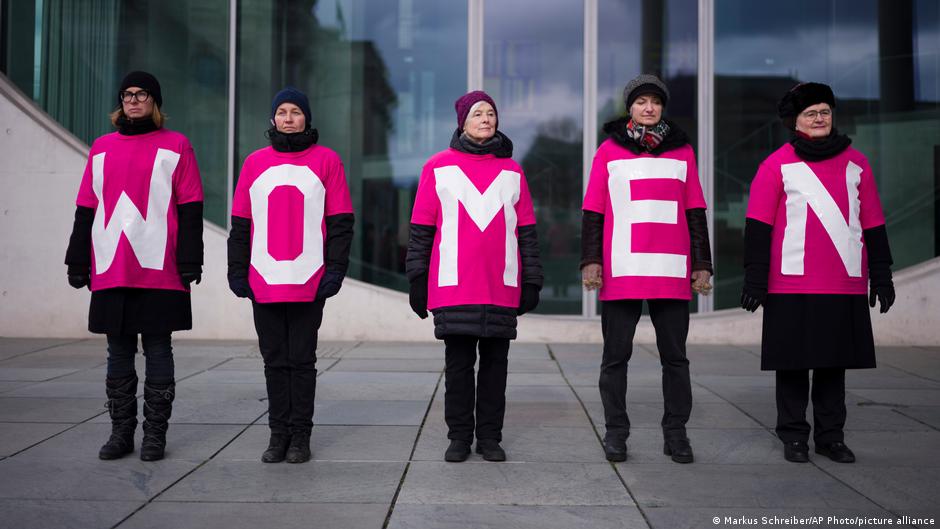
Women in Germany who wish to have careers and families face systemic challenges.
The German sociologist Jutta Allmendinger sees reason for optimism, with countries like Iceland showing the way.
In practice, however, patterns often persist that favor men in mixed-gender couples.
Women are still significantly more likely to work part-time, while men are more frequently the primary earners.
This imbalance is reflected in the latest gender pay gap data from Germany's Federal Statistical Office.
The figures for 2025 show that the gap remains wide.
German sociologist Jutta Allmendinger said the discrepancy was not due to a lack of good intentions.
Allmendinger is an honorary professor at the Free University of Berlin and sits on several advisory bodies, including the German Ethics Council.
She served as president of the WZB Berlin Social Science Center until 2024.
"When we ask couples what would happen if they had a child now, 80% of men say they would reduce their working hours and they would want an equal split," Allmendinger said.
"In the end, though, things often turn out differently."
Financial incentives send the wrong signal
What's more, Germany's tax system favors married couples in which one partner earns significantly more than the other.
"That leads to couples dividing their responsibilities in response to tax rules, not according to any principles of fairness they themselves had agreed on," Allmendinger said.
In her view, this is where policymakers must step in and take action.
If the goal really is equality, she said, then such tax concessions need to be abolished.
Allmendinger is not the only one to voice criticism: Germany's approach to splitting married couples' income has been hotly debated in recent years.
When it comes to gender equality, Germany still shows a clear East-West divide.
In the eastern German states — the area that used to be in the German Democratic Republic (GDR) — fewer women work part-time, and career breaks tend to be shorter, even with the usual structural challenges.
Cultural habits play a big role, Allmendinger said.
"In West Germany , the model was the single-earner marriage.
A 'good family' was one where the husband worked and the wife didn't have to — with the emphasis on 'have to,'" she said.
In the former East, by contrast, it was normal and socially accepted for both parents to work.
That legacy still shapes choices today.
The differences even shows up in pensions.
Women in the east tend to have smaller gaps in retirement income compared with men.
In western Germany, the gap is much wider, reflecting different work patterns over a lifetime.
When it comes to balancing a career and family, young parents across Germany, mothers in particular, face similar pressures.
The strain can be considerable, and that takes its toll, Allmendinger said.
"While that's not the majority," she said, "it's a growing trend."
Iceland: How families are closing the gender care work gap
To view this video please enable JavaScript, and consider upgrading to a web browser that supports HTML5 video
What would help to make choices about career and family better for both parents?
Allmendinger said the solution must be sustainable.
The standard 40-hour workweek for everyone, with no concession made for unpaid child care, isn't realistic.
Quite the opposite, in fact.
Allmendinger has proposed a new standard: a 33-hour workweek for all.
"My concept is for men to slightly reduce their average working hours, and for women to slightly increase theirs," she said.
"Not only would that not reduce the overall total work volume compared to what we have now, it would actually increase it."
Greater flexibility throughout one's career is also essential, she said.
"We all know there are phases when you may need to work just 28 hours, and other periods when you can work much more.
I think it's absurd that in Germany the time to start a family coincides with the peak phase of career advancement."
Who pays the bill?
Exploring gender, money & relationships
Countries such as Iceland have proved that change is possible.
For the past 16 years, Iceland has ranked first in the Global Gender Gap Report.
In recent years, it has made headlines for studies testing shorter working hours.
Allmendinger said advances in artificial intelligence would make reduced working hours even more feasible.
She points to the growing number of full-time positions that are structured as job-sharing arrangements.
"It works marvelously," she said.
"And this would also be a much more sustainable model."
Even if Germany is still struggling to achieve gender equality, she remains optimistic.
"In international comparisons, we can see what needs to be done to make things better," she said.
"As long as we have those examples, we know the diagnosis isn't terminal."
This article was translated from German and edited by Sarah Hucal.
Related Stories



Source: This article was originally published by Deutsche Welle (DW)
Read Full Original Article →
Comments (0)
No comments yet. Be the first to comment!
Leave a Comment