
Market watcher says money is pouring into British atomic and fusion startups amid massive energy demand
Investors are backing nuclear power as a solution to fuel the UK's datacenter buildout, according to researchers tracking investment activity.
Tracxn, a market intelligence biz that monitors startups, says institutional capital is "quietly but aggressively pivoting toward private nuclear innovation as a sustainable, sovereign solution for baseload power" and investment in the area is rising.
It points to the growth in power-hungry AI infrastructure in the UK, driven partly by the government's AI Opportunities Action Plan , published last year, in combination with "geopolitical energy volatility" as factors driving this trend.
The latter refers to the war in Iran pushing up fuel prices worldwide, however, the UK already had some of the most expensive energy costs in the world before the conflict started.
Both enterprises and governments are starting to understand that reliance on imported, volatile energy sources is a critical vulnerability for national AI sovereignty, Tracxn says.
This is casting a spotlight on nuclear startups offering the promise of always-on baseload power.
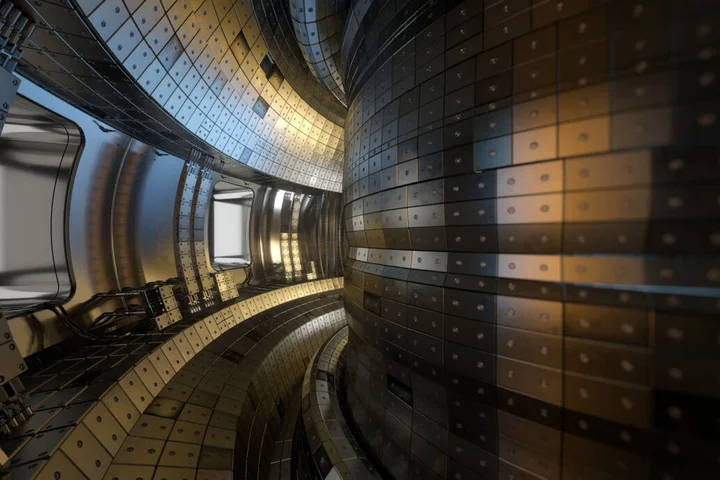
Tracxn claims $370 million has been injected into the sector, with 2024 seeing a surge of $170 million, driven by funding rounds from players including Tokamak Energy, which is working on fusion power projects , and Blue Energy, which develops modular reactors.
Blue Energy is also involved in a project with rent-a-GPU biz Crusoe to provide on-site power for an AI datacenter located in Port of Victoria, Texas.
Tracxn says it is watching 83 companies in the UK's private nuclear startup ecosystem.
These are concentrated around Abingdon and Oxford, which the analyst quaintly dubbed the UK's "Nuclear Valley," with Edinburgh, Bristol, and Glasgow also emerging as hubs.
Culham is also the government's first "AI Growth Zone," intended to serve as a testing ground for research into how sustainable energy like nuclear fusion could power the UK's AI ambitions.
However, technologies including small modular reactors (SMRs) are still in development, and fusion power is likely at least a decade away.
Even conventional atomic plants take years to build - the need for more sustainable and cheaper power is more pressing, as former Canalys principal ESG analyst Elsa Nightingale told The Register last year.
"Undoubtedly, nuclear energy will serve as part of the world's energy mix for years to come," she said .
"However, investing heavily in nuclear energy doesn't address the core issue.
For one, nuclear projects have long lead times while AI's energy demands are coming now."
Nevertheless, Tracxn reckons private nuclear startups will be able to offer always-on baseload power that neither solar nor wind can reliably deliver at the scale required.
Though this was disputed by the Centre for Net Zero (CNZ), which issued a report last year estimating that it would cost less to power a 120 MW datacenter with renewables and a small amount of gas-generated energy.
Tracxn claims the UK sector is already showing early signs of consolidation, with global industrial giants like Hitachi and Toshiba making "strategic buyouts" of British atomic businesses.
"Nuclear is not simply an energy story anymore; it is the infrastructure layer upon which the AI economy will be built," the report states .
®
Related Stories



Source: This article was originally published by The Register
Read Full Original Article →
Comments (0)
No comments yet. Be the first to comment!
Leave a Comment