
Updated on: April 1, 2026 / 3:31 AM EDT / CBS News
What to know about the Iran war today:
Missiles apparently hit former U.S.
Embassy compound in Tehran
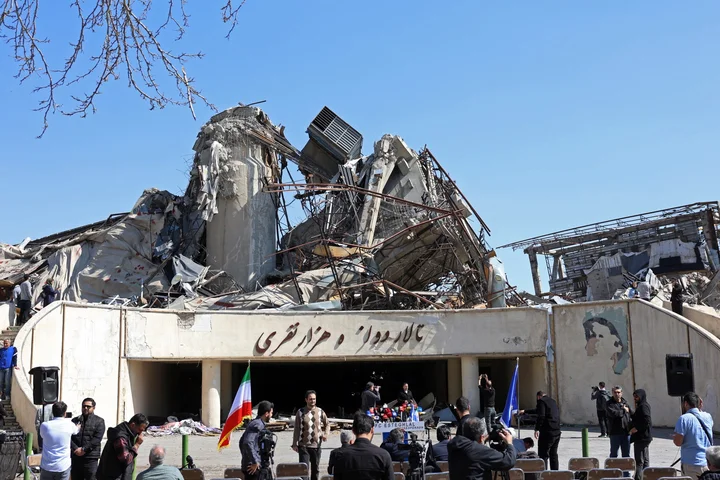
An airstrike in Iran's capital, Tehran, on Wednesday morning appears to have struck inside the former U.S.
Embassy compound.
The embassy has been controlled by Iran's Revolutionary Guard since the 1979 hostage crisis.
Its all-volunteer Basij force operates the compound, running an anti-American museum inside the embassy and other in new buildings on its grounds.
Witnesses saw blown-out windows surrounding the massive compound on Tehran's Taleghani Street.
However, there was no missile strike visible around the compound, with witnesses saying they believe the strike happened inside the compound.
The 444-day hostage crisis saw American diplomats held until President Ronald Reagan took office from President Jimmy Carter in 1981.
Yemen's Houthis claim third missile attack on Israel
Yemen's Houthis on Wednesday claimed a missile attack targeting Israel that they said was launched jointly with their backer Iran and Lebanon's Hezbollah, which is also a Tehran proxy.
It was the third such attack claimed by the Houthis since they entered the Middle East war.
The Houthis "carried out the third military operation ...
targeting sensitive Israeli enemy targets ...
with a barrage of ballistic missiles," military spokesman Yahya Saree said in a video statement.
"This operation was conducted jointly with our mujahideen brothers in Iran and Hezbollah in Lebanon," he added.
There was no mention by any of the warring factions of any damage caused by that latest strike.
Israel says it hit Tehran with "wide-scale wave of strikes"
The Israeli military said it carried out strikes on Wednesday on Tehran, where Iranian state broadcaster IRIB reported blasts in several areas.
A brief military statement said Israeli forces had "completed a wide-scale wave of strikes targeting infrastructure sites of the Iranian terror regime in Tehran."
Israeli medics says at least 13 wounded by Iran missile fire
Israel's emergency medical service said an 11-year-old girl was in serious condition after a missile attack that the military blamed on Iran and police said caused damage at several sites.
The Magen David Adom emergency medical service said an 11-year-old girl was seriously wounded by shrapnel in central Israel in the first launch.
Spokesman Zaki Heller told Israeli TV at least 12 others were also wounded, including a 13-year-old boy and 33-year-old woman in moderate condition, all at the same impact site.
Israeli media said cluster munitions, which explode mid-air and scatter bomblets across a wide area, were used in the attack.
Iran and Israel have previously accused each other of using cluster bombs.
Several U.S.
Gulf allies hit by strikes from Iran
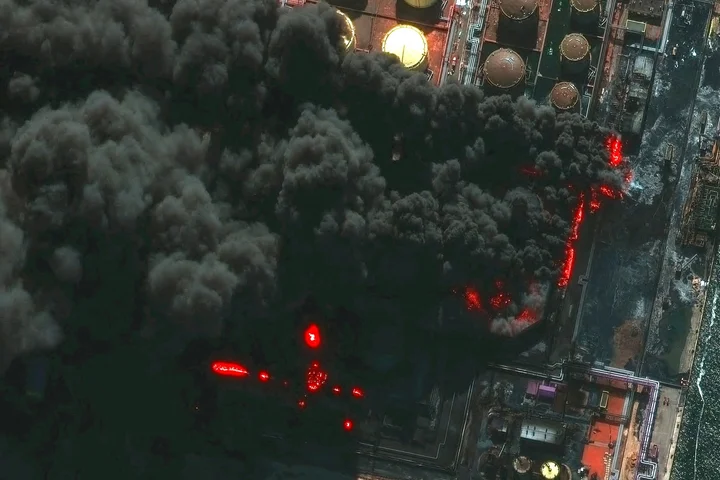
Kuwait's civil aviation authority said Wednesday that the Gulf state's international airport had come under an Iranian drone attack that led to "a large fire" at fuel tanks but no casualties.
Iran has fired missiles and drones at Israel and U.S.
allies in the Gulf since the start of the war.
Elsewhere in the Gulf on Wednesday, Bahrain's interior ministry said a fire broke out at a business facility "as a result of the Iranian aggression." Saudi Arabia's defense ministry said several drones were "intercepted and destroyed."
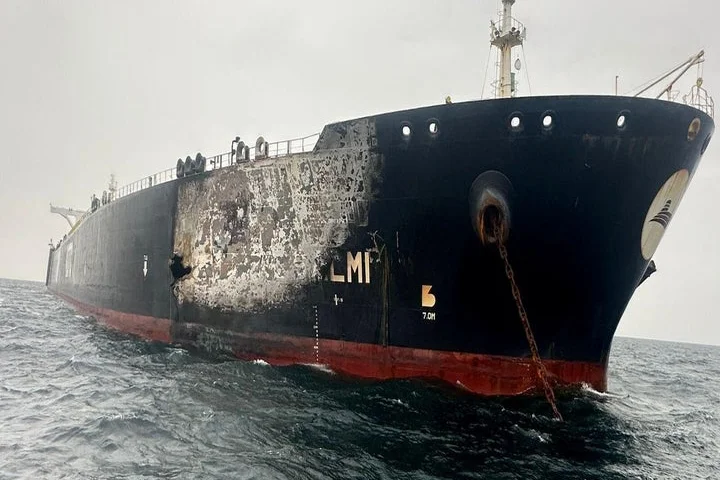
And a tanker was hit in the waters off Qatar, a British maritime security agency said.
The U.K.
Maritime Trade Operations (UKMTO) said "the vessel was struck by two projectiles" 17 nautical miles north of Ras Laffan, a major natural gas facility.
One caused a fire, which was extinguished, and another "remains unexploded within the vessel's engine room," UKMTO said, adding that all crew members were reported as safe.
It also said there was "no environmental impact" and that authorities were investigating the incident.
On Tuesday, state-run Kuwaiti news agency KUNA said an Iranian attack sparked a fire on a Kuwaiti oil tanker at Dubai Port but didn't cause any injuries.
The oil-rich Gulf nation has borne the brunt of Iran's attacks in response to the U.S.-Israeli strikes that sparked the war.
Tehran has threatened to target vital infrastructure across the Gulf, including energy sites.
Iranian drone attack targets Kuwait airport, aviation agency says
Kuwait's civil aviation authority said the Gulf state's international airport was under an Iranian drone attack on Wednesday local time that led to "a large fire" at fuel tanks.
"Kuwait International Airport has been subjected to blatant attacks by drones launched by Iran and the armed factions it supports," the official Kuwait News Agency quoted the spokesman of the General Directorate of Civil Aviation as saying.
The spokesman said "fuel storage tanks...
were targeted," which resulted in a large fire.
There were no casualties reported.
Rubio says NATO's value will need to be "very carefully reexamined" after Iran war
Secretary of State Marco Rubio said Tuesday in a Fox News interview that the United States' relationship with the NATO alliance will need to be "very carefully reexamined" after the war with Iran concludes.
Several NATO member states in Europe have sought to distance themselves from the war.
Spain has said it will not allow U.S.
aircraft to use its airspace or military bases in connection with the Iran conflict, Italy reportedly blocked U.S.
bombers from landing at a base in Sicily, and President Trump accused France earlier Tuesday of preventing American flights .
Rubio sharply criticized those moves.
He said he's long defended NATO because the United States' presence in Europe "allowed us to project power into different parts of the world," in addition to helping defend Europe.
But if that's no longer the case, that means "NATO is a one-way street," he said.
"When we need them to allow us to use their military bases, their answer is no?
Then why are we in NATO?
You have to ask that question," he said, adding that it will be up to Mr.
Trump.
Rubio made similar comments in an interview Monday with Al Jazeera.
Australian prime minister to address nation on Middle East war
Australian Prime Minister Anthony Albanese will make a rare address to the nation across television and radio networks on Wednesday, outlining Canberra's response to the Middle East conflict.
Australia said Monday it would halve a fuel tax to help motorists amid soaring prices, and Treasurer Jim Chalmers also announced temporary tax relief for small businesses on Wednesday local time.
Albanese's government has sought to reassure motorists that shipments of fuel continue to arrive in Australia, and gasoline shortages in rural towns stem from panic buying and distribution bottlenecks.
Australia, a U.S.
security ally, last month sent an electronic surveillance aircraft to help defend the United Arab Emirates.
Albanese is addressing his country ahead of a planned primetime address by President Trump at 9 p.m.
ET on Wednesday.
UAE bars Iranians from entering or transiting the country, major airlines say
The United Arab Emirates has barred Iranians from entering or transiting the country as the war rages, three major airlines said Wednesday.
Long-haul carriers Emirates and Etihad, as well as the lower-cost airline FlyDubai, made the announcements on their websites.
The airlines said holders of 10-year Golden Visa residency permits could still enter the country.
Entry rules can sometimes be opaque in the autocratic United Arab Emirates, a federation of seven sheikhdoms.
Authorities have offered no official comment.
Over the last month, Iranian missiles and drones have targeted the United Arab Emirates , a U.S.
ally that hosts American military forces, including at its Al Dhafra Air Base.
Dubai had already shut down the city-state's Iranian Hospital and Iranian Club, institutions that date back to the time of the shah, the monarch who ruled Iran until the country's 1979 Islamic Revolution.
Trump holding prime-time address for "important update on Iran" tomorrow night
President Trump will deliver a nationwide address Wednesday evening "to provide an important update on Iran," White House press secretary Karoline Leavitt said on X.
The address is scheduled for 9 p.m.
ET.
Trump: "We're not going to have anything to do with" the Strait of Hormuz
President Trump told reporters that after the war with Iran ends, other countries will "be able to fend for themselves" if they need to import oil or natural gas from the Middle East via the Strait of Hormuz, a chokepoint that has been effectively closed to ship traffic for weeks.
"What happens with the strait, we're not going to have anything to do with," the president said, because other countries like China and France will "take care of themselves."
Oil tankers have all but stopped transiting the Strait of Hormuz.
In the past, Mr.
Trump has floated offering U.S.
military escorts through the strait, but in recent weeks, he has said the burden of reopening the waterway should be carried by countries that are reliant on Middle Eastern oil.
The U.S.
does not import much petroleum from the Persian Gulf region and produces more oil than it uses , but the disruptions in the Strait of Hormuz have pushed up prices globally, including in the U.S.
He told CBS News on Tuesday other countries are "going to have to come in and do their own work."
In a Truth Social post earlier Tuesday, he wrote: "Go get your own oil!"
Trump says he expects Iran war to end in "2 weeks, maybe 3"
President Trump told reporters Tuesday he expects the U.S.
to wrap up its operations against Iran in "two weeks, maybe three."
He said the U.S.
and Iran are negotiating, and it's possible that the two countries will reach a deal before then, but he said a formal deal isn't needed to end the war.
Iran has denied that direct negotiations are taking place, but has confirmed that the country has exchanged messages with the U.S.
through mediators.
When asked at one point about when gas prices will come down after spiking amid the Iran war, Mr.
Trump also told reporters: "All I have to do is leave Iran, and we'll be doing that very soon."
Wall Street posts best day since last spring
Major stock indices jumped on Tuesday to cap a rough month dominated by uncertainty over the Iran war, as investors look for signs that the U.S.
operations against Iran are nearing an end.
The S&P 500 closed up 2.9% and the Dow Jones Industrial Average spiked 2.5%, posting their best days since mid-May 2025.
Both indices remain down about 5% since the day before the war started.
Wall Street analyst Adam Crisafulli, head of Vital Knowledge, said in a note that Tuesday's rally was "thanks in large part to anticipation of a further deescalation in the war." He pointed to a Wall Street Journal report from Monday that President Trump is weighing ending the war with Iran without launching a military operation to reopen the Strait of Hormuz, a key chokepoint for oil exports from the Middle East.
Mr.
Trump told CBS News on Tuesday that he isn't pulling U.S.
forces out of an effort to force Iran to reopen the strait "quite yet." When asked when the military operation could end, he said: "it won't be long."
Still, oil prices were mixed on Tuesday as shipping through the Strait of Hormuz remains largely stalled.
The international oil benchmark, Brent Crude, was up 4.9% to just over $118 per barrel for May deliveries.
The price fell 3.6% to around $103.50 for the more widely traded June delivery contract.
Oil is generally traded through futures contracts for delivery at a later date.
State Department official says suspect in American's abduction in Iraq has ties to Iran-backed militia
Dylan Johnson, an assistant secretary of state for global public affairs, confirmed in a post on X that the suspect who was taken into custody for the kidnapping of American journalist Shelly Kittleson had ties to Kata'ib Hezbollah, the Iranian-backed militia.
"An individual with ties to the Iranian-aligned militia group Kataib Hizballah believed to be involved in the kidnapping has been taken into custody by Iraqi authorities," Johnson wrote.
Iraqi authorities said previously that they were able to intercept a vehicle used in the kidnapping and make the arrest, but the vehicle was not carrying Kittleson.
Kata'ib Hezbollah was also behind the abduction of researcher Elizabeth Tsurkov in Iraq in 2023.
The group released her in September 2025 as part of a prisoner swap.
American journalist Shelly Kittleson kidnapped in Iraq
American journalist Shelly Kittleson was kidnapped in Baghdad on Tuesday, according to two sources familiar with the matter as well as an Iraqi official.
Iraq's Interior Ministry announced that a foreign journalist was kidnapped by "unknown individuals" but did not identify the victim.
The ministry said that security forces had managed to arrest one suspect and seize a vehicle used in the abduction.
Alex Plitsas, Kittleson's designated point of contact in the U.S.
and a CNN national security analyst, confirmed to CBS News that Kittleson had been taken.
Plitsas said that the U.S.
government had warned Kittleson about a specific threat against her by the Iranian-backed paramilitary group Kata'ib Hezbollah, which was allegedly looking to kidnap or kill female journalists.
Plitsas said Kittleson was advised that her name was on a list in Kata'ib Hezbollah's possession.
A second source confirmed that she had been told of a risk but that she thought it was likely false information.
State Department says gathering places of U.S.
citizens in Saudi Arabia could be targeted
The State Department issued a new warning advising Americans in Saudi Arabia to avoid places where U.S.
citizens gather.
"We are tracking reports of threats against locations where American citizens gather.
We advise U.S.
citizens that hotels and other gathering points including U.S.
businesses and U.S.
educational institutions may be potential targets," the department's consular affairs office said .
The warning comes after the Iranian Revolutionary Guard Corps said that it would begin targeting U.S.
tech firms and financial institutions in the region.
The IRGC accused the companies of acting as "spies" on behalf of the U.S.
Iran and U.S.
exchanging messages, foreign minister says
Iranian Foreign Minister Abbas Araghchi told Al Jazeera that the U.S.
and Iran are engaged in an "exchange of messages."
"What is happening now is not negotiations but an exchange of messages directly or through our friends in the region," Araghchi said.
"I receive messages from [U.S.
envoy Steve] Witkoff directly as before, and this does not mean that we are negotiating."
Araghchi told Al Jazeera that "these messages include warnings or mutual insights exchanged via friends."
It's not just oil — the Iran war is also disrupting helium and aluminum supplies
The Iran war is not only disrupting the global energy market but is also threatening the world's supply of helium and aluminum, key materials used in products such as semiconductor chips, medical equipment and other everyday goods.
Qatar, which accounts for roughly one-third of the world's helium supply, stopped producing helium this month following Iranian strikes on two liquid natural gas (LNG) facilities owned by state-run QatarEnergy.
Helium is a byproduct of natural gas processing, and attacks on Qatar's liquefied natural gas facilities mean it could take years to rebuild production lines.
Earlier this month, QatarEnergy told Reuters that the attacks wiped out 17% of the country's LNG export capacity, and that repairs could take three to five years.
Hegseth slated to testify before House panel on April 29
Defense Secretary Pete Hegseth is tentatively expected to testify publicly before the House Armed Services Committee on April 29, according to two sources familiar with the plans, in what would mark his first appearance under oath on Capitol Hill since the U.S.
conflict with Iran began.
The timing of the hearing has not been finalized and could shift, the sources said.
The session will fall under the committee's routine oversight of the Defense Department and its annual budget request.
Foreign journalist kidnapped in Iraq
Iraq's Interior Ministry says a foreign journalist has been kidnapped in the country.
The ministry did not identify the journalist or give further details on their nationality.
It said Tuesday that security forces had launched an operation to track down the kidnappers.
It said they intercepted a vehicle belonging to the kidnappers that overturned as they tried to flee.
One suspect was arrested and one of the vehicles used in the kidnapping was seized, but others remain on the loose, the statement said.
A spokesperson for the U.S.
Embassy in Baghdad declined to comment to the Associated Press.
British defense chief says more troops and air defenses headed to Middle East
British Defense Secretary John Healey said the U.K.
will send more troops and air defense systems to the Middle East, according to BBC News , CBS News' partner network.
Speaking in Qatar, Healey said additional air defense systems and teams will be sent to Kuwait, Saudi Arabia and Bahrain.
He also said a deployment of jets to Qatar will be extended.
Around 1,000 British troops are involved in the defensive mission in the Gulf and in Cyprus, Healey said.
"My message to Gulf partners is: Britain's best will help you defend your skies," he said, according to the BBC.
Trump calls U.S.
strike on Isfahan a "beauty," says Strait of Hormuz will open "automatically"
Speaking to the New York Post , President Trump called the overnight U.S.
strike near the Iranian city of Isfahan a "beauty," but declined to disclose what the bombing hit.
The president posted a video of the attack on Truth Social , showing enormous explosions lighting up the night sky.
Isfahan is the location of one of three nuclear sites that the U.S.
bombed in June 2025.
"It'll come out, but it was just another one of their wonderful areas that we took care of," he told the Post.
"That was a beauty," he added.
"That was a beauty.
That was stuff that we blew up.
That was some explosion."
The president also said he believes the Strait of Hormuz will open "automatically" by "whoever's controlling the oil." The strait's effective closure has strangled the flow of oil internationally, sending prices across the globe skyrocketing.
"Well, I think it'll automatically open, but my attitude is, I've obliterated the country," he told the Post.
"They have no strength left, and let the countries that are using the strait, let them go and open it … because I would imagine whoever's controlling the oil will be very happy to open the strait."
Iran arrests 54 allegedly connected to U.S.
and Israel, state TV says
The Iranian Ministry of Intelligence said Tuesday that 54 people allegedly linked to the U.S.
and Israel have been arrested, according to Iranian state media.
Iran warns it will target 18 specific U.S.
tech and finance companies in Mideast from Wednesday
Iran's Islamic Revolutionary Guard Corps said Tuesday that it would start targeting 18 U.S.
technology and finance companies in the Middle East.
The IRGC had issued a similar threat in early March , warning that the country's "legitimate targets are gradually expanding."
In its Tuesday post on the Telegram messaging app, the IRGC accused 18 U.S.-based companies of acting as "spies" for the U.S.
government, helping it to carry out strikes.
The IRGC said the U.S.
had "ignored our repeated warnings about the need to stop terrorist operations, and today, a number of Iranian citizens were martyred in your and your Israeli allies' terrorist attacks; Since the main element in designing and tracking terror targets are American ICT and AI companies, in response to this terrorist operation, from now on the main institutions effective in terrorist operations will be our legitimate targets."
Most of the companies named are major tech firms, including Microsoft, Apple, Google, Meta, IBM and Cisco, but financial giant J.P.
Morgan and Elon Musk's Tesla were also named, along with defense contractor Boeing and microchip maker Nvidia.
U.S.
stock prices rise as markets monitor Middle East war
Wall Street stocks opened higher Tuesday on hopes for a near-term resolution to the Middle East war despite the continued blockage of most petroleum deliveries in the Strait of Hormuz.
Equities have been "energized" by reports that President Trump could soon end the war with Iran, said Briefing.com analyst Patrick O'Hare.
About 15 minutes into trading, the Dow Jones Industrial Average was up 1.0 percent at 45,677.81.
The broad-based S&P 500 gained 1.3 percent to 6,426.13, while the tech-rich Nasdaq Composite Index jumped 1.7 percent to 21,138.99.
Meanwhile, the average price of gasoline at U.S.
pumps has soared past $4 a gallon, the highest for nearly four years on the back of the Iran war.
Israel says it struck missile research and development sites in Tehran.
Iran says it hit a pharmaceutical company.
The Israeli military said Tuesday that it had completed "another wave of strikes against weapon production sites" in Iran's capital Tehran, claiming to have destroyed a facility used for the manufacture of ballistic missile warheads, and two facilities used for the production, research and development of "components used in anti-tank missiles, anti-aircraft missiles, and other weapons."
"In parallel, the IDF continued to strike firepower arrays in Tehran, including launch sites and surface-to-air missile launch positions," the Israel Defense Forces said in a statement.
In a post on social media, meanwhile, Iranian Foreign Minister Abbas Araghchi accused Israel of "openly and unashamedly bombing pharmaceutical companies."
Araghchi included a photo of a destroyed building with a sign outside indicating it was a research and development site of the Tofigh Daru pharmaceutical firm.
The company's LinkedIn profile describes it as Iran's biggest pharmaceutical holding company, with a research and development facility in Tehran.
Israel's "intentions are clear," said Araghchi in his post.
"What they've gotten wrong is that they're not dealing with defenseless Palestinian civilians.
Our Powerful Armed Forces will severely punish aggressors."
Hegseth says "upcoming days will be decisive" in war against Iran
Defense Secretary Pete Hegseth and Gen.
Dan Caine, Joint Chiefs Chairman, declared at a news conference on Tuesday "the upcoming days will be decisive" in the war with Iran.
"Iran knows that, and there's almost nothing they can militarily do about it," Hegseth claimed.
The Defense Secretary said that "American firepower is only increasing," while saying Iran's is "decreasing."
"Just one month in — only one month — we set the terms," Hegseth said.
Trump tells CBS News he's not ready "quite yet" to abandon bid to force Iran to reopen Strait of Hormuz
CBS News White House correspondent Weijia Jiang called President Trump on Tuesday morning to ask for clarity about his social media post suggesting he could abandon efforts to force Iran to reopen the Strait of Hormuz .
Mr.
Trump reiterated his frustration that other countries had not sent military assets to join the U.S.-Israeli war against Iran, but said he wasn't ready to pull American forces out of the fight "quite yet."
"At some point I will, not quite yet.
But countries have to come in and take care of it.
Iran has been decimated, but they're going to have to come in and do their own work," Mr.
Trump told Jiang.
Mr.
Trump also reiterated his claim that, despite ongoing Iranian strikes on ships and Persian Gulf nations' infrastructure, "there's no real threat" in the Strait of Hormuz.
"I'll be there, but if they're having a hard time getting oil, let them come and take it like they're supposed to.
Let them come up and take it.
They didn't want to give a hand to anybody.
NATO is terrible, and they're all terrible.
So if they want oil, come up and grab it.
There's no real threat, there's no substantial threat because the country [Iran] has been decimated," Mr.
Trump said.
"Let them come up and take it.
It's about time they did something for themselves."
Trump says France "VERY UNHELPFUL" for denying U.S.
warplanes use of airspace for Iran war
President Trump heaped more criticism on one of America's longest-standing and closest NATO allies Monday, calling France "VERY UNHELPFUL" amid the ongoing U.S.-Israeli war against Iran.
Mr.
Trump said in a post on his Truth Social platform that France had denied U.S.
warplanes access to its airspace as they "headed to Israel, loaded up with military supplies."
"The U.S.A.
will REMEMBER!!!," said Mr.
Trump.
Spain has publicly denied U.S.
military planes use of its airspace for all operations connected to the Iran war, while Italy recently denied specific requests for American bombers to touch down at a joint base on Sicily, according to multiple reports.
President Emmanuel Macron did, however, question the legality of the U.S.-Israeli assault on Iran early in the war.
Trump indicates he could abandon effort to force Iran to reopen Strait of Hormuz
President Trump dropped a hint on Tuesday, in the context of another dig at U.S.
allies in Europe who have declined to join the U.S.-Israeli war against Iran, that he could be prepared to abandon efforts to force Tehran to reopen the Strait of Hormuz to all shipping traffic.
After issuing increasingly aggressive threats to order attacks on Iran's civilian power and water infrastructure if it does not make a deal to end the war and reopen the vital shipping lane, Mr.
Trump said Monday that other countries, which rely much more directly on oil and gas from the Persian Gulf, could be left to "get your own oil!"
"All of those countries that can't get jet fuel because of the Strait of Hormuz, like the United Kingdom, which refused to get involved in the decapitation of Iran, I have a suggestion for you: Number 1, buy from the U.S., we have plenty, and Number 2, build up some delayed courage, go to the Strait, and just TAKE IT.
You'll have to start learning how to fight for yourself, the U.S.A.
won't be there to help you anymore, just like you weren't there for us.
Iran has been, essentially, decimated.
The hard part is done.
Go get your own oil!" Mr.
Trump said in a Truth Social post .
The Wall Street Journal reported Monday that Mr.
Trump had told aides he'd be willing to end the war on Iran even without wresting control of the Strait of Hormuz from Tehran, which is blocking vessels it deems linked to the U.S.
or Israel and imposing hefty fees on some other ships to transit the strait.
According to the Journal, Mr.
Trump and his aides have recently come to the conclusion that a military operation to force Iran to reopen the key shipping lane would likely extend the war beyond his stated timeline of up to six weeks.
Analysts have warned that while the U.S.
does not rely significantly on energy imports from the Persian Gulf, due to the global nature of gas and oil markets a prolonged closure of the Strait of Hormuz is likely to keep prices elevated for American consumers .
Israeli Defense Minister Israel Katz said Tuesday that the country's military would continue occupying a significant portion of southern Lebanon even after its ongoing war against the Iranian-backed group Hezbollah.
"At the end of the operation, the IDF will establish itself in a security zone inside Lebanon, on a defensive line against anti-tank missiles, and will maintain security control over the entire area up to the Litani," Katz said in a video posted online by the defense ministry, referring to a river that runs east-west about 20 miles north of the Israeli-Lebanese border.
He added that "all the houses in the villages adjacent to the border in Lebanon will be demolished," mirroring actions by Israel in the Palestinian territories of the West Bank and Gaza.
After Katz' remarks were posted online, the Israel Defense Forces issued a new warning to residents in seven neighborhoods in the southern suburbs of Lebanon's capital Beirut, where Hezbollah has long had a presence, to evacuate immediately.
Beirut is
The IDF statement said forces were continuing operations "targeting military infrastructure belonging to Hezbollah across the southern suburbs," adding: "The IDF does not intend to harm civilians, and for your safety, immediate evacuation is required."
Italy denied U.S.
warplanes use of major base for Iran operation mid-flight, report says
Italy denied permission for U.S.
military aircraft to touch down at the Sigonella air base in Sicily as they headed to the Middle East recently as part of operations against Iran, Italy's Corriere della Sera newspaper and the Reuters news agency reported, citing anonymous sources.
According to the Corriere, one of Italy's most widely-circulated broadsheets, "several U.S.
bombers" were denied permission to land at the base as the U.S.
military had failed to seek prior authorization or consult with Italian military leaders, as required by access agreements governing the use of joint military installations in the country.
The U.S.
Navy operates Air Station Sigonella as part of the larger Italian base at the site.
Italian center-left opposition parties have urged the government of right-wing Italian Prime Minister Giorgia Meloni for weeks to follow Spain's example and block all U.S.
use of bases in Italy for offensive operations in Iran.
Madrid has gone a step further, barring all use of its airspace by U.S.
miltiary aircraft taking part in the attacks on Iran.
Meloni's administration has assured lawmakers that it would seek parliamentary authorization if any requests were made by the U.S.
for such use of bases.
Corriere della Sera said the decision to deny the U.S.
warplanes use of the base was made several days ago, after initial checks suggested the flights were not part of normal exercises or logistics maneuvers, and were therefore not covered under the U.S.-Italy treaty governing use of bases.
The newspaper said it was General Luciano Portolano, chief of staff for Italy's defense forces, who informed U.S.
commanders of the decision.
Water desalination plant on Iran's Qeshm island in Strait of Hormuz reportedly offline after strike
Iranian media said Tuesday that an Israeli or U.S.
airstrike had taken a water desalination plant on the Persian Gulf island of Qeshm offline.
According to the Iranian government affiliated Borna News, the head of the Ministry of Health's Environmental and Labor Health Center said all drinking water on Qeshm is supplied by desalination and that the strike had taken the plant out of service.
Borna cited the minister as saying repairs were not possible in the short term.
There were unconfirmed reports that a power plant on the same island was also hit by a strike, and power and desalination plants are often linked.
President Trump warned on Monday that, unless Iran makes a deal to end the war, "we will conclude our lovely 'stay' in Iran by blowing up and completely obliterating all of their Electric Generating Plants, Oil Wells and Kharg Island (and possibly all desalinization plants!), which we have purposefully not yet 'touched.'"
Kuwait's Army said Monday that an explosion likely caused by an Iranian drone had caused serious damage to one of the country's power and water desalination plants, killing a worker.
Iran and most Persian Gulf states rely heavily on desalination plants to produce fresh water for everything from crop irrigation to human consumption, making them vital civilian infrastructure and a major point of vulnerability in conflict.
According to the Center for Strategic and International Studies , Kuwait relies on desalination for 90% of its drinking water, with at least half a dozen plants operating to meet the need.
Iran strikes Kuwaiti oil tanker at Dubai Port, state media report
An Iranian attack sparked a fire on a Kuwaiti oil tanker at Dubai Port, state media reported on Tuesday local time.
"The Kuwaiti giant crude oil tanker was subjected to a direct and malicious Iranian attack while in the anchorage area of Dubai Port in the UAE," official news agency KUNA reported , citing Kuwait's state-owned oil company.
The Kuwaiti Very Large Crude Oil Carrier (VLCC) Al-Salmi was targeted, according to state media.
KUNA reported there were no injuries and that Dubai authorities confirmed specialized maritime firefighting units were continuing to suppress the fire.
According to KUNA, the tanker was fully laden at the time of the attack, which had caused "material damage to the ship's hull" and "the possibility of an oil spill in the surrounding waters."
Kuwait's military also said on Tuesday its air defenses were responding to "hostile missile and drone attacks," according to a post on X.
Netanyahu says goals of Iran war achieved "beyond the halfway point"
Israeli Prime Minister Benjamin Netanyahu said Monday that the war on Iran had achieved more than half its aims, without putting a timeline on when it would end.
"It's definitely beyond the halfway point.
But I don't want to put a schedule on it," Netanyahu told Newsmax in an interview .
He added that he meant the war was more than halfway "in terms of missions, not necessarily in terms of time."
When asked about the plan to open the Strait of Hormuz, Netanyahu said there are military solutions that the United States is leading, but declined to go into details, including regarding whether the U.S.
would send troops to try to take Kharg Island.
Speaking of a long-term and post-war solution, the prime minister floated the idea "to divert all the energy pipelines, oil and gas, from the Gulf where the Iranians have a geographic chokepoint to across Saudi Arabia, to the Red Sea … and up there to the Mediterranean port — our ports in Israel."
4 Israeli soldiers, 3 U.N.
peacekeepers killed in Lebanon
The Israeli military said Tuesday that four of its soldiers had been killed in combat in southern Lebanon, where its forces are clashing with Iran-backed Hezbollah.
A military statement named three soldiers from the same battalion who "fell during combat" and a separate statement said another soldier, who hadn't yet been publicly named, had died in the same incident.
Another soldier was severely wounded and a reservist moderately wounded, according to the second statement.
In addition, the U.N.
mission in Lebanon said two Indonesian peacekeepers were killed when "an explosion of unknown origin destroyed their vehicle" and two other peacekeepers were wounded, one seriously.
A third peacekeeper was killed Sunday.
The Israeli military said early Tuesday that it had opened an investigation to determine if it or Hezbollah was responsible.
France, a key player in Lebanon, called for an urgent U.N.
Security Council meeting, which was subsequently scheduled for Tuesday.
A satellite image taken just before the 12-day war in June between Iran and Israel suggests Tehran transferred a truckload of highly enriched uranium to the facility at Isfahan.
The image from an Airbus Defense and Space Pléiades Neo satellite shows a truck loaded with 18 blue containers going into a tunnel at the Isfahan Nuclear Technology Center on June 9, 2025.
Israel launched the war on June 13.
The United States joined, bombing the Isfahan facility along with two other nuclear sites on June 22.
François Diaz-Maurin, an analyst with the Bulletin of Atomic Scientists, wrote that the truck likely carried 18 secured containers of as much as 534 kilograms (1,177 pounds) of uranium enriched up to 60% purity, a short, technical step from weapons-grade levels of 90%.
The Washington-based Institute for Science and International Security also suggested the vehicle was transferring the highly enriched uranium.
The French newspaper Le Monde first reported on the images.
U.S.
Gulf allies quietly trying to get Trump to continue the war: AP
Gulf allies of the United States, led by Saudi Arabia and the United Arab Emirates, are urging President Trump to continue prosecuting the war against Iran, arguing that Tehran hasn't been weakened enough by the monthlong U.S.-led bombing campaign, according to U.S., Gulf and Israeli officials.
After private grumbling at the start of the war that they weren't given adequate advance notice of the U.S.-Israeli attack, and complaining the U.S.
had ignored their warnings that the war would have devastating consequences for the entire region, some of the regional allies are making the case to the White House that the moment offers a historic opportunity to cripple Tehran's clerical rule once and for all.
Officials from Saudi Arabia, the United Arab Emirates, Kuwait and Bahrain have conveyed in private conversations that they don't want the military operation to end until there are significant changes in the Iranian leadership or there's a dramatic shift in Iranian behavior, according to the officials who weren't authorized to comment publicly and spoke on the condition of anonymity.
The push from the Gulf nations comes as Mr.
Trump vacillates between claiming that Iran's decimated leadership is ready to settle the conflict and threatening to further escalate the war if a deal is not reached soon.
Related Stories
Source: This article was originally published by CBS News
Read Full Original Article →
Comments (0)
No comments yet. Be the first to comment!
Leave a Comment