
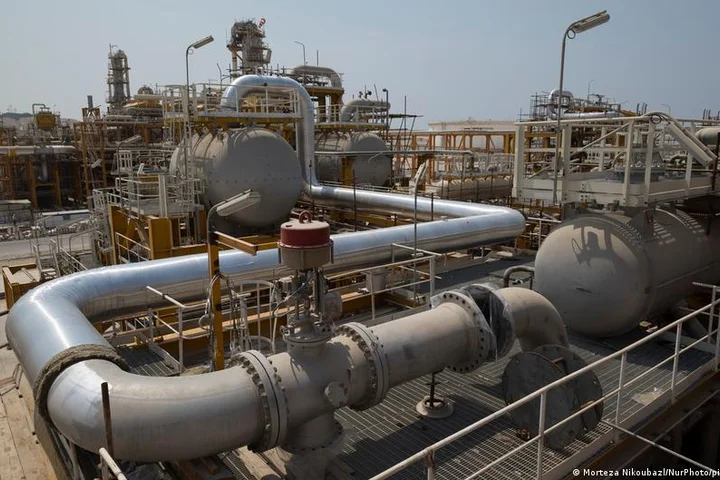
Iran has given ten conditions as it seeks a permanent end to the war, IRNA news agency reported.
Meanwhile, Israel has targeted a key petrochemicals site.
Follow DW for the latest.
Here are the main developments in the US-Israel war with Iran on Monday, April 6:
Trump calls ceasefire proposal 'a significant step'
US President Donald Trump confirmed on Monday that a 45-day ceasefire proposal had been presented to him, and that he studied it.
"It's a significant proposal, it's a significant step.
It's not good enough, but it's a very significant step," Trump told reporters during an Easter event at the White House.
"It could end very quickly, the war, if they do what they have to do.
They have to do certain things.
They know that, they've been negotiating I think in good faith."
He added that his Tuesday deadline to Iran was final.
The ceasefire proposal was reportedly put forward by Egyptian, Pakistani and Turkish mediators.
Trump's comments come after Iranian state news agency IRNA said that Tehran "has rejected a ceasefire and insists on the need for a definitive end to the conflict."
Meanwhile, Trump also gave an update on the two US troops whose fighter jet was shot down over Iran, prompting a dramatic search and rescue operation over two days.
"They are both recovering very well," Trump said.
"They were both injured, and they’re doing well."
Iran rejects ceasefire proposal - state media
Iran has rejected the latest ceasefire proposal, reportedly submitted by regional mediators, as it seeks a permanent end to the war, its state media reported on Monday.
"We won't merely accept a ceasefire," Mojtaba Ferdousi Pour, head of the Iranian diplomatic mission in Cairo, told The Associated Press.
"We only accept an end of the war with guarantees that we won’t be attacked again."
Tehran conveyed its response to mediator Pakistan, the official IRNA news agency reported.
Its response instead gave ten clauses, including an end to conflicts in the region, a protocol for safe passage through the strategic Strait of Hormuz , lifting of sanctions and reconstruction, the agency reported.
Israel deals 'severe economic blow' to Iran – defense minister
Israeli Defense Minister Israel Katz claimed on Monday that two strikes on Iranian petrochemical sites had dealt a "severe economic blow" to Iran .
Katz described the attack on the South Pars gas field plant at Asaluyeh on the Persian Gulf as a "powerful strike on the largest petrochemical facility in Iran," claiming it was responsible for "about 50% of the country's petrochemical production."
According to local Iranian officials, Israel also carried out a similar strike on the Mahshahr Petrochemical Special Zone in the southwestern Khuzestan province, close to the border with Iraq at the northern end of the Persian Gulf, adding that five people were killed.
"At this point, the two facilities, which together account for roughly 85% of Iran's petrochemical exports, have been taken out of operation and are no longer functioning," Katz said.
Iran: IAEA confirms strikes 75 meters from Bushehr nuclear power plant
The International Atomic Energy Agency (IAEA) confirmed on Monday that US-Israeli air strikes had impacted close to Iran 's Bushehr nuclear power plant – including one just 75 meters (250 feet) from the site's perimeter.
The United Nations ' atomic watchdog said its conclusion was based on independent analysis of new satellite imagery and detailed knowledge of the plant.
According to Iranian state media, Saturday's attack near the plant killed a member of security staff and damaged an ancillary building, although the plant itself was not damaged.
The head of Iran 's nuclear energy authority has criticized the IAEA for its perceived failure to act on repeated strikes near the power plant.
In a letter to IAEA Director General Rafael Grossi , Iran's Atomic Energy Organization chief Mohammad Eslami said the UN watchdog's inaction "emboldens aggression" and warned that such attacks risked the release of radioactive material into the atmosphere.
Such an event could have "irreparable consequences" for people, the environment and neighboring countries, he said.
Eslami described the attacks as a clear breach of international law, and criticized what he called a "lack of decisive action" by Grossi and the IAEA, saying mere expressions of concern were insufficient.
The Bushehr facility, Iran's only nuclear power plant, is located about 760 kilometers (470 miles) south of Tehran on the Persian Gulf, directly across from Kuwait and not far from Kharg Island, which US President Donald Trump has threatened to seize.
The plant's Russian reactor has been generating electricity since 2011.
The Russian state-owned nuclear company Rosatom is reportedly in the process of building a second reactor for the site.
Iranian South Pars gas site hit by fresh Israeli strike
Iran's Fars news agency reported a series of blasts near a refinery in the costal town of Asaluyeh, the heart of the Iranian gas industry.
The area is part of the South Pars natural gas field , the world's largest known gas reserve, providing some 70% of Iran's total gas supply.
Israeli Defense Minister Israel Katz on Monday said that Israel attacked the South Pars petrochemical plant at Asaluyeh, saying the strike targeted "the largest petrochemical facility in Iran ...
responsible for about 50% of the country’s petrochemical production."
An Iranian facility in the area was already targeted by Israel in mid-March, which was described as a major escalation at the time.
Iran responded to that strike by attacking a Qatari gas facility and causing significant damage.
US President Donald Trump had said he wasn't informed ahead of time about that strike, but added that Israel had promised to refrain from striking sensitive Iranian gas facilities in South Pars.
However, since then, Trump himself has threatened to target Iranian energy infrastructure if Iran does not open the Strait of Hormuz by a Tuesday deadline.
European Council chief says targeting civilian facilities 'illegal'
European Council President Antonio Costa said Monday that "any targeting of civilian infrastructure, namely energy facilities, is illegal and unacceptable," after US President Donald Trump threatened to bomb power plants and bridges this week if Iran did not reopen the Strait of Hormuz.
In a post on X, Costa said escalation would not achieve peace.
"Only negotiations will, namely the ongoing efforts led by regional partners," he said.
His statements come amid reports that a new ceasefire proposal has been presented to the US and Iran by regional mediators.
There was no official response from Washington or Tehran about the status of potential talks.
"The Iranian civilian population is the main victim of the Iranian regime," Costa wrote.
"It would also be the main victim of a widening of the military campaign."
Trump vows to hit more Iranian infrastructure
To view this video please enable JavaScript, and consider upgrading to a web browser that supports HTML5 video
Israel confirms 4 killed in Haifa apartment strike
The bodies of four people missing after an Iranian missile strike hit an apartment building in the northern Israeli city of Haifa were recovered on Monday, rescue services said.
The bodies of two victims had been pulled from the rubble on Sunday.
Two others were reported missing, and were located after an hours-long search effort.
Israel's military earlier said the seven-story building had taken a direct hit from an Iranian missile on Sunday.
According to Magen David Adom rescue service, an 82-year-old man was pulled from the rubble with serious injuries.
Two women, aged 77 and 38, reportedly sustained minor injuries.
A 10-month-old baby was injured in the head.
Iranian attack injures 6 in Kuwait
Kuwait's Health Ministry said six people were injured by "falling projectiles and debris in a residential area" in the north of the country as Iran launched attacks on Gulf countries Monday.
The United Arab Emirates also reported an injury after drone fragments fell onto an industrial area.
Iran also claimed to have targeted US forces on Kuwait's Bubiyan island in the Persian Gulf, but these reports were not immediately confirmed by the US military.
Civilian infrastructure in Gulf countries has come frequently under attack, and Gulf nations said air defenses had been activated in response to wave of fresh strikes from Sunday to Monday,
New strikes hit southern Beirut
Lebanese state media reported an Israeli strike on Beirut's southern suburbs on Monday, as the Israeli miliary said it was continuing to target Hezbollah militants.
The area south of the Lebanese capital is considered a Hezbollah stronghold, and its residents have largely left amid repeated Israeli attacks and evacuation warnings.
Live footage from AFP news agency showed smoke billowing from the area.
After Israel and the US launched attacks on Iran, Tehran-backed Hezbollah began launching strikes on northern Israel.
The Israeli military launched a ground invasion in parts of southern Lebanon targeting the militant group.
More than 1,400 people have been killed in Lebanon, and 1 million displaced since hostilities resumed.
Israel strikes Hezbollah sites in Beirut
Top Iranian intelligence official killed in strikes
The intelligence chief of Iran's Revolutionary Guards, Majid Khademi, was killed in an Israeli airstrike on Monday, Iranian state media reported, without sharing more details.
Israeli Defense Minister Israel Katz confirmed that Israel had targeted Khademi.
"The Revolutionary Guards are shooting at civilians and we are eliminating the leaders of the terrorists," Katz said.
"Iran's leaders live with a sense of being targeted.
We will continue to hunt them down one by one," he added.
Khademi was among 25 people killed in a wave of US and Israeli airstrikes on Iran on Monday.
Iran also fired drones and missiles at targets in the Gulf and Israel.
At least two people were killed in Israel's Haifa in an Iranian missile strike on an apartment late Sunday.
Several senior Iranian security officials have been killed since the war began, among them security chief Ali Larijani , and the Guards' commander-in-chief Mohammad Pakpour.
Analysts have pointed out that a decentralized command structure has enabled Iran's regime to continue coordinating attacks, even when senior officials are killed.
US, Iran presented with draft ceasefire proposal: reports
The US and Iran have received a draft ceasefire proposal calling for a 45-day halt in fighting and the reopening of the Strait of Hormuz, according to unnamed officials speaking to news agencies on Monday.
The Associated Press reported that the proposal came from Egyptian, Pakistani and Turkish mediators , and it was sent late Sunday night to both Iranian Foreign Minister Abbas Araghchi and US Mideast envoy Steve Witkoff.
Iran and the US have yet to officially respond.
An unidentified Iranian official told Reuters news agency that Iran would not reopen the strait as part of a temporary ceasefire, and would not accept any deadlines to review the proposal.
The reports of a ceasefire plan come after US President Donald Trump issued a new Tuesday deadline for Iran to reopen the strait or else face attacks on energy infrastructure.
Can Pakistan stop the Iran war?
South Korea seeks alternative oil supply amid Hormuz crisis
South Korean officials say diplomatic efforts are underway to secure alternative oil supplies as the conflict in the Middle East continues to disrupt global energy shipments.
South Korea's economy is heavily dependent on crude oil imports, with some two-thirds of its total transiting the Strait of Hormuz .
The threat of Iranian strikes on shipping vessels has largely closed the vital waterway since the war began in late February, setting off a global shock in energy supplies .
In mid-March, Seoul released part of its strategic oil reserve to cushion short-term shortages.
On Monday, ruling Democratic Party lawmaker Ahn Do-geol told reporters that South Korean authorities are working with oil-producing countries like Saudi Arabia, Oman and Algeria to secure alternative routes.
This could include dispatching special envoys to assist in the process.
Additionally, South Korea's Industry Ministry is planning the deployment of South Korean-flagged oil tankers on the Red Sea route.
The tankers would be sent to the Red Sea port of Yanbu in Saudi Arabia, from where crude oil arrives via pipelines from The Gulf for export.
Why reopening the Strait of Hormuz by force is so dangerous
Israeli rescuers search for missing after deadly Haifa strike
Israeli rescuers are continuing to search for missing people after an apartment building in the northern city of Haifa was hit by an Iranian missile on Sunday and partially collapsed.
Firefighters said they were looking for two missing people in the rubble.
Two others had earlier been found dead.
The seven-story building took a direct hit, the military said.
Dozens of Israeli security and rescue service personnel were deployed at the site, according to AFP news agency.
Iran launches fresh strikes after issuing warning
Israel, Kuwait and the United Arab Emirates reported fresh missile and drone fire early on Monday.
There were no immediate reports of major damage or injuries.
Kuwait's army said its air defenses had been working intercepting missiles and drones in the morning, after responding to a similar barrage overnight.
In Abu Dhabi, authorities were responding to an incident of falling debris from an intercepted projectile on to an industrial facility.
A Ghanaian man was injured by the falling shrapnel.
And the Israeli military said it had identified missiles launched from Iran, with air defenses working to intercept.
Hours earlier, Iran's central military command warned of "devastating and widespread" retaliatory operations if civilian targets in Iran were hit.
The warning came after US President Donald Trump threatened to destroy Iran's civilian infrastructure if Tehran did not open the Strait of Hormuz.
Gas outages hit Tehran after strike on university, Iran state TV reports
Gas outages have been reported in parts of Tehran after a strike on a university, Iran's state broadcaster said on Monday.
The attack "hit the Sharif University gas station and we are facing a temporary gas outage in the Sharif neighborhood," state broadcaster IRIB quoted the head of Tehran's District 9 neighborhood as saying.
Related Stories
Source: This article was originally published by Deutsche Welle (DW)
Read Full Original Article →
Comments (0)
No comments yet. Be the first to comment!
Leave a Comment