
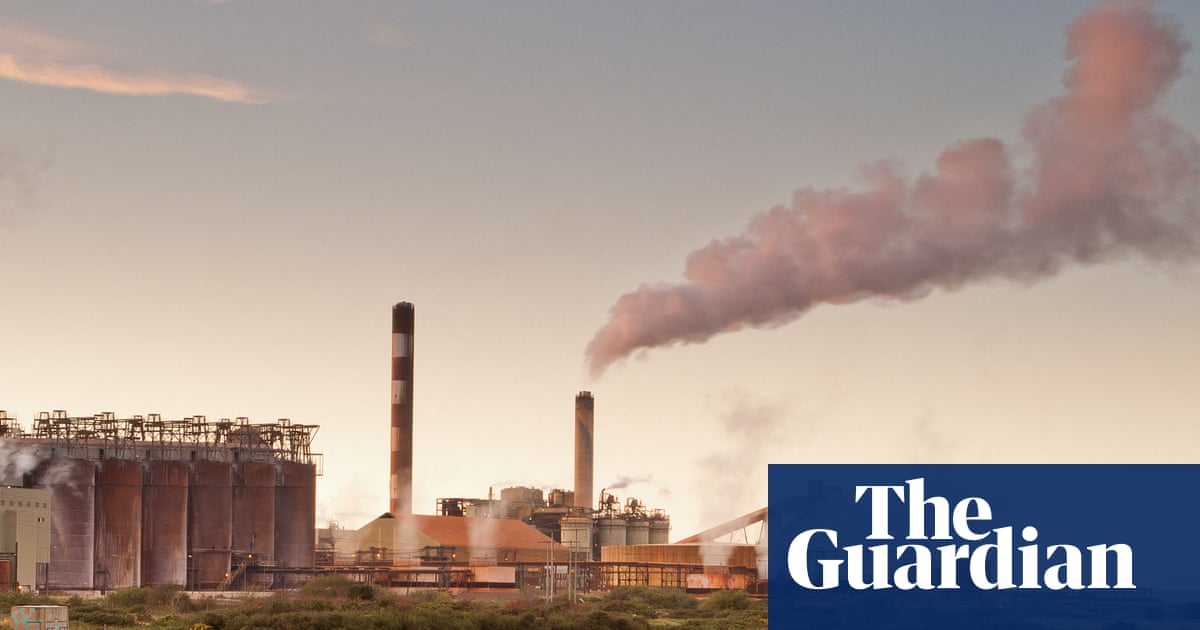
Shipments to Russian smelters from Aughinish Alumina have increased sharply since the invasion of Ukraine
A leading Irish metals refinery is part of an international aluminium supply chain that appears to conclude with shipments to arms producers feeding the Kremlin’s war machine in Ukraine , leaked records and public data suggests.
Trading records show that shipments to Russian smelters from Aughinish Alumina, which is located on the Shannon estuary in the west of Ireland and has been owned by the Russian aluminium group Rusal since 2006, have increased sharply since the invasion of Ukraine in 2022.
Ireland exported $243m (£180m) of alumina to Russia in 2022 , according to the Observatory of Economic Complexity (OEC), a data analytics website,and this rose by 55% to $376m in 2024 .
Aughinish is Ireland’s only producer of alumina and the largest producer of the main raw material for making aluminium in Europe, according to a 2021 report by the accounting group KPMG .
The rising trade with Russia does not appear to breach sanctions law and can be interrogated via publicly available shipping records.
The records also appear to misalign with previous reassurance from the Irish government.
In 2022, Ireland’s then public expenditure minister of state, Patrick O’Donovan, told the country’s parliament that the plant “is not in any way connected to a war machine”.
Having been presented with findings from the new data, Aughinish representatives did not comment when asked by the Guardian and the OCCRP how the facility ensured products had not contributed to Russian assaults on Ukraine.
O’Donovan did not comment.
Prof Aristides Matopoulos, a defence supply chains specialist from Cranfield University, said: “Defence supply chains are inherently multi-tier and cross-border, which creates structural gaps that can render sanctions architecture not fully fit for purpose.
“When you trace the supply chain – from bauxite mine to alumina refinery, to smelter, to trading intermediary, and ultimately to a weapons producer – it becomes clear that every node in the chain could appear fully compliant while still enabling strategic materials to reach sanctioned end users.
This is because end-use tracing of commodities such as alumina across opaque supply chains, while technically possible, remains highly challenging in practice.”
A spokesperson for Aughinish said: “We operate in strict compliance with all applicable EU laws, including sanctions, export control measures and trade regulations.
We uphold a strong commitment to lawful and responsible business practices and continuously monitor regulatory developments to ensure the highest standards of compliance.
The company implemented a robust sanctions compliance and due diligence framework covering its entire supply chain.”
The Aughinish refinery was built in the 1970s by the aluminium giant Alcan as Ireland prepared to join what was then the European Economic Community (EEC).
The facility was acquired by the commodity trader Glencore, which then joined forces with the Russian aluminium groups Rusal and SUAL in 2006 to create the “ world’s biggest aluminium producer ”.
The plant is one of the largest employers in the west of Ireland, and was reported as employing about 900 staff and supplying about 30% of the EU’s alumina, for use in everything from medical devices to mobile phones, according to the KPMG report.
Rusal’s refinery in Aughinish extracts aluminium oxide – otherwise known as alumina – from the sedimentary rock bauxite.
The alumina is then shipped to several Russian sister companies in the wider Rusal group, including a huge smelter at Krasnoyarsk, the second largest city in Siberia, where it is converted into aluminium.
Analysis of public records suggests that almost 500,000 tonnes of alumina, worth about $200m, was exported from Aughinish to Krasnoyarsk in 2024, which accounted for around two-thirds of the aluminium oxide imported into Russia by that Rusal smelter that year.
The quantities of Irish alumina shipped appear to satisfy about 25% of the Siberian facility’s annual aluminium output of 1m tonnes .
During the same period, aluminium produced at Krasnoyarsk was sold through Rusal’s in-house trading firm, OK Rusal TD, to a third-party trading company called Aluminium Sales Company (ASK), the leaked records suggest, with ASK seeming to have paid Rusal about $300m in 2024.
Meanwhile, ASK customers include dozens of under-sanctions arms companies that have produced missiles, explosives and long-range bombers that have been used in attacks on Ukraine.
For example, during 2024, ASK’s largest client appeared to be the Sverdlov plant in the Russian town of Dzerzhinsk, about 250 miles to the east of Moscow, which manufactures missile casings and explosives and was said by Ukrainian forces to have been targeted by its forces in October .
The Sverdlov plant is Russia’s only significant maker of the high explosives RDX and HMX , according to a Ukrainian intelligence official and the Council of the European Union, which placed the company under sanctions in 2023 .
In total, companies that manufacture weapons paid ASK $337m for aluminium under Russian state defence contracts from February 2022 and April 2025, according to the leaked documents.
Spokespeople for ASK, Rusal, EN+ and Deripaska did not respond to invitations to comment on the analysis of the data when approached by the Guardian – including questions on whether the use of an intermediary trading company was a method of avoiding sanctions.
Rusal’s Aughinish’s spokesperson said: “We particularly underline the fact that both alumina and aluminium are an internationally recognised basic commodity, the very nature of which means they serve broad general purpose societal needs and vital for countless civilian industries.
“We believe, that any attempt to state the contrary is flawed and seeks to create a biased narrative.
Especially singling out one company for criticism in this manner discredits legitimate and vital business operations supporting thousands of workers, contractors and families, bringing economic value.”
A spokesperson for Ireland’s department of enterprise, tourism and employment said: “The general principle of EU sanctions on Russia is that their imposition does not have a greater impact on a European member state than on Russia itself.
The Aughinish plant is not subject to sanctions by the EU, nor has it been proposed by the EU for sanctions.
Alumina is also not a sanctioned good therefore its export to other countries, including Russia, is not restricted.
The Irish authorities are committed to ensuring all sanctions are observed once they take force.
“Ireland remains unequivocal in its continuing support for Ukraine in light of Russia’s unjustified invasion.”
The Guardian app has a tool to send tips about stories.
Messages are end to end encrypted and concealed within the routine activity that every Guardian mobile app performs.
This prevents an observer from knowing that you are communicating with us at all, let alone what is being said.
When asked who you wish to contact please select the ‘Business (UK & Global)’ team.
Our guide at theguardian.com/tips lists several ways to contact us securely, and discusses the pros and cons of each.
Related Stories



Source: This article was originally published by The Guardian
Read Full Original Article →
Comments (0)
No comments yet. Be the first to comment!
Leave a Comment