
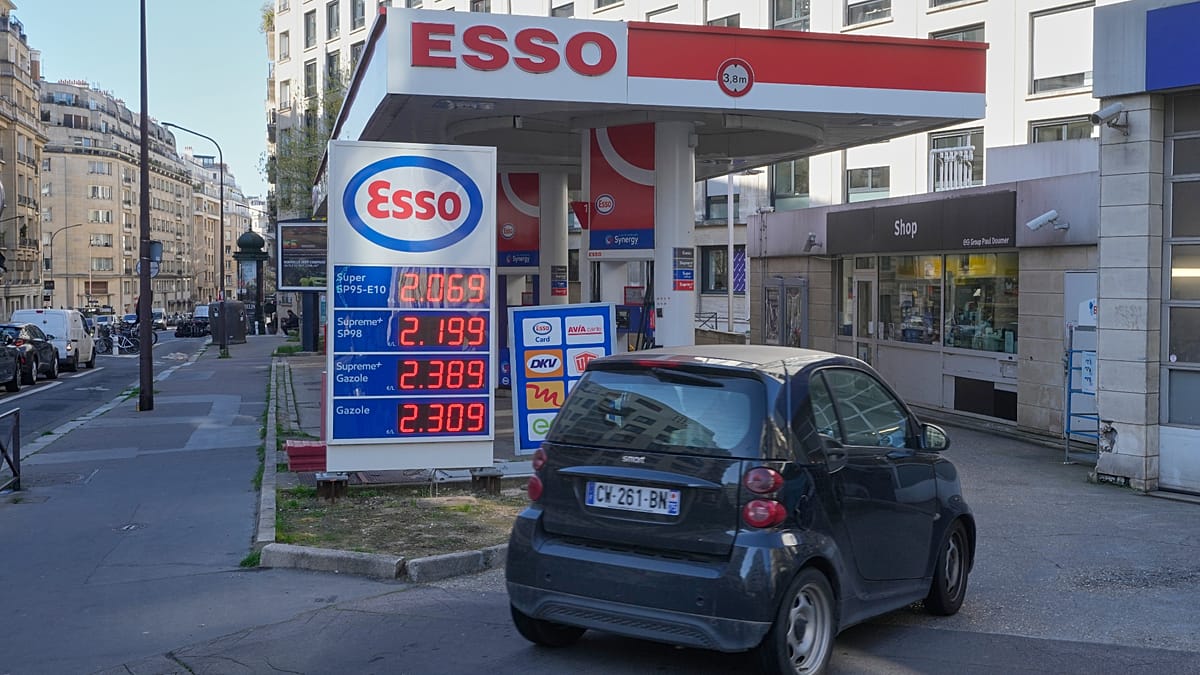
A car drives into a gas station as gasoline prices are displayed in Paris, Monday, March 9, 2026
-
Copyright
Copyright 2026 The Associated Press
Copyright Copyright 2026 The Associated Press
Published on
24/03/2026 - 11:20 GMT+1
The Iran conflict has handed Europe its most punishing economic combination in years — stagflation
With input costs surging, output stalling and confidence collapsing, the ECB's window of stability seems to have closed.
The war in the Iran — and the surge in oil prices it has unleashed — is already inflicting measurable damage on eurozone business activity, supply chains, and business confidence
The result: the sharpest stagflation alarm from European survey data in years.
According to flash Purchasing Managers’ Index (PMI) surveys from S&P Global released Tuesday, Eurozone business activity lost momentum in March as rising energy prices pushed input costs to their highest level in more than three years
The convergence of slowing growth and accelerating prices — a classic stagflationary mix — is the economic scenario policymakers fear most.
Stagflation alarm bells
The headline eurozone composite PMI came in at 50.5 in March, down from 51.9 in February and below the 51.0 consensus — the weakest reading in ten months, barely above the stagnation threshold
But the more alarming signal is not the lack in growth — it is the simultaneous inflation surge.
Input cost inflation across the eurozone accelerated to its fastest pace since February 2023, driven by soaring energy prices, fuel costs and maritime freight disruptions directly linked to the conflict in the Middle East and the heightened threat to shipping through the Strait of Hormuz
Supplier delivery times lengthened to their most severe since August 2022, as goods producers scramble to secure inputs amid choking supply chains.
"The flash Eurozone PMI is ringing stagflation alarm bells as the war in the Middle East drives prices sharply higher while stifling growth," said Chris Williamson, chief business economist at S&P Global Market Intelligence
"The drop in future output expectations was the largest recorded since Russia's invasion of Ukraine in 2022," he continued.
The survey data, according to S&P Global's economists, are consistent with eurozone GDP growth slowing to a quarterly rate of just below 0.1% in the first quarter — dangerously close to stagnation
Meanwhile, the price gauge implies consumer price inflation could accelerate toward 3%, complicating the European Central Bank's policy calculus at precisely the wrong moment.
Eurozone manufacturing at a turning point
PMI hits 44-month highCould inflation in Europe make an unexpected comeback in 2026?
Eurozone services activity stalls as uncertainty rises
The growth slowdown was primarily driven by the services sector, where activity came close to stagnation
New orders declined for the first time in eight months, reflecting weaker demand and heightened uncertainty.
By contrast, manufacturing output showed modest resilience, supported in part by a temporary rise in orders as firms sought to frontload purchases and avoid potential supply disruptions
The war’s impact is also evident in logistics
Companies reported widespread delays in supplier deliveries, often linked to disruptions in maritime transport and rising shipping costs.
Inventories continued to fall as firms struggled to secure inputs, while purchasing activity picked up slightly as businesses attempted to build buffers against further disruptions.
Germany: Manufacturing boom masks a fragile picture
Germany remained in expansion territory, with its composite PMI at 51.9, although this marked a three-month low
Manufacturing was the main bright spot, with outputs rising at the fastest pace in more than four years
The Germany Manufacturing PMI surged to 51.7, a 45-month high, handily beating the 49.5 consensus
The explanation, however, is not reassuring: German manufacturers are reporting a demand surge driven by fear.
Companies are front-loading purchases and building up inventories specifically to hedge against anticipated supply disruptions from the Middle East conflict
Phil Smith, economics associate director at S&P Global Market Intelligence, noted that the acceleration in manufacturing is "likely short-lived" and that the supply-chain pressures now building — with average lead times on inputs lengthening to the greatest extent in three-and-a-half years — are already feeding directly into the sharpest spike in manufacturing input costs since late 2022.
German services activity weakened notably, reflecting falling new business and rising cost pressures.
Services companies reported clients pulling back on spending amid heightened uncertainty and sharply rising costs — a consumer and business sentiment squeeze that threatens to widen in the months ahead.
France: No recovery cushion to absorb the shock
France's picture is considerably more concerning
The flash France Composite PMI fell to 48.3 in March, a five-month low, missing the 49.3 consensus and decisively back into contraction territory
Both manufacturing output (48.5) and services activity (48.3) contracted, with the services sector posting its fastest decline since October 2025.
Unlike Germany, France entered this external shock without the buffer of a strong industrial recovery
New orders shrank at the sharpest rate since July 2025, with businesses citing the war in the Middle East, generalized geopolitical uncertainty, and client hesitancy ahead of local elections as converging headwinds
International demand for French goods and services dropped at the steepest pace in 15 months.
"France's burgeoning recovery looks to be on ice," said Joe Hayes, principal economist at S&P Global Market Intelligence.
"A sharp reduction in business confidence backs this assessment, with the threat of higher inflation, prolonged supply-side disruption and heightened near-term uncertainty prompting a re-evaluation of the outlook," he continued.
The inflation picture in France carries a distinctive characteristic: input costs surged to their highest since November 2023 — with manufacturing input prices near a three-and-a-half-year high driven by oil, oil-based products, copper, stainless steel, and aluminium.
Yet selling prices rose only marginally, as subdued pre-war demand conditions left companies with insufficient pricing power to pass costs through
This margin compression dynamic could prove a critical stress point for French corporate earnings in the quarters ahead.
ECB's policy dilemma deepens
The March PMI data place the European Central Bank in an increasingly uncomfortable position
With growth slowing toward stagnation across the eurozone and inflation simultaneously re-accelerating — driven not by demand but by a geopolitical supply shock — the standard monetary policy toolkit offers no clean answers.
“The ECB is no longer in a ‘good place’,” Williamson noted, warning that the risk of stagflation is rising if energy prices remain elevated and supply disruptions persist.
The duration and intensity of the conflict — and its lasting impact on energy markets and global supply chains — will be the decisive variable.
Europeans anxious over wars and push for more EU independence
Trump backs down on ultimatum as EU seals trade deal with Australia
Latest news bulletin | March 24th, 2026 – Morning
Related Stories


Source: This article was originally published by Euronews
Read Full Original Article →
Comments (0)
No comments yet. Be the first to comment!
Leave a Comment