
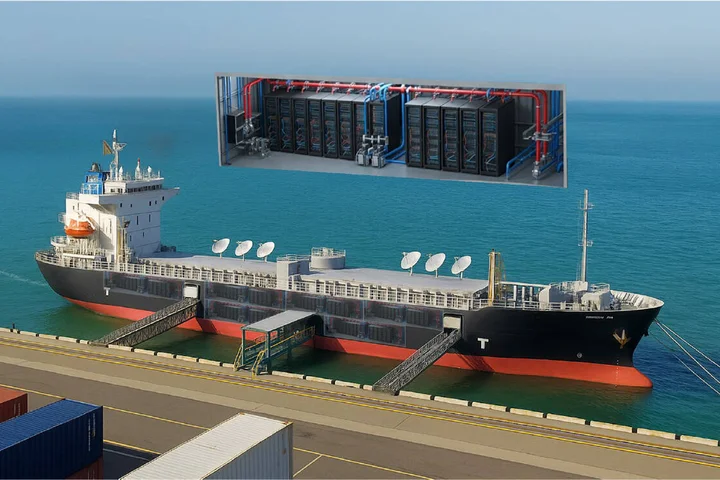
Second-hand ship, seawater cooling, with operations eyed for 2027
Japan is getting more serious about floating datacenters, as Mitsui OSK Lines (MOL) has agreed to a deal with Hitachi to develop one with operations targeted for 2027 or later.
The shipping company announced plans last year to kit out a vessel as a floating server farm, which would allow it to use seawater or river water for cooling purposes.
Now, it has signed a memorandum of understanding (MoU) with multinational conglomerate Hitachi and its subsidiary Hitachi Systems for the development, operation, and commercialization of a "Floating Data Center (FDC) converted from a second-hand vessel."
Based on this agreement, the companies will carry out feasibility studies for commercial operation of a floating bit barge, with a view to commencing operations in 2027 or later.
And reading between the lines, it looks like they expect this to be just the first.
Hitachi and Hitachi Systems already have experience owning and operating conventional land-based datacenters in Japan, as well as installing containerized data facilities and providing datacenter services in Malaysia and the US.
The pair will take the lead on the IT infrastructure design, installation, and operation, as well as winning customers and clarifying their requirements.
As a shipping line, MOL will be responsible for planning vessel conversions, leading discussions with port authorities and other stakeholders, and taking care of maritime operational requirements such as mooring and maintenance.
As many Reg readers will know, demand for server farms has accelerated recently, partly because of the generative AI fad.
This has created a need for a diverse range of facilities to address factors such as location, availability of water resources for power generation and cooling, surrounding infrastructure, and disaster risks, according to MOL.
The firm says that using converted ships for datacenters eliminates the need to secure large plots of land to build on, as well as shortening the construction time to as little as one year.
Japan, like many developed nations, has a shortage of available land, and most of the country's existing data campuses are concentrated around Tokyo and Osaka.
Mitsui / Hitachi's conceptual illustration of their floating datacenter - Click to enlarge
When this concept was first floated (sorry), MOL said it expected to use an unidentified 120-meter, 9,731-ton ship for the conversion, with the work scheduled to happen sometime this year.
Now, however, it talks of examining a car carrier, which could mean a roll-on, roll-off cargo carrier or ferry.
Finding one with a cargo area of approximately 54,000 m² (580,000 square feet) would rival one of Japan's largest existing datacenters in terms of total floor space, it states.
Last year, the shipping company also signed an MoU with a Turkish firm that operates powerships - vessels that function as electric power generators – with an eye to delivering energy for its floating bit barge this way.
Now it is looking to use existing onboard systems, such as air conditioning, water intake, and power generation, in order to reduce the initial investment required.
We asked MOL for further details on its floating datacenter scheme, and will update if we get answers.
®
Related Stories



Source: This article was originally published by The Register
Read Full Original Article →
Comments (0)
No comments yet. Be the first to comment!
Leave a Comment