
Donald Trump has tasked his vice president JD Vance with shoring up a shaky ceasefire at the high-level talks with Iran in Islamabad.
Iran has threatened to break the truce over Israel's strikes on Lebanon.
DW has more.
Welcome to DW's coverage of the US-Israel war with Iran and the wider conflicts in the Middle East on Friday, April 10:
Friday prayers for late supreme leader Khamenei
Thousands of Iranians gathered in Tehran on Friday to pray for Iran's late supreme leader, Ayatollah Ali Khamenei, who was killed in the first wave of US-Israeli airstrikes on February 28.
The mourning ceremonies for Khamenei began on Wednesday and coincided with the end of the traditional 40-day mourning period in Shia Islam.
UK's Starmer discusses Strait of Hormuz with Trump
British Prime Minister Keir Starmer said on Friday that he discussed the logistical practicalities of restoring maritime traffic through the Strait of Hormuz with US President Donald Trump on Thursday night.
"We've been pulling together a coalition of countries [and] working on a political, diplomatic plan, but also looking at military capabilities and … the logistics of actually moving vessels through the Strait," Starmer said in Qatar , his final stop on a tour of the region following the announcement of a two-week ceasefire on Tuesday.
After meeting with leaders in the region, Starmer said they had insisted that "there can’t be tolling or restrictions" on commercial shipping through Hormuz, adding that ending the conflict "has to involve" Iran's neighbors in the Gulf who "have very strong views" on the future of the strait.
London: 'US is absolutely locked into NATO'
Starmer was also asked whether he raised US threats to withdraw from NATO with Trump following a Reuters report on Thursday which said the president had discussed removing some US troops from Europe.
He did not answer directly but insisted that the alliance was in both US and European interests.
"NATO is a defensive alliance which, for decades, has kept us much safer than we would otherwise have been," he said.
Back in London, British Defense Minister John Healey said the United States is still committed to the alliance.
"America is absolutely locked into, with benefits as well as massive contributions, to NATO," he said at the London Defense Conference.
"We have to do more.
We are, and we will, on the European side."
No longer special?
Britain's relationship with the US
To view this video please enable JavaScript, and consider upgrading to a web browser that supports HTML5 video
Ukrainian forces shot down Iranian drones in Gulf – Zelenskyy
Ukrainian President Volodomyr Zelenskyy said on Friday that Ukrainian military personnel have shot down Iranian "Shahed" drones across multiple Middle Eastern countries.
Zelenskyy did not identify the countries involved but said Ukrainian personnel had been helping to boost air defense systems across several nations.
He has previously said that over 200 Ukrainian experts have been deployed to the region.
"We demonstrated to some countries how to work with interceptors ," Zelenskyy told journalists in comments released on Friday.
"Did we destroy [drones]?
Yes, we did.
Did we do it in just one country?
No, in several."
Having been subjected to almost daily Russian drone assaults on its cities and along its eastern frontline for over four years now, Ukraine has become a world-leader in modern anti-drone warfare.
Many of the drones deployed by Russia are based on the Iranian "Shahed," which Tehran has launched against targets in the Gulf over the past month.
"Yes, they were shooting down Shaheds," confirmed Zelenskyy.
"This was not about a training mission or exercises, but about support in building a modern air defense system that can actually work."
Zelenskyy made whistle-stop visits to Saudi Arabia , Qatar , the United Arab Emirates and Jordan last week as Kyiv looks to bolster diplomatic support in the Middle East, offering its hard-earned drone expertise in exchange for military, financial and political support in its continuing fight against the Russian invasion .
"We are helping strengthen their security in exchange for contributions to our country's resilience," said Zelenskyy.
"This is about far more than simply receiving money."
Could the war in Iran benefit Ukraine?
WATCH: What is Israel's endgame with Hezbollah and Lebanon?
Mutual attacks between the Israeli military and the Lebanese Hezbollah militia continue despite planned direct talks between Israel and Lebanon.
DW speaks to Middle East security analyst Shukriya Bradost on a long-lasting conflict and what the US-Israel war with Iran has to do with it.
Saudi Arabia: major refinery closed after strike
French energy giant TotalEnergies said on Friday that it had shut down a major oil refinery on Saudi Arabia 's Gulf coast after it sustained damage in an Iranian attack earlier this week.
The SATORP refinery in the eastern city of Jubail was damaged in "incidents that occurred during the night of April 7 to 8, causing damage to one of the refinery's two processing trains," Total said.
No casualties were reported, but a Saudi energy ministry official told the Kingdom's SPA news agency that the attacks "disrupted several production operations at key facilities."
The SATORP site is a joint venture by Saudi state oil giant Aramco (which holds a 62.5% stake) and France's TotalEnergies (37.5%).
It processes 465,000 barrels of crude oil a day, making it one of the world's largest refining platforms.
Saudi Arabia's oil production capacity has reportedly been reduced by around 600,000 barrels per day due to Iranian on energy facilities.
Tension in Islamabad ahead of crunch US-Iran talks
Fresh paint on the sidewalks.
Every corner is marked by heightened security and an almost palpable quiet tension.
Islamabad is not just preparing for another diplomatic event; it is preparing for a moment the world is watching.
Set against the calm backdrop of the Margalla Hills, Pakistan’s capital has suddenly become the center of global attention.
Rare talks between US and Iranian officials are taking place here, drawing international focus to a city more accustomed to steady diplomacy than dramatic headlines.
The change in atmosphere is hard to miss.
Long lines of black SUVs move swiftly through streets that are otherwise subdued.
Police and military checkpoints control access to major roads.
Paramilitary Rangers stand guard outside key government buildings, their presence a visible sign of how sensitive these discussions are.
In the heavily secured Red Zone, the security of Islamabad’s diplomatic and administrative heart has been elevated to a new level.
Highways have been closed.
Nearby schools have shifted to online classes.
Some government offices have temporarily shut their doors to ease congestion and tighten control.
Shipping containers block off sections of the city, restricting movement for ordinary residents.
Even the capital’s famous hiking trails have been closed.
Large parts of Islamabad have effectively been sealed off, as Iranian officials and the US delegation led by Vice President JD Vance are expected to arrive in Islamabad on Friday, ahead of talks slated for Saturday.
Among the city's residents, emotions are mixed.
Many take pride in Pakistan hosting such crucial talks and potentially helping reduce tensions.
At the same time, there is unease.
People wonder whether the discussions will lead to meaningful progress or stretch on longer than hoped.
"Stakes are high, and I hope that the war will end, but it will not be easy," said Fatima Ali, a doctor in Islamabad.
For now, Islamabad waits, watchful, cautious, and aware that what happens here could echo far beyond its quiet streets.
Why Pakistan has emerged as a mediator between US and Iran
Pakistan 's role as a diplomatic mediator in an increasingly global conflict may have surprised some, but there are several good reasons for Islamabad's involvement.
And it's not the first time that Pakistan has stepped up, either.
Here's how Pakistan emerged as a key go-between in the Middle East conflict :
Can Pakistan stop the Iran war?
Spain calls on Iran to negotiate in 'good faith,' slams Israel over Lebanon
Spain has called on Iran to engage in negotiations with the United States "in good faith" during talks in Pakistan this weekend.
Spanish Foreign Minister Jose Manuel Albares told reporters in Madrid on Friday that he had spoken to his Iranian counterpart, Abbas Araghchi, "the day before yesterday" to convey that message and also asked him to halt "all missile and drone launches."
Madrid slams Israel over Lebanon
Spain, a member of both the European Union and NATO , has emerged as one of the most vocal Western critics of the US-Israeli war on Iran, and of Israel 's activities in the region generally, including in Gaza , Lebanon and the occupied West Bank .
Albares called Israel's most recent attacks on Lebanon, which killed over 300 people and left over 1,000 injured on Wednesday, "a disgrace on the conscience of humanity."
He added: "The level of violence, the violation of international law and international humanitarian law by Israel is unacceptable."
Spain's firm 'no' to Iran war: A new voice in Europe?
How Pakistan is preparing to host US-Iran talks
There was a visibly increased security presence in Islamabad's diplomatic quarter on Friday as Pakistan prepares to host high-level negotiations between United States and Iranian delegations.
A local holiday has been declared to minimize residents' movements, while more than 10,000 security personnel, including police, soldiers and paramilitary units, have been deployed.
"Pakistan welcomes all delegates, including journalists from participating nations, traveling in relation to Islamabad Talks 2026," Foreign Minister Ishaq Dar wrote on social media, confirming that visa restrictions for participants had been relaxed.
"To this end, all airlines are requested to permit boarding to all such individuals without visas," he added.
"Immigration authorities in Pakistan will issue visas on arrival."
According to the German news agency dpa, citing Pakistani security sources, talks between the delegations' respective diplomatic experts are scheduled for Friday, before the lead negotiators meet on Saturday.
If necessary, talks could potentially continue into Sunday.
The talks themselves are expected to be indirect, with the two delegations sitting in separate rooms while Pakistani officials shuttle proposals between them, mirroring the format used in earlier rounds of talks mediated by Oman .
US Vice President JD Vance is heading up Washington's delegation, along with President Donald Trump 's special Middle East envoy, real estate mogul Steve Witkoff, and son-in-law Jared Kushner.
Iran's parliament speaker, Mohammad Bagher Ghalibaf, and Foreign Minister Abbas Araghchi are expected to lead the Iranian delegation, but there were still mixed messages from Tehran regarding Iran's participation.
"The holding of talks to end the war is dependent on the US adhering to its ceasefire commitments on all fronts, especially in Lebanon," said a foreign ministry spokesman, referring to ongoing Israeli attacks on supposed Hezbollah targets in Lebanon .
"Once the travel plan is finalized, the composition of the delegation will also be announced," he added.
Whether any active members of Iran's powerful Islamic Revolutionary Guard Corps (IRGC) would be taking was also unclear, but the group did say it was committed to the ceasefire.
"We would like to inform you that the armed forces of the Islamic Republic of Iran have not launched anything at any country during the ceasefire hours until now," read an IRGC statement.
Vance heads to Pakistan for Iran talks as ceasefire strains
US Vice President JD Vance is heading to Pakistan to lead high-level talks with Iran as a fragile ceasefire risks collapsing.
President Donald Trump tasked Vance — long skeptical of foreign interventions — with seeking a resolution to the six-week war.
Vance is set to arrive in Islamabad alongside envoy Steve Witkoff and adviser Jared Kushner, who previously engaged in indirect negotiations with Iranian officials over nuclear and regional security concerns.
The White House has offered few details on whether the talks in Pakistan will be direct or indirect.
The meeting marks one of the highest-level US engagements with Iran in decades, with limited direct contact since Barack Obama spoke by phone with Hassan Rouhani in 2013.
Negotiators face major hurdles, with disagreements emerging almost immediately after the ceasefire announcement.
Iran has said the truce should include an end to Israeli operations in Lebanon, while Benjamin Netanyahu and Trump have rejected that interpretation.
Is the Iran truce already unraveling?
Washington to host Israel, Lebanon talks next week — reports
Israel and Lebanon will hold talks in Washington next week, the French AFP news agency reported, quoting an unnamed US State Department official.
"We can confirm that the Department will host a meeting next week to discuss ongoing ceasefire negotiations with Israel and Lebanon," the US official said.
Earlier on Thursday, Israeli Prime Minister Benjamin Netanyahu announced he had instructed his Cabinet to seek direct talks with Lebanon, pushing for the disarmament of the Iran-backed Hezbollah militant group.
AFP cited an unnamed Lebanese government official as saying Beirut required a truce before any negotiations with Israel.
Will Israel-Lebanon talks make a difference?
Kuwait accuses Iran of striking it amid ceasefire
Kuwait said on Thursday evening that it was targeted by drone attacks despite the ceasefire in place between Iran, the US and Israel, blaming Tehran.
A statement by Kuwait's Foreign Ministry carried by the state-run KUNA news agency said the attacks "targeted some vital Kuwaiti facilities." It reportedly caused significant material damage but no injuries.
Iran's Revolutionary Guard denied launching any attacks on Gulf countries during the ceasefire.
In a statement on state media, the Guard said that should it carry out any strike, it would publicly announce it in an official statement.
Kuwait was among the Gulf countries routinely targeted by Iran throughout the war in retaliation for US and Israeli strikes on the Islamic Republic.
Israel says struck Hezbollah positions in Lebanon
Israel continued its strikes on Lebanon , announcing early on Friday striking positions it said belong to the Iran-backed Hezbollah militant group.
The Israeli military said it hit some 10 launch sites that it said were used to fire projectiles at northern Israel.
Meanwhile in Israel, air raid sirens were activated amid media reports of overnight rocket fire from Lebanon.
Hezbollah said it had fired rockets toward Israel in response to what it said was a violation of the ceasefire.
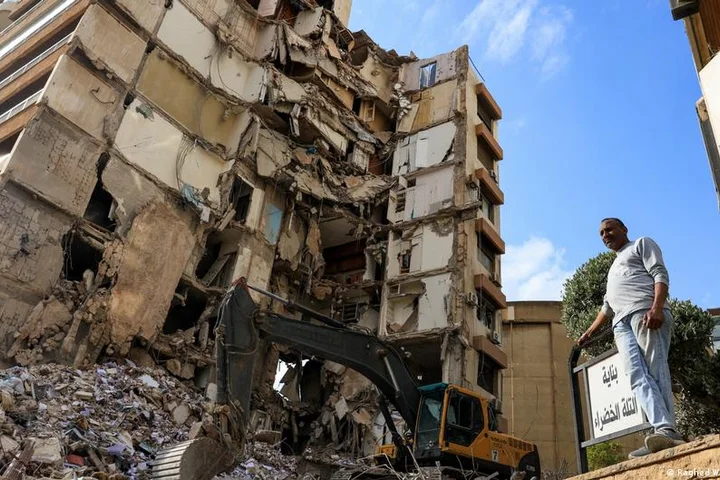
Israel intensified its attacks on Lebanon as the ceasefire went into effect on Wednesday, killing over 300 people in a single day.
Israel and the US deny that Lebanon is included in the ceasefire, which Iran and mediator Pakistan have strongly contradicted.
Several US allies condemned the Israeli strikes on Lebanon, wary that they might undo the already fragile ceasefire.
Israeli strikes in Lebanon kill, injure hundreds
A shaky two-week ceasefire between Iran, the US and Israel seems to be holding for the most part, despite multiple violations and a growing rift over whether Lebanon was included in the truce.
Here are the main headlines on the ceasefire from Thursday:
Israel bombed Beirut and southern Lebanon, killing over 300 people
The bombings came despite the US and Iran agreeing to a ceasefire on Wednesday
Iran has said negotiations with the US are 'meaningless' if Israel continues to attack Lebanon
UN, several US allies have warned the Israeli attacks on Lebanon threaten the ceasefire with Iran
Pakistan, France, Russia, the UK and other countries have called for Lebanon to be included in the ceasefire deal
Germany has said it will restart talks with Iran, while Spain is set to reopen its Tehran embassy
Israel's Netanyahu said he told his Cabinet to start talks with Lebanon 'as soon as possible'
Trump has warned Iran not to impose tolls on the Strait of Hormuz
You can read our live blog for all the biggest headlines on the war and the ceasefire from Thursday.
Stay tuned as we bring you all the latest today.
Related Stories

Source: This article was originally published by Deutsche Welle (DW)
Read Full Original Article →
Comments (0)
No comments yet. Be the first to comment!
Leave a Comment