
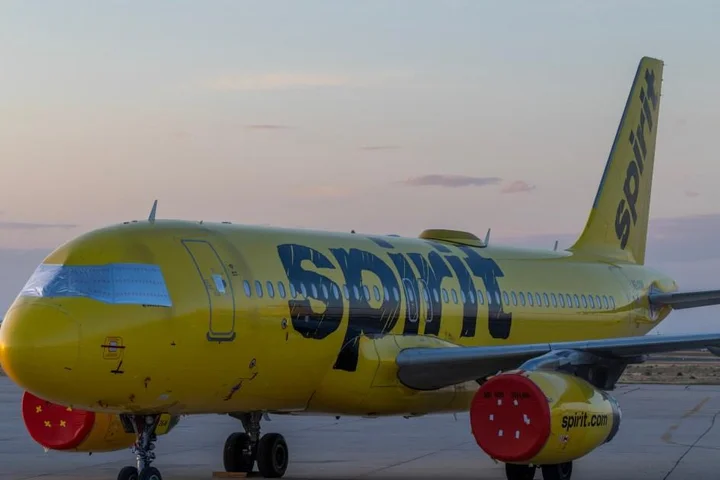
The news that Spirit Airlines has gone out of business has shaken the airline industry in the US , which is already grappling with fuel issues from the Iran War .
The ultra-low cost airline that once operated hundreds of daily flights on its bright yellow planes and employed about 17,000 people said it had ‘started an orderly wind-down of our operations, effective immediately.’
The airline said on its website that all flights have been cancelled and customer service is no longer available.
The shutdown was announced after the government declined a bailout for the cash-strapped business.
Spirit has struggled financially since the Covid-19 pandemic, weighed down by rising operating costs and growing debt, but the war in Iran has made the situation worse.
The fuel crisis has already claimed one UK airline, which cancelled all flights and operations immediately last week.
The Strait of Hormuz, which has effectively been blocked by Iran since February, handles approximately 20% of the world’s oil supply.
Its closure and the subsequent jet fuel crisis have had a massive impact on the aviation industry, with costs for a barrel skyrocketing from around $85 to $90 (£62 to £85) per barrel to $150 to $200 (£110 to £150).
While airlines around the world are cutting routes and introducing extra charges in an effort to manage soaring prices , Ascend is the first UK airline to have ceased operations because of it.
Which UK airlines have been affected by fuel prices?
Carriers around the world are cutting routes and introducing extra charges in an effort to manage soaring fuel prices driven by the ongoing conflict in the Middle East .
On April 16, head of the International Energy Agency (IEA), Fatih Birol, said Europe has ‘maybe six weeks or so [of] jet fuel left,’ warning passengers to expect cancellations into the summer months.
Aegean Airlines announced last week that it would raise ticket prices as a result of the spike, although hikes would be limited to around 7% to 8%.
Over 500 flights have been dropped from Aer Lingus ’s schedule, although it claims this is due to ‘mandatory maintenance’ on aircraft rather than the fuel crisis.
Air France said it has made ‘price adjustments’ to long-haul ticket prices to address surging costs, with return fares rising by €50 euros (£44) per round trip, while short and medium-haul round trips in economy increasing by €10 (£9).
The group’s Dutch arm, KLM, has also said it would cancel 160 flights in Europe over the coming month as a result of the fuel shortages.
In March, Air India began a phased expansion of a fuel surcharge on its domestic and international routes ‘necessitated by the steep rise in jet fuel prices arising from the geopolitical situation in the Gulf.’
Brixton drive-by shooting 'may be linked to South London stabbing on same night'
All new bookings for flights to and from Europe now incur a $125 (£92) fee, up from $100 (£74) before the conflict began.
However, the company noted it will be reviewing surcharges periodically, and may ‘make appropriate adjustments’ as required.
In March, British Airway s owner IAG said it did not plan to increase ticket prices in the short to medium-term, as it was well hedged for upcoming shortages.
However, on April 25, the group acknowledged it was ‘not immune’ to the ongoing fuel cost pressures linked to instability in the Middle East, and indicated that fares would likely rise to reflect higher jet fuel prices.
Dozens of other airlines have also been affected from the ongoing crisis.
Get in touch with our news team by emailing us at webnews@metro.co.uk .
For more stories like this, check our news page .
Arrow MORE: Marco Rubio seizes DJ decks at wedding with top button done up
Arrow MORE: Russian minister ‘dodges Putin’s security service and flees to US’ after sacking
Arrow MORE: King Charles brutally roasted in ‘hilarious’ SNL joke after US visit
Stay on top of the headlines with daily email updates.
This site is protected by reCAPTCHA and the Google Privacy Policy and Terms of Service apply.
Your information will be used in line with our Privacy Policy
Related Stories


Source: This article was originally published by Metro UK
Read Full Original Article →
Comments (0)
No comments yet. Be the first to comment!
Leave a Comment