
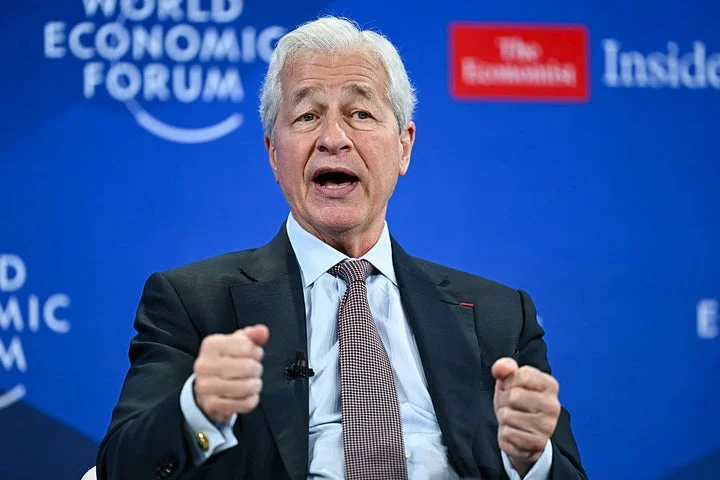
The CEO of JPMorgan Chase also seemed critical of Donald Trump distancing himself from allies
The head of JPMorgan Chase has warned the world will face “significant” interest rate shocks as a consequence of Donald Trump’s war on Iran.
Jamie Dimon said spiralling oil and gas prices, which have skyrocketed following Iran’s blockade of the key shipping lane, the Strait of Hormuz, and its attacks on regional energy infrastructure, would lead to “stickier” inflation that could push up interest rates.
Higher interest rates mean more costly borrowing of money for loans and investments, as well as mortgages, government borrowing costs and more.
They are also associated with lower economic growth, as firms do not spend as much on new projects or hiring, and consumers spend less on non-essential items as they manage household finances amid rising essential bills.
Mr Dimon warned: “Now, because of the war in Iran, we additionally face the potential for significant ongoing oil and commodity price shocks, along with the reshaping of global supply chains, which may lead to stickier inflation and ultimately higher interest rates than markets currently expect.
“Nations that are heavily dependent upon imported energy are already seeing the effects.
And it’s not just energy, it’s commodity products that are byproducts of oil and gas, like fertiliser and helium.”
“Given our complex global supply chains, countries are experiencing disruptions in shipbuilding, food and farming, among others.
“The outcome of current geopolitical events may very well be the defining factor in how the future global economic order unfolds – then again, it may not.”
Brent crude oil prices fell to below $100 again at the start of April, but have since risen once more.
On Tuesday, it sits at $110.
Last month, the Bank of England (BoE) voted 9-0 to maintain interest rates at 3.75 per cent, due to the uncertainty over the war in the Middle East, which had only just started.
The Monetary Policy Committee (MPC), which votes on any such rate changes, is set to meet again on 30 April, with a big division currently visible between economists and market rates.
Traders in money markets are currently betting on two interest rate increases this year, but as recently as two weeks ago, that was close to four rate increases .
However, what traders bet on is not always the same as an expectation of what will actually happen.
Most major economists have so far stuck to expectations of the BoE maintaining rates for the first half of 2026 at least, while some were even still pricing in a cut later in the year.
An extra problem for the MPC is that while lifting rates is the usual response to inflation, cutting them is typically the antidote to poorly performing economies and rising unemployment - both of which the UK currently faces.
Likely, some domestic-focused analysts may now update their outlook in the coming weeks, with the new financial year getting underway and the MPC vote on the horizon, as well as Mr Trump ’s latest deadline for Iran to reopen the Strait, which expires on Tuesday night.
Prolonged oil prices at elevated levels are far worse than high spikes when it comes to energy prices and subsequently raised expectations for inflation, which is expected to hit somewhere around 4 per cent for the UK this year, but more than double that level when it comes to food prices .
Meanwhile, the Organisation for Economic Co-operation and Development (OECD) last week predicted both the BoE and the US Federal Reserve would maintain rates at their present levels throughout this year.
The Bank of Japan is expected to lift interest rates this month, while the European Central Bank is forecast to raise rates up to three times this year by several major banks - including Dimon’s JPMorgan Chase.
Such a move could not only weaken the US, the Wall Street giant said, but could in time make other nations susceptible to the whims of “bad actors”.
“Economic weakening of the world’s democracies or a fragmentation of their economic bonds could lead to truly adverse consequences.
This is precisely what some of our adversaries and many autocratic nations want – it is their stated objective,” he said.
“They would like to see all of our allies far less dependent on the United States and therefore far more dependent on them.
In this scenario, many countries would be compelled to seek deeper economic bonds with some possible bad actors – over time, they could become vassals of these countries and unable to avoid coercion from them.”
Join thought-provoking conversations, follow other Independent readers and see their replies
Related Stories

Source: This article was originally published by The Independent
Read Full Original Article →
Comments (0)
No comments yet. Be the first to comment!
Leave a Comment