
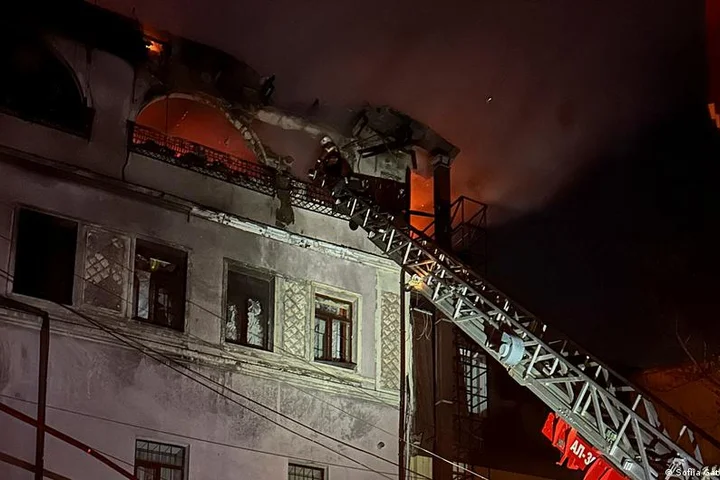
Ukrainian authorities say Russia is deploying "new tactics" as the city of Kharkiv comes under rolling aerial assaults from missiles and drones fitted with jet engines.
Six people have been killed across Ukraine.
Ukraine 's second-largest city, Kharkiv , was facing wave after wave of Russian air strikes on Thursday night and Friday morning, Ukrainian officials said, as Russia's full-scale assault on its neighbor continued into its 1,500th day.
According to local authorities in Kharkiv, which lies just 40 kilometers (about 25 miles) from the Russian border in northeastern Ukraine, four rocket attacks took place overnight and at least 20 drones struck the city, damaging houses and offices and injuring five people, including an eight-year-old girl.
The rockets were reportedly followed by repeated drone attacks, with Moscow deploying Iranian -built Shahed drones fitted with jet engines, which can cover the short distance from Russia to Kharkiv so quickly that they are difficult to shoot down.
In the capital Kyiv and its surrounding areas, "massive" daytime Russian missile and drones strikes on Friday had killed at least one person, the head of the local military administration, Mykola Kalashnyk, said.
Three more people were killed in Ukraine's northern Sumy region, one person was killed in the northwestern Zhytomyr region and another in Kharkiv, local officials said.
The Ukrainian Air Force said on Friday that Russia had launched a total of 542 drones and 37 missiles since Thursday night targeting Ukraine's critical infrastructure facilities.
Air defence units reportedly shot down 515 drones and 26 missiles.
Zelenskyy accuses Russia of 'Easter escalation'
Ukrainian President Volodymyr Zelenskyy on Friday accused Russia of escalating its attacks on Ukraine just days before Easter and said he spoke by phone with Pope Leo XIV during the latest aerial assaults.
"At the very moment of our conversation, the Russians attacked Ukraine yet again," Zelenskyy said.
"The Russians have only intensified their strikes, turning what should have been silence in the skies into an Easter escalation."
Zelenskyy had previously said Kyiv was prepared for a truce over the Easter holidays, but the Kremlin said it had not received any proposals.
"Russian terrorists reject diplomacy and peace efforts," said Ukrainian Foreign Minister Andrii Sybiha on X.
"They must get strong responses that they deserve."
The attacks come as peace talks brokered by the US have stalled in recent weeks due to the war in the Middle East, which has also led to uncertainty over future supplies of weapons to Ukraine.
But Zelenskyy said he had invited US negotiators to Kyiv, saying: "The delegation will do everything possible under the current circumstances – during the war with Iran – to come to Kyiv.
"This is an alternative format to a trilateral meeting at the level of technical teams."
Ukraine: Russia using 'new tactics'
"We see that the enemy is using new routes, increasingly modernized drones and new tactics," said a Ukrainian Air Force spokesman on state television.
It's the second time this week Russia has followed up an overnight drone barrage with heavy daytime attacks — seemingly a new tactic as Moscow probes ways to penetrate Ukraine's air defenses.
"The enemy is exerting [pressure] on our population, paralyzing the work of certain public institutions, as well as learning institutions," the spokesman said.
Such is the scale of the ongoing attacks that Poland also scrambled fighter jets, the Polish armed forces confirmed on Friday morning.
"Due to the activity of the Russian Federation's long-range aviation, which is carrying out strikes on the territory of Ukraine, military aviation operations have commenced in our airspace," the Polish army wrote on social media.
"Duty jets have been scrambled, and ground-based air defense systems as well as radar reconnaissance have reached a state of maximum readiness."
Russia: Ukrainian drones intercepted
Meanwhile, the Russian Defense Ministry claimed to have intercepted 192 Ukrainian drones overnight, which, based on their flight paths, were possibly targeting oil export facilities near the northern port city of St.
Petersburg .
In Moscow , one-time Russian president and outspoken firebrand Dmitry Medvedev said Russia should drop "tolerant attitude" towards Ukraine's possible future membership of the European Union .
"The EU is no longer just an economic union; it can transform, and rather quickly, into a full-blown military alliance, overtly hostile to Russia, and in some ways worse than," claimed Medvedev who, when he's not posting on social media, serves as deputy chairman of Russia's Security Council.
"It's time to the tolerant attitude toward our neighbors joining what is now a military economic European Union," he said.
Medvedev added that, while he did not believe the United States would leave the NATO military alliance as President Donald Trump has threatened, Washington could make symbolic moves such as cutting the number of US troops deployed in other NATO countries.
He posited that the "obvious divisions" within NATO could push the EU towards becoming more than simply an economic union.
Zelenskyy: currently no 'large-scale threat' on frontline
Meanwhile, President Volodymyr Zelenskyy said on Friday that the situation along the 1,200-kilometer (745-mile) frontline in eastern Ukraine was largely stable and "slightly in the positive" from Ukraine's point of view.
"At this point, we do not see a large-scale threat," he said, claiming that Ukrainian forces repelled a Russian offensive last month.
"The offensive they were planning for March was thwarted by the actions of our armed forces," he said, but predicted that "the Russians will now simply step up their assault operations."
Russia controls just under 20% of Ukraine's territory – much of which was seized before the 2022 full-scale invasion.
Russian President Vladimir Putin has said that full control of Ukraine's eastern Donbas region is a prerequisite for any ceasefire negotiations, but open source intelligence suggests the pace of the Russian advance has slowed considerably since last year, with troops capturing only around 500 square kilometers since the start of January.
"Overall, the front line is holding," said Zelenskyy.
"The situation is complex, but it's the best it has been in the last 10 months."
Related Stories



Source: This article was originally published by Deutsche Welle (DW)
Read Full Original Article →
Comments (0)
No comments yet. Be the first to comment!
Leave a Comment