
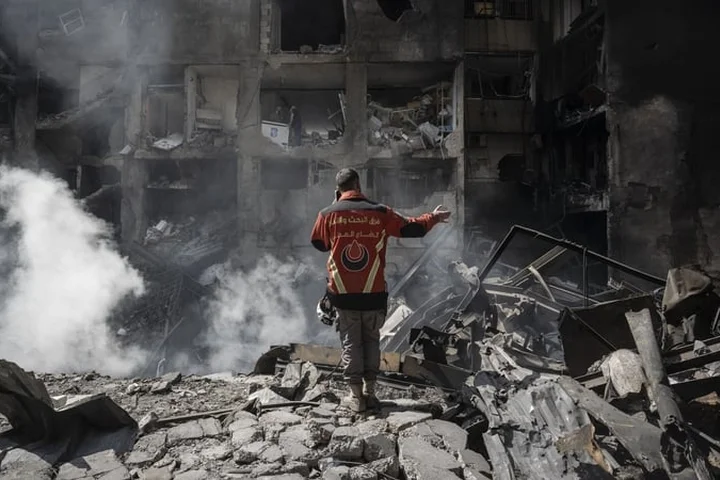
Washington's top diplomat urged Israel and Lebanon to seize a "historic opportunity" for peace as direct talks between the two opened despite objections from Hezbollah, which announced fresh attacks on Israel just as negotiations got underway.
The United States is pressing for a halt to the conflict between Israel and Hezbollah, fearing it could derail the two-week ceasefire in Washington's war with Iran after talks with Tehran in Pakistan failed to achieve a breakthrough.
Washington said "the ball is in the Iranian court" on ending the region-wide war, after a US naval blockade on Iranian ports began in the Strait of Hormuz, which had already been effectively closed by Tehran.
Lebanon was pulled into the broader conflict when Hezbollah attacked Israel in support of its backer Iran, sparking an Israeli ground invasion and strikes - including an extremely heavy attack on Beirut on 8 April - that have killed more than 2,000 people and displaced over one million.
Today's meeting in Washington - the first high-level, direct talks since 1993 - was mediated by Secretary of State Marco Rubio and involved the Israeli and Lebanese ambassadors to the United States.
"This is a historic opportunity," Mr Rubio said as he welcomed the ambassadors, acknowledging the "decades of history" complicating the process.
"The hope today is that we can outline a framework upon which a current and lasting peace can be developed," he said.
Lebanon's President Joseph Aoun said he hoped the talks "will mark the beginning of the end of the suffering of the Lebanese people".
But expectations of any major breakthroughs were low, with Hezbollah's leader Naim Qassem calling for the talks to be scrapped before they even began, describing them as "futile".
Shortly after the talks began, Hezbollah said it had launched "simultaneous rocket salvos" at 13 northern Israeli towns.
Israel's Foreign Minister Gideon Saar said his country was seeking "peace and normalisation" with Lebanon.
But he insisted that Hezbollah was the "problem", and that it needed to be addressed in order to move to a "different phase".
The Israeli military had previously warned it expected a rise in attacks by Hezbollah as the talks kicked off.
Foreign ministers from 17 countries, including Britain and France, urged both countries to seize the chance to bring lasting security to the region.
Related Stories
Source: This article was originally published by RTÉ News
Read Full Original Article →
Comments (0)
No comments yet. Be the first to comment!
Leave a Comment