
Mariana Lenharo is a reporter for Nature in New York City.
Search author on: PubMed Google Scholar
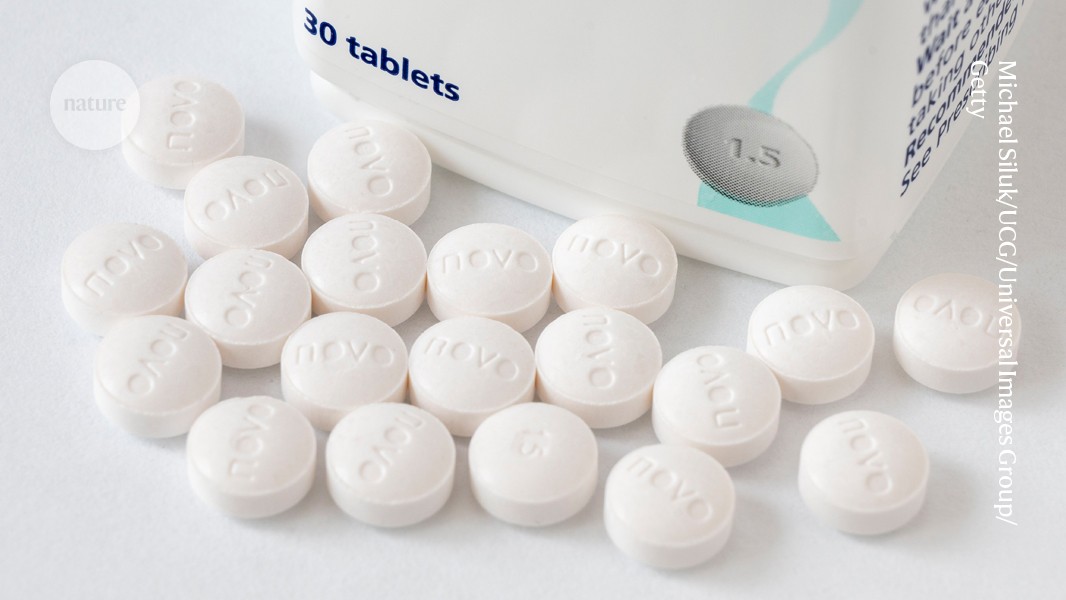
Pills of the obesity drug semaglutide (pictured) prompt less weight loss than does the injectable form.
Credit: Michael Siluk/UCG/Universal Images Group/Getty
The weight-loss drugs that took the world by storm a few years ago have a drawback for anyone afraid of needles: they must be injected weekly.
But scientists have been racing to perfect anti-obesity pills — which are now coming to market.
An oral anti-obesity drug called orforglipron is likely to be approved by US regulators by the end of April, pharmaceutical analysts say.
In December, a pill version of the obesity drug semaglutide won US regulatory approval.
Both drugs belong to the class of therapies called glucagon-like peptide-1 (GLP-1) receptor agonists .
Semaglutide, sold as Wegovy, is made by Novo Nordisk in Bagsværd, Denmark; orforglipron is made by Eli Lilly and Company in Indianapolis, Indiana.
Obesity drugs aren’t always forever.
What happens when you quit?
Clinical-trial results have been positive.
After around one year of treatment at the highest dosage, people taking orforglipron lost, on average, about 11% of their body weight 1 , and those taking semaglutide pills lost almost 14% 2 .
But it’s uncertain whether pills could one day replace the GLP-1 pens that have become a weight-loss staple .
Oral drugs face formidable developmental challenges, and several injected drugs cause greater weight loss than does either orforglipron or oral semaglutide: the approved injectable drug Zepbound , for example, leads to weight loss of up to 21% of body weight 3 .
“It’s encouraging, and it’s fantastic to have double-digit weight loss with a pill,” says Daniel Drucker, an endocrinologist at the University of Toronto in Canada.
“But so far, rather than replace, I would say they’re going to complement the options that we have.”
There’s a good reason why the original GLP-1 receptor agonists, which mimic the natural hormone glucagon-like peptide-1, were sold in injectable form.
The drugs are composed of peptides, which are relatively large molecules.
Because of their size, digestive enzymes quickly break them down, and the intestinal lining limits their entry into the bloodstream.
So pharma companies packaged the drugs inside pen-shaped devices that have tiny needles.
The medications are injected into the fatty tissue under the skin, allowing the drugs to bypass the digestive tract and reach the bloodstream intact.
However, manufacturing these devices is a complex process, making it difficult to scale up drug production.
Are obesity drugs causing a severe complication?
What the science says
“We build state-of-the art plants that cost billions of dollars and require incredible oversight and design, and they can only meet the needs of single-digit millions of patients per year,” says Ken Custer, president of cardiometabolic health at Eli Lilly, which makes Zepbound.
Seeking an alternative to the injectable form, Novo Nordisk developed a Wegovy pill that pairs semaglutide with a compound that enables absorption in the stomach.
But the semaglutide in the pill has a bioavailability of 1–2%, which means that only this small fraction reaches the bloodstream.
As a result, each pill, which is taken daily, must contain a much higher dose of the drug than the injection, which is taken weekly.
This requirement limits the number of doses companies can make, says Thomas von Erlach, co-founder and chief executive of Vivtex, a biotechnology start-up company in Boston, Massachusetts.
His company is now working with Novo Nordisk to develop oral peptide drugs that are more easily absorbed than current pills.
Enjoying our latest content?
Log in or create an account to continue
doi: https://doi.org/10.1038/d41586-026-00856-7
Wharton, S.
et al.
N.
Engl.
J.
Med.
393 , 1077–1087 (2025).
Wharton, S.
et al.
N.
Engl.
J.
Med.
393 , 1796–1806 (2025).
Jasreboff, A.
M.
et al.
N.
Engl.
J.
Med.
387 , 205–216 (2022).
The ‘astounding’ rise of semaglutide — and what’s next for weight-loss drugs
Beyond Ozempic: brand-new obesity drugs will be cheaper and more effective
How rival weight-loss drugs fare at treating obesity, diabetes and more
Dozens of new obesity drugs are coming: these are the ones to watch
How anti-obesity drugs cause nausea: finding offers hope for better drugs
Experimental obesity drug packs double punch to reduce weight
‘Baked, not fried’: five highlights from nutrition research
Do obesity drugs treat addiction?
Huge study hints at their promise
Insulin resistance prediction from wearables and routine blood biomarkers
What is the science behind ‘science-backed’ supplements?
Facile induction of immune tolerance by an interleukin-2–TGFβ surrogate agonist
Risk-adaptive therapy guided by dynamic ctDNA in nasopharyngeal carcinoma
The missing pieces of menopause science
CeMM is recruiting two scientists to join as Starting Principal Investigators within a new research program on pain and aging/healthy.
Research Center for Molecular Medicine (CeMM), ÖAW
Profile the cellular components of tissue microenvironments (TME) in healthy and inflamed sites.
Dortmund, Nordrhein-Westfalen (DE)
Leibniz-Institut für Analytische Wissenschaften – ISAS – e.V.
Postdoctoral positions exploring microbiota–stem cell interactions in development, disease & cancer using gnotobiotic models, organoids & multi-omics.
The Chinese Institutes for Medical Research (CIMR), Beijing
Join Huazhong Agricultural University
No.1 Shizishan Street, Hongshan District, Wuhan, Hubei Province, China
Huazhong Agricultural University (HZAU)
SUSTech School of Medicine offers equal opportunities and welcome applicants from the world with all ethnic backgrounds.
Southern University of Science and Technology, School of Medicine
Related Stories



Source: This article was originally published by Nature News
Read Full Original Article →
Comments (0)
No comments yet. Be the first to comment!
Leave a Comment