
Important topics and their relevance in UPSC CSE exam forMarch 13, 2026.If you missed the March 12, 2026, UPSC CSE exam key from the Indian Express, read it here.
Preliminary Examination:Current events of national and international importance.
Mains Examination: General Studies-I, II, III:Geography, Effect of policies and politics of developed and developing countries on India’s interests, Indian Economy and issues relating to planning, mobilisation of resources, growth, development.
What’s the ongoing story:Delhiis in talks with Tehran to let India-bound fuel ships transit the Strait of Hormuz,closed by the Iranian militaryfollowing the outbreak of war in West Asia.
— How do tensions in West Asia affect global energy security?
— What is the strategic significance of the Strait of Hormuz?
— What role does the Essential Commodities Act play in ensuring the availability of essential fuels in India?
— What is an Automatic Identification System (AIS)?
— Know about the UN Security Council in detail.
— What is the Gulf Cooperation Council?
— Know the portfolio of India’s crude oil, LPG and LNG imports.
— What diplomatic challenges can India face in balancing its ties with Israel, the US and Iran?
— What is India’s Middle East policy?
— How is self-reliance important for India in the present global order?
— What are the efforts taken by the government for energy security amidst conflict in West Asia?
— Map work:Locate Iran, the Strait of Hormuz, Israel, Bab Al Mandab, the Horn of Africa, and other places in the news related to the US-Israel attack on Iran on the map.
— “External Affairs Minister S Jaishankar and Foreign Minister of Iran Seyed Abbas Araghchi have had three conversations in the last few days.
The last one discussed issues pertaining to safety of shipping and India’s energy security.
Beyond that, it would be premature for me to say anything,” Randhir Jaiswal, spokesperson for the Ministry of External Affairs, said Thursday.Sources indicated that since the talks are underway, it is still “work in progress”.
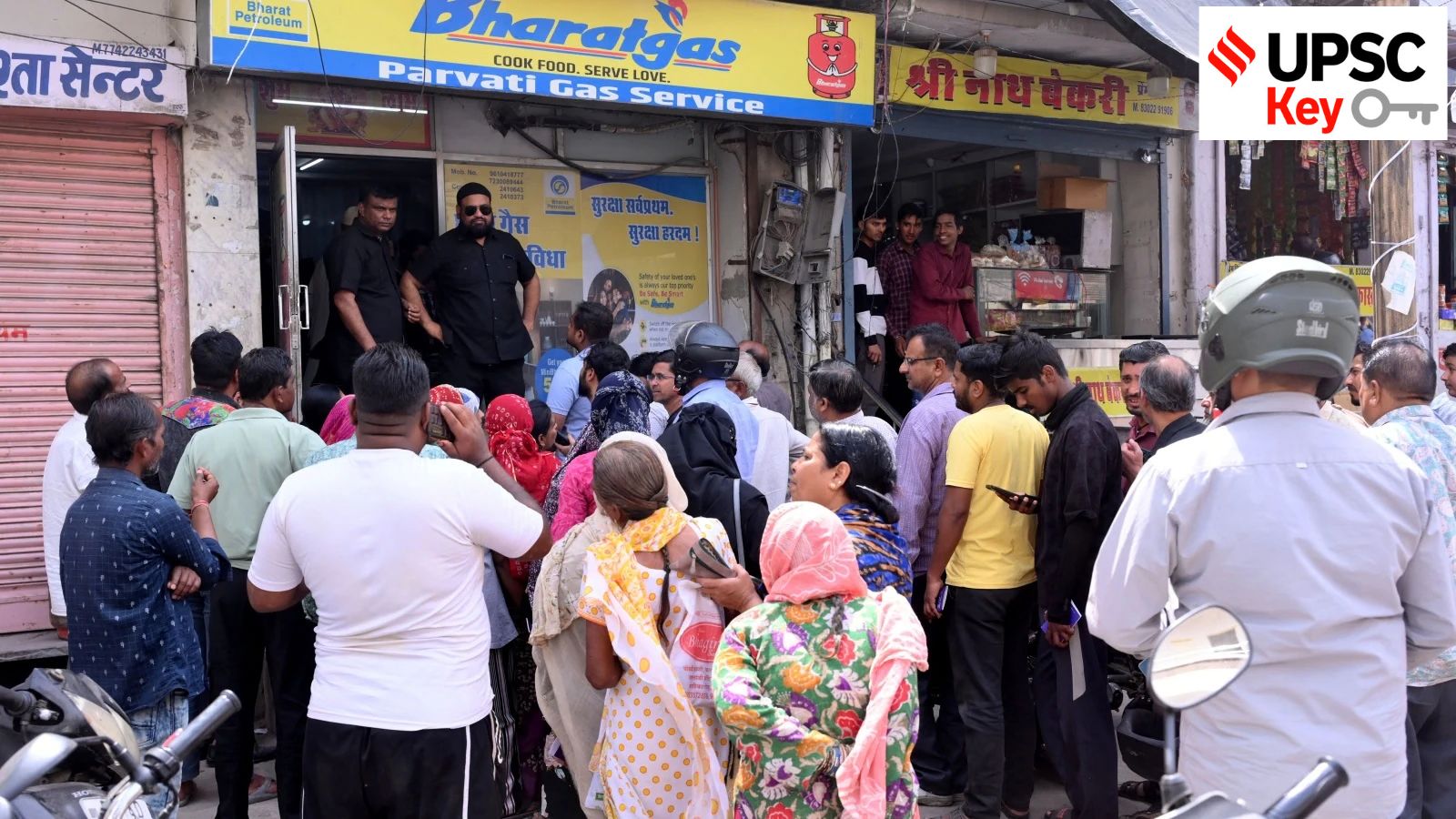
— With maritime traffic through the Strait of Hormuz halted, India’s LPG imports have been significantly impacted.
The country depends on imports to meet around 60% of its LPG requirement, and 90% of its LPG imports come from West Asia through the Strait.
This effectively means that roughly 55% of India’s LPG consumption volumes are currently unavailable.
— With an India-bound ship coming under attack from suspected Iranian fighters,DelhiWednesday “deplored” the targeting of commercial shipping in the Strait of Hormuz.
From the Front Page-“LPG supply hit, Govt pushes kerosene & coal as options”
—Amid growing concerns over liquefied petroleum gas (LPG) — cooking gas — supplies in the country, which have been hit due to the West Asia conflict, the government is activating other fuel options like kerosene, fuel oil, biomass and even coal to ease pressure on LPG for commercial users like restaurants and hotels.
— The government has also decided to allocate for commercial use 20% of the average monthly commercial LPG requirement; this will be done in coordination with state governments.
— Moreover, as a demand management measure amid panic booking by household consumers, the minimum gap between cylinder bookings by households in rural and remote areas has been increased to 45 days, while for urban households, it continues to be 25 days.
The minimum gap used to be 21 days earlier, but was increased to 25 days after the conflict started.
— Noting that bookings for LPG cylinders have shot up multifold due to misinformation and concern, the government also appealed to consumers to not fall prey to panic and avoid rush-booking of cylinders.
— “Alternate fuel options are being activated to ease pressure on LPG and gas channels.
Kerosene is being made available through retail outlets and PDS channels, and fuel oil is being made available for industrial and commercial consumers.
— The MoEFCC (Ministry of Environment, Forest and Climate Change) has advised State Pollution Control Boards to permit, for the duration of this crisis period, the use of biomass, RDF (Refuse-derived fuel) pellets, and kerosene/ coal as alternate fuels for the hospitality and restaurant segment for one month, which would enable a wider range of establishments to switch and free up LPG for priority consumers,” Union Petroleum Minister Hardeep Singh Purisaid in Lok Sabha.
— Given the crisis, the government has invoked the Essential Commodities Act to prioritise LPG supplies to households over commercial and industrial consumers, ordered refiners to maximise LPG production, and directed them to divert propane, butane, and other streams from petrochemical production to LPG production.
In the commercial segment, hospitals and educational institutions have been placed on uninterrupted priority supply; their access to LPG is fully assured regardless of broader demand conditions, the government said.
From the Economy Page-“Two oil tankers reach India via Strait of Hormuz, ignite hope”
— Amid the massive disruption in maritime traffic through theStrait of Hormuz, two crude oil tankers—cumulatively carrying roughly 3 million barrels of West Asian oil—have arrived in India after transiting the fraught waters of the Strait, according to vessel tracking data and industry sources.
— Both tankers are estimated to have crossed the Strait of Hormuz—the narrow waterway between Iran and Oman that connects the Persian Gulf with the Gulf of Oman and the Arabian Sea—sometime in the past five-six days.
— These mark the first known instances of non-Iranian crude oil tankers transiting the critical chokepoint of the Strait of Hormuz, where vessel movements have effectively come to a halt since the West Asia conflict started on February 28.
Reports indicate that Iran was allowing only its own oil tankers—headed to China—to cross the Strait.
According to sources in India’s oil and gas industry, the arrival of tankers has raised hopes that more of India’s energy supplies that are currently stuck in the Persian Gulf could find their way to the country in the coming days and weeks.
— According to sources, the two oil tankers that have arrived in India may have sought permission from Iran to cross the Strait of Hormuz, although there is no confirmation on that.
As per vessel tracking data, the tankers had switched off their Automatic Identification System (AIS) transponders—also called “going dark” in shipping parlance—to avoid public detection before crossing the Strait, and switched them on only after clearing the waterway, which usually handles approximately one-fifth of global liquid petroleum consumption and global liquefied natural gas (LNG) trade.
— Around 2.5–2.7 million bpd of India’s crude imports—accounting for around half of the country’s total oil imports—have transited the Strait of Hormuz in recent months; the longer-term average is around 40%.
This oil is mainly from Iraq, Saudi Arabia, the UAE, and Kuwait; India doesn’t buy Iranian oil due to American sanctions on Tehran.
With Iran warning vessels to not transit through the Strait of Hormuz, and even hitting a few vessels that were passing through the waterway, there is an effective halt in maritime traffic through the Strait with most trading houses, insurers, and vessels loath to get involved in the prevailing extremely high-risk environment.
From the Politics Page-“India co-sponsors resolution at UNSC condemning Iran attacks on Gulf nations”
— The 15-nation UN Security Council, currently under the presidency of the United States, adopted the resolution on Wednesday with 13 votes in favour, none against and abstentions by veto-wielding permanent members China and Russia.
— The 13-0 vote at the UNSC saw China and Russia — two Iranian allies — abstaining from Wednesday’s vote, allowing it to be approved.
— The resolution condemned in the strongest terms the egregious attacks by Iran against the territories of Bahrain, Kuwait, Oman, Qatar, Saudi Arabia, the United Arab Emirates and Jordan and determined that such acts constitute a breach of international law and are a serious threat to international peace and security.
— The resolution demanded immediate cessation of all attacks by Iran against the GCC countries and Jordan.
It called upon Tehran to “immediately and unconditionally” cease from any provocation or threats to neighbouring states, including the use of proxies.
— It reaffirmed that the exercise of navigational rights and freedoms by merchant and commercial vessels, in accordance with international law, must be respected, particularly around critical maritime routes, and takes note of the right of member states, in accordance with international law, to “defend their vessels from attacks and provocations, including those that undermine navigational rights and freedoms”.
— The resolution condemned any actions or threats by Iran aimed at closing, obstructing, or otherwise interfering with international navigation through the Strait of Hormuz, or threatening maritime security in the Bab Al Mandab, the strait between Yemen on the Arabian Peninsula and Djibouti and Eritrea in the Horn of Africa.
From the Editorial Page-“Atmanirbharta is managing external dependencies, big-power rivalries”
— Sanjaya Baru writes- “The weaponisation of India’s oil imports by the United States, linking the sourcing of oil to terms for bilateral trade, is a reminder of the constraints imposed by such external dependence on national security and foreign policy.”
— “Independent India began its development process with four critical external dependencies — food, foreign exchange, defence equipment and energy.
The foreign exchange crisis of 1957-58 alerted policy makers to the external financial constraint.
The war with China in 1962 signalled the shortage of defence equipment.
The droughts of 1965-67 drew attention to the critical dependence on food imports.
The Gulf War of 1990 contributed to a spike in oil prices that triggered a balance-of-payments crisis.”
— “The governments of the day learnt important economic and foreign policy lessons from each crisis.
The shortcomings in defence equipment available during the 1962 war forced Prime Minister Jawaharlal Nehru to reach out to the United States for assistance.
The food crisis of the mid-Sixties showed how external dependence in a vital sector like food could also be used to shape foreign-policy choices.
President Lyndon Johnson tried to link food aid to a change in India’s stance on the war in Vietnam.
Prime Minister Indira Gandhi stood her ground.”
— “More recently, the weaponisation of finance by the Group of Seven (G7) economies, following the Russian invasion of Ukraine, and the weaponisation of energy supplies by US PresidentDonald Trump, draw attention to the constraints being imposed on the pursuit of an independent foreign policy and highlight the strategic importance of greater self-reliance.”
— “Little wonder then that Prime Minister Narendra Modi has rediscovered the relevance of Nehru’s policy of self-reliance, that is atmanirbharta, even as Panditji is slammed day in and day out.”
— “It should be clear to the managers of national security that the US will persist with its present policy of weaponising all forms of trade, especially trade in energy, defence equipment and access to advanced and critical technologies.”
— “Indian national security managers would be well advised not to get locked into any more agreements with the US during the remainder of the Trump administration given the direction of Trump’s economic and geopolitical policies.
The Modi government’s policy of “atmanirbharta” requires it to stand up to the challenge of neo-imperialism posed by Trump’s aggressive moves around the world.
Self-reliance is earned, not granted.”
Other Important Articles Covering the same topic:
📍Strait of Hormuz oil flows dry up: How this affects India, and the options ahead
📍Iran war: ‘Oil reserves are sufficient… LNG reserves are the greater concern’
📍Knowledge Nugget | US-Israel war on Iran: 10 must-know tidbits for UPSC Exam
📍UPSC Issue at a Glance | How did the Israel-Iran conflict escalate?
A look from history to its impact
UPSC PrelimsPrevious year andPractice Question Covering similar theme:
(1) What is the importance of developing Chabahar Port by India?
(UPSC CSE 2017)
(a) India’s trade with African countries will increase enormously.
(b) India’s relations with oil-producing Arab countries will be strengthened.
(c) India will not depend on Pakistan for access to Afghanistan and Central Asia.
(d) Pakistan will facilitate and protect the installation of a gas pipeline between Iraq and India.
(2) Which of the statements about the Strait of Hormuz isnotcorrect?
(a) It is a critical region for international oil and gas supplies.
(b) It is a narrow waterway between Bahrain and Qatar.
(c) It connects the Persian Gulf with the Gulf of Oman and the Arabian Sea.
(d) Disruption of shipping in this strait can significantly affect global energy prices.
Mains Examination: General Studies-I, II, III:Effects of globalisation on Indian society, Government policies and interventions for development in various sectors and issues arising out of their design and implementation, Awareness in the fields of IT.
What’s the ongoing story:Alisha Lalljee writes-“The Andhra Pradesh government has recently announced that it is exploring banning social media for children under 13.
Other states such as Karnataka, Maharashtra, and Kerala, too, have expressed interest in bringing in legislation to restrict social-media use.
When the government proposes a ban on social-media use for children, reactions tend to be immediate.
Some see it as moral policing.
Others see it as long-overdue protection.
But if we pause the outrage and listen carefully to what is happening in homes, classrooms and therapy rooms, a quieter truth emerges.”
— What are social networking sites?
— Why is social media called a double-edged sword?
— What is the regulatory framework for social media in India?
— Know about the Digital Personal Data Protection (DPDP) Act, 2023.
— How is social media impacting different sections of the society?
— How does it impact the children?
— What are the criticisms related to the age-based restriction on social media?
— What measures should be taken for better regulation of social media?
— “Children today are growing up in digital spaces that are not built for their psychological safety.
Unlike television, which we consumed passively, social media is immersive, persuasive and algorithm-driven.
It does not just entertain; it studies behaviour, amplifies insecurities and rewards comparison.”
— “What makes this more concerning is that harm on social media is not loud at first.
It does not always show up as obvious distress.
It shows up as subtle withdrawal, shorter attention spans, constant checking, fear of missing out (FOMO), and a quiet but persistent comparison with others.”
— “All of these do call for a supervisory mechanism that empowers not just parents, but also children in the long run.
An absolute and blanket ban, however, may not be the most effective or realistic way to go about it.
Technology is embedded in modern life.
A rigid prohibition may simply drive usage underground, making monitoring harder and conversations difficult.
Children would continue using social media whether we like it or not, but they would simply do it on the sly this time.”
— “What could the possible restrictions look like?
For instance, delaying independent access until a certain age while allowing supervised, time-limited exposure could strike a balance, as children would be more accountable.
Screen-time caps integrated at a system level rather than left entirely to parental enforcement could ease the burden on families, as many children are manipulative about it.
Digital literacy education must also become compulsory in schools, teaching children not only how to use technology, but how not to use it.”
— “Ultimately, this debate is not about control; it is about protection during a vulnerable developmental window.
We do not allow children to drive cars before they are ready, not because driving is evil, but because age-related maturity matters.
The same principle applies here.
Childhood is a period when identity is fragile, self-worth is still at a formative stage, and peer validation carries enormous weight.
A thoughtful, calibrated restriction acknowledges both realities: That social media is here to stay, and that children deserve stronger guardrails.
The ban, if refined rather than absolute, could serve as a protective pause, giving children time to build the emotional tools they need before stepping into a digital world that does not always have their best interests at heart.
This would also lessen the burden on already struggling parents.”
— Aparajita Bharti and Siddharth Deb write-“It is rare for policy discussions to resonate in every home as much as the potential ban on social media for those under 16.
Regulating screen time is one of the most stressful features of modern parenting, and these proposals seem to be resonating with exhausted parents worldwide.
India until recently appeared on a different path.
However, something shifted in the last two months.
The Andhra Pradesh government, otherwise known to be one of the most tech-forward state governments, was the first to announce that it was exploring such a move.
Other states — Karnataka, Maharashtra, Goa, Bihar, and Kerala — rushed to announce exploratory discussions in this regard.”
— “This year’s Economic Survey framed social media addiction as a “public health issue” but shied away from a policy prescription.
Reports suggest that the Centre has also started looking at age-related restrictions.”
— “However, what seems “popular” is not often the best policy solution.
First, a social media ban for under-16s can create a false sense of security among policymakers and caregivers.
Risk permeates across the internet.
The nature of those risks differs from platform to platform.
Young people encounter varying risks on gaming platforms, AI chatbots and VoIP (voice over internet protocol) services.
Banning one kind of platform will only result in young people migrating to other online spaces that adults (and regulators) are less familiar with.
Thus, the limits of ban-first approaches cannot be ignored.”
— “Second, a significant number of young people access the internet in single-device households.
In shared-device settings, family structures organically regulate screen time.
Regulations around young people’s access to digital services must be attuned to the reality that kids often bypass these restrictions by simply using their parents’ accounts and are generally adept at bypassing access-control restrictions.”
— “Third, unlike the Global North, access to digital platforms in India helps bridge existing socio-economic inequities to a larger extent.
The 2024 ASER survey cited by the Economic Survey also observes that over half of young people in rural areas use smartphones for education.
It also observed that nearly 80 per cent of mothers were only schooled till Class X, with over 40 per cent having only completed Class V.
This points to the inverse dependence of mothers (often primary caregivers) on their children for digital guidance.
Therefore, policymakers should weigh the wider ramifications of cutting kids’ access to online spaces.”
— “Given this context, India should explore frameworks that align with social realities while addressing parents’ legitimate concerns.
First, interventions should build on recent legislative reforms like India’s forthcoming DPDP Act, which holds critical implications for young people’s digital safety.
Set for rollout in May 2027, the DPDP Act limits personalisation and bans targeted advertising for under-18s.”
— “Additionally, its verifiable parental consent requirement for children is India’s first brush with age verification.
Its implementation will provide evidence about India’s ability to successfully deploy population-scale age-verification methods.
For context, countries like Australia are struggling with domestic rollouts.
Even limited bans like the “Cinderella law” in South Korea, which prohibited children from using gaming platforms late at night, failed as young people circumvented age-verification systems easily.
— “In parallel, India can introduce a framework built on well-being-by-design principles.
These can apply universally to all digital services with specific guardrails around addiction, stranger contact and other harmful behaviours.
The principles should be augmented by transparency norms and penalties in case of violations.
Platforms can be nudged to increase the uptake of parental controls and user awareness about their reporting and safety features.”
— “Lastly, we need to increase investments in digital safety education for children and parents.
We have a generation of parents that have had social media since they were teens and are no less prone to harmful online behaviours.
While some school boards have adopted digital safety curricula, they are not implemented uniformly as this is often seen as a “supplementary” activity.
Such curricula should also be dynamically updated to keep pace with rapid technological change.”
— In today’s world, social media has emerged as a powerful force, connecting people on local, national, and international levels like never before due to previous technological advancements.
However, it is often referred to as a double-edged sword due to the negative impact it has on multiple fronts
— A report by cybersecurity firm McAfee Corp informs that as many as 85 per cent of children in India have been victims of cyberbullying.
Given the lasting emotional harm caused by cyberbullying, coupled with the tender age of its victims, the world of social media becomes an exceptionally challenging turf for parents.
📍Govt looks at nuanced, graded age-based restrictions on social media for children
📍UPSC Issue at a Glance | Social Media, the double-edged sword: 4 Key Questions You Must Know for Prelims and Mains
Previous year UPSC Prelims Question Covering similar theme:
(3) In India, it is legally mandatory for which of the following to report on cyber security incidents?
(UPSC CSE 2017)
Select the correct answer using the code given below:
Previous year UPSC Mains Question Covering similar theme:
What are social networking sites and what security implications do these sites present?
(UPSC CSE 2013)
Social media is triggering ‘Fear of Missing Out’ amongst the youth, precipitating depression and loneliness.
(UPSC CSE 2024)
Main Examination: General Studies-II:Appointment to various Constitutional posts, powers, functions and responsibilities of various Constitutional Bodies.
What’s the ongoing story:Derek O’Brien writes- “Parliament is in session.
There is a strong buzz in the corridors of the Lok Sabha and theRajya Sabhathat a clutch of Opposition parties will soon be moving a motion of removal against the Chief Election Commissioner (CEC).
If the motion to remove the CEC is filed (as I think it will be), this will be a first.”
— What are the constitutional provisions related to the Election Commission of India?
— How does the constitution provide for the independence of constitutional bodies like the Election Commission?
— What is the process of selection of CEC?
— How is the Chief Election Commissioner different from the other Election Commissioner?
— How does the Chief Election Commissioner and Other Election Commissioners Act, 2023, elaborate the selection of the Chief Election Commissioner?
— “In the last 75 years, India has had 25 Chief Election Commissioners.
Neither House of Parliament has ever brought a removal motion against the CEC.”
— “For the removal of the CEC, 100 members of the Lok Sabha or 50 members of the Rajya Sabha have to submit a notice to the Speaker or Chairman.
If the notice is admitted, a three-member committee is formed to investigate the same.
If the committee finds the grounds valid, the motion is taken up for consideration.
It needs to be passed by a special majority (a majority of the total membership of the House and at least two-thirds of the members present and voting) of both the houses.”
— “The Constitution prescribes that the CEC can be removed from his office on the same grounds as a judge of the Supreme Court —“proved misbehaviour or incapacity”.
The term “proved misbehaviour” has been interpreted to include deliberate abuse of powers, partisan exercise of constitutional functions favouring one political formation over others, and actions that undermine public confidence in the independence and impartiality of the CEC, amongst other attributes.”
— “During the Constituent Assembly debates, B R Ambedkar had said, “the election machinery should be outside the control of the executive government”.
This was reiterated by the Supreme Court during the Anoop Baranwal v Union of India case of 2023, when it ruled that the Chief Election Commissioner (CEC) and Election Commissioners (ECs) should be selected by a three-member committee consisting of the Prime Minister, the Leader of the Opposition, and the Chief Justice of India.”
— “A few months later, the Union government cocked a snook at the SC and came up with the CEC Act.
Section 7 of the Act fundamentally changed this structure by creating a selection committee consisting of the Prime Minister (chairperson), the Leader of the Opposition in the Lok Sabha, and, incredulously, a Union Cabinet Minister nominated by the Prime Minister.
This arrangement gives the executive a majority (two out of three members), allowing the Union to control appointments to the ECI.”
— “The Election Commission has a long and famed record.
Sukumar Sen, West Bengal’s Chief Secretary and later India’s first Chief Election Commissioner, was given the enviable task of conducting India’s first general election.
More than 170 million Indians were eligible to vote.
Of these, around 85 per cent were illiterate.
16,500 clerks, 56,000 presiding officers and over 2 lakh policemen were deployed.
Bridges were built over rivers to reach villages in the hills.
Naval vessels sailed to reach small islands.
This was the largest democratic exercise in the world.”
— “S Y Quraishi, the 17th CEC, expanded the Systematic Voters’ Education and Electoral Participation (SVEEP) in order to achieve voter literacy.
He also took categorical stands against the negative effects of the media boom such as paid news and opinion polls.
The 23rd CEC of India, Sunil Arora, capitalised on technology to create a database of more than 930 million electors, and launched a nationwide phone helpline number.”
— “In 1991, there was an uproar in Parliament to remove T N Seshan as the CEC.
But no formal notice was ever filed.
In 2006, the BJP-NDA submitted a memorandum seeking the removal of Navin Chawla as an Election Commissioner.
Here, too, no parliamentary process was involved.”
— The Part XV of the Constitution of India deals with Elections.
It has the following articles (Articles 324–329) to empower the Election Commission and provide insight into the potential roles and functions of the commission.
— Article 324: The superintendence, direction and control of the preparation of the electoral rolls for, and the conduct of, all elections to Parliament and the Legislature of every state and of elections to the offices of President and Vice-President.
— Article 325: No individual to be excluded from electoral rolls on the basis of religion, race, caste, sex or any of them.
— Article 326: Adult suffrage shall be the basis for elections to the House of the People and to the Legislative Assemblies of States.
— Article 327: Parliament may, according to the provisions of this Constitution, from time to time enact laws with respect to all matters relating to elections to Parliament and Legislative Assemblies of States.
— Article 328: A state’s Legislature may from time to time by law make provision with respect to all matters relating to, or in connection with, the elections to the House or either House of the Legislature.
— Article 329: The article prohibits the courts from becoming involved in electoral matters.
📍Election Commission of India is one of the greatest gifts of the Constitution
📍Opposition considers motion to remove Chief Election Commissioner: What is the process?
(4) Consider the following statements: (UPSC CSE 2017)
1.
The Election Commission of India is a five-member body.
2.
Union Ministry of Home Affairs decides the election schedule for the conduct of both general elections and bye-elections.
3.
Election Commission resolves the disputes relating to splits/mergers of recognised political parties.
Which of the statements given above is/are correct?
Discuss the role of the Election Commission of India in the light of the evolution of the Model Code of Conduct.
(UPSC CSE 2022)
Preliminary Examination:Current events of national importance, Polity and Governance.
Mains Examination: General Studies-II:Government policies and intervention, Issues relating to development and management of Social Sector/Services relating to Health.
What’s the ongoing story:The Supreme Court on Tuesday (March 10) directed the Centre to formulate a “no-fault” compensation policy for individualswho suffered serious adverse effects or died after receiving Covid vaccines.
— Read about the Covishield and Covaxin.
— What is the “no-fault liability” principle?
— Know about Article 14 and 21 of the Constitution of India.
— Why is informed consent important in public health programmes?
— What are the challenges involved in determining liability in cases of adverse events following immunisation?
— What is the significance of the no-fault compensation framework?
— The court was hearing a batch of petitions led by people who lost their children or spouses — all aged between 18 and 40 years — to rare complications, such as blood clotting disorders, shortly after receiving the Covishield and Covaxin vaccines in 2021.
The petitioners argued that the government failed to ensure informed consent and transparently communicate the risks associated with the vaccines.
According to them, the vaccination drive, while officially voluntary, was effectively made mandatory through various administrative restrictions on unvaccinated individuals, thereby violating their fundamental rights.”
— The Union government, in its defence, argued that the vaccines underwent rigorous regulatory approvals and that the existing system for detecting Adverse Events Following Immunisation (AEFI) was robust.
— The government maintained that vaccine-related deaths were extremely rare, citing a reporting rate of just 0.001 per one lakh doses in India for certain clotting disorders.
It contended that aggrieved families already had a legal remedy: they could approach civil or consumer courts to claim damages for negligence or malfeasance against vaccine manufacturers.
— The Bench, comprising Justices Vikram Nath and Sandeep Mehta, rejected the government’s suggestion to let families approach lower courts individually.
It noted that vaccine injury claims involve complex scientific attribution.
Insisting on proof of negligence, the Bench noted, “would impose an onerous burden upon affected families and would not be the best solution to those left affected.” Forcing citizens into a multiplicity of individual legal battles would also risk inconsistent outcomes and unequal access to relief, which undermines the guarantee of equality under Article 14 of the Constitution, it held.
— To resolve this, the court invoked the legal principle of “no-fault liability”, which means that a victim or their family can receive financial relief without having to prove that the injury was caused by someone’s negligence or intentional wrongdoing.
The court noted that this principle is already recognised in Indian law, such as in motor vehicle accidents, and is a standard feature of vaccine injury schemes in countries like Australia, the United Kingdom and Japan.
— The judgement relied on Article 21 of the Constitution, which guarantees the right to life, including the right to health.
The court stated that the Constitution “does not conceive of the State as a distant spectator to human suffering, but as an active guardian of welfare and dignity.” It ruled that since the mass vaccination programme was a State-led public health intervention, the State bears a positive obligation to support those who suffered grave outcomes, “no matter how rare they are.”
— The court clarified that it was not sitting in scientific review of the vaccines.
It referred to its 2022 judgement inJacob Puliyel vs Union of India, in which it had upheld the legality of the vaccine approval process and the government’s AEFI monitoring mechanisms while ruling that bodily integrity is protected under Article 21 and no individual can be forcefully vaccinated.
— The apex court directed the Ministry of Health and Family Welfare to expeditiously formulate and publish a no-fault compensation framework to address serious adverse events arising from theCovid-19vaccination drive, while clarifying that this policy shall not be construed as an admission of liability or fault by the Union government.
📍Frame no-fault compensation policy for adverse events after Covid vaccination, SC tells Centre
UPSC Prelims Practice Question Covering similar theme:
(5) Which of the following is/are considered a fundamental right under the Article 21?
Select the correct answer using the codes given below:
Mains Examination: General Studies-II:India and its neighbourhood- relations, Bilateral, regional and global groupings and agreements involving India and/or affecting India’s interests.
What’s the ongoing story:China has constructed 72% of its 628 Xiaokang, or “well-off villages,” near theLine of Actual Control(LAC) in northeastern states, with 90% in Arunachal Pradesh.
— What is the history of India-China relations?
— What is LAC?
What is the history of the LAC?
— What are the security challenges faced by India on the LAC?
— What are the Xiaokang border defence villages?
— What are the areas of cooperation and conflict between India and China?
— India-China Border Dispute- Know the background
— How is developing border infrastructure important for effective border management?
— What is the Vibrant Villages Programme?
— The details were revealed on Tuesday (March 10) by Deputy Chief of the Army Staff (Strategy), Lieutenant General Rajiv Ghai, during an address at the annual Assam Rifles-USI seminar, who added that many of these settlements are in areas contested between the two countries.
— China has been constructing 628 such Xiaokang or “well-off villages” along India’s borders with the Tibet Autonomous Region for over five years now.
These have been constructed all along the LAC, including the Ladakh and Arunachal Pradesh borders.
— The structures include mostly double-storey, large and spacious buildings.
The construction for most of these planned villages has already been completed, as per officials.
— The exact purposes of these villages have remained unclear, but they were understood to be dual-use infrastructure — can be used both for civil and military purposes — and have thus been a concern from a defence perspective.
The strategic community looks at it as a way to assert Chinese claims over certain areas along the LAC.
— Notably, the exact extent of the LAC has been a source of contention between the two countries for years.
India considers it to be 3,488 km long, while China says it is around 2,000 km.
—While China had been constructing them aggressively since 2019, they remained vacant for a long time.
However, since late 2023, Chinese nationals have started occupying several of these villages particularly across from Lohit Valley and the Tawang sector of Arunachal Pradesh.
China has also been constructing infrastructure, including border villages, in Bhutanese territory.
—A new law on China’s land borders was brought into effect from January 1, 2022.
The law was passed in 2021 by the Standing Committee of China’s National People’s Congress (which is China’s rubber-stamp Parliament), for the “protection and exploitation of the country’s land border areas”.
—The Indian government announced the Vibrant Villages Programme in 2022 to develop its border villages into modern villages with all amenities and as tourist attractions.
The programme builds on the existing Border Area Development Programme (BADP) under the Union Ministry of Home Affairs.
— Under the programme, India plans to develop 663 border villages into modern villages in the first phase.
Of them, at least 17 such border villages along the borders with China in Ladakh, Himachal Pradesh, Uttarakhand, Sikkim and Arunachal Pradesh, have been selected for development as a pilot project.
— In Arunachal Pradesh, villages in the eastern part of the state and the Tawang region have been identified such as Zemithang, Taksing, Chayang Tajo, Tuting and Kibithu.
— China has been constantly building infrastructure all along the LAC, including in Arunachal Pradesh’s Tawang region and the Siang Valley.
— India has also focused on strengthening its border infrastructure and improving forward connectivity with the construction of new roads, bridges, and helipads.
There has also been a push to develop alternate routes to the LAC and improve inter-valley connectivity in the northeast.
— The LAC is the demarcation that separates Indian-controlled territory from Chinese-controlled territory.
India considers the LAC to be 3,488 km long, while the Chinese consider it to be only around 2,000 km.
It is divided into three sectors: the eastern sector which spans Arunachal Pradesh and Sikkim, the middle sector in Uttarakhand and Himachal Pradesh, and the western sector in Ladakh.
📍Thaw in China chill: Direct flights, Mansarovar Yatra, easing of visas
📍An Expert Explains the LAC issue: ‘The Chinese are using ambiguity on the LAC… as a major pressure point against us’
(6) “Belt and Road Initiative” is sometimes mentioned in the news in the context of the affairs of : (UPSC CSE 2016)
‘China is using its economic relations and positive trade surplus as tools to develop potential military power status in Asia’, In the light of this statement, discuss its impact on India as her neighbour.
(UPSC CSE 2017)
🚨Click Hereto read the UPSC Essentials magazine forFebruary 2026.Share your views and suggestions in the comment box or at manas.srivastava@indianexpress.com🚨
Roshni Yadav is a Deputy Copy Editor with The Indian Express.
She is an alumna of the University of Delhi and Jawaharlal Nehru University, where she pursued her graduation and post-graduation in Political Science.
She has over five years of work experience in ed-tech and media.
At The Indian Express, she writes for the UPSC section.
Her interests lie in national and international affairs, governance, the economy, and social issues.
You can contact her via email: roshni.yadav@indianexpress.com....
Read More
Related Stories

Source: This article was originally published by The Indian Express
Read Full Original Article →
Comments (0)
No comments yet. Be the first to comment!
Leave a Comment