
Those with more than two power banks will have to give up the rest before boarding, civil aviation authority says
Singapore has decided to allow only two power banks per passenger on flights starting from 15 April, the city-state’s civil aviation authority said on Monday.
Those with more than two power banks will have to give up the rest before they board their flights, the Civil Aviation Authority of Singapore (CAAS) added.
“Power banks must also not be charged on board the aircraft and passengers are advised not to use power banks to charge their devices during the flight,” it said in a statement.
This comes after Singapore ’s aviation authority introduced new rules for power banks on flights leaving the country.
These changes follow updated global safety guidelines issued by the International Civil Aviation Organisation (ICAO) on 2 April.
Lithium-ion batteries inside power banks can cause fires in aircraft and enclosed cabin spaces if they are damaged.
“ICAO’s new requirement of a maximum of two power banks per passenger and restrictions on the charging and use of power banks on board flights seek to reduce the risk of fire while catering for passengers’ travelling needs.”
CAAS said that it is working with airlines and other aviation stakeholders “to implement the new requirements in a smooth and orderly manner”.
It said airlines will inform their passengers of the new requirements.
“In consultation with the airlines , CAAS will provide some time for the airlines to do so and for passengers to familiarise themselves and have the requirements take effect only from 15 April 2026.
In the meantime, passenger service and security screening officers will be trained.”
The new rules shall be displayed at key touchpoints “across the airport as a reminder to passengers”.
“Other existing requirements continue to apply, including the prohibition of power banks in check-in baggage, capacity limits and the requirement for power banks to be individually protected to prevent short circuit (such as keeping them in protective pouches).
As airlines may also have more restrictive policies on power banks, passengers are advised to check with their airlines before travelling,” CAAS said.
Foong Ling Huei, director of Flight Standards at CAAS, said: “The new requirements will help reduce the risk of fire caused by power banks on board flights.
We urge all passengers to familiarise themselves and comply with the new requirements, for their own safety and the safety of other passengers.”
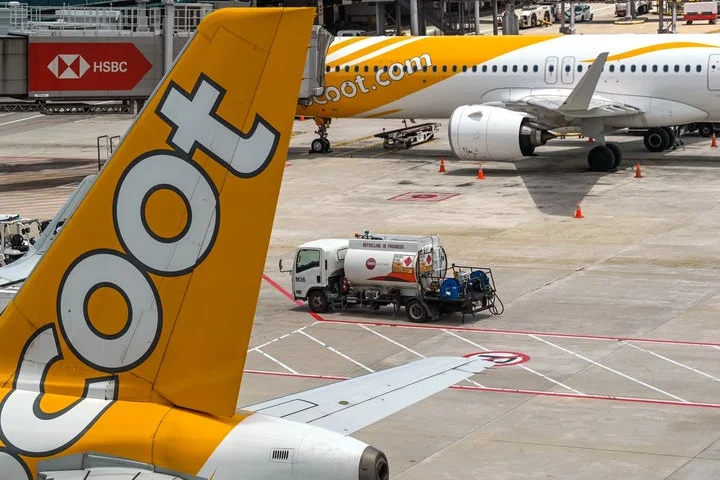
Since 1 April last year, Singapore Airlines and its budget airline Scoot have banned passengers from using or charging power banks during flights.
The move followed a number of cabin fire incidents on airlines like Batik Air and Air Busan.
Earlier this year, it was reported that passengers flying with Lufthansa Group airlines will not be allowed to use or charge power banks during the flight.
Each passenger will also be limited to carrying a maximum of two power banks to improve safety on board.
Several airlines have already introduced similar rules, including banning power banks in overhead lockers, so crew can respond quickly if a battery overheats or catches fire.
Japan is currently considering a blanket ban on the use of power banks on board domestic flights from April, following fire safety concerns in the cabin.
Travellers in Japan are limited to a maximum of two portable chargers per person, not exceeding 160Wh, in carry-on luggage.
Last year, the Hong Kong Civil Aviation Department banned passengers from using power banks on flights.
Join thought-provoking conversations, follow other Independent readers and see their replies
Related Stories


Source: This article was originally published by The Independent
Read Full Original Article →
Comments (0)
No comments yet. Be the first to comment!
Leave a Comment